Dombrowski, E.

Early Childhood Education: Considerations for Programming Overview

Submitted by admin on
Description/Abstract
The purpose of this brief is to answer the question: What are the considerations for effective ECE programming in the Asia region? To answer, we focus on the quality and sustainability, including governance and financing, of ECE. The four subject briefs provide evidence and present considerations for the following topics: ECE assessments, including measures of child learning and assessments of the quality of learning environments; Approaches to quality teaching and learning, focusing on emergent literacy and early mathematics, with consideration given to the language of instruction; Ensuring early childhood educator quality; and Sustainability of ECE.
Assoc. Photo (Port.)
ECE programming.jpeg
Resource (File)
Country
Resource Type
Featured projects
Month and Year

Early Childhood Education: Considerations for Programming in Early Learning Assessment

Submitted by admin on
Description/Abstract
Assessment of learning and the quality of early learning environments is an important component of early childhood education. This brief outlines the existing early learning assessments of children and environments used in the Asia region, excluding diagnostic and screening assessments.
Assoc. Photo (Port.)
ece assessment.jpeg
Resource (File)
Resource Type
Featured projects
Month and Year

Early Childhood Education: Considerations for Programming in Approaches to Teaching and Learning

Submitted by admin on
Description/Abstract
The quality of instruction in the classroom is key to children's learning and development. This brief looks at the dimensions of guided play, emergent literacy, emergent mathematics, and language of instruction on the quality of instruction.

Assoc. Photo (Port.)
ece tandl.jpeg
Resource (File)
Resource Type
Featured projects
Month and Year

Early Childhood Education: Considerations for Programming in Educator Quality

Submitted by admin on
Description/Abstract
Training opportunities and appropriate teacher curriculum are often insufficient, and effective regulatory frameworks for preparing, staffing, and monitoring ECE teachers are often lacking. This brief presents selected country-by-country findings on policy relating to ECE teacher quality in six countries in Asia.
Assoc. Photo (Port.)
ece educators.jpeg
Resource (File)
Resource Type
Featured projects
Month and Year

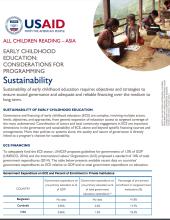
Early Childhood Education: Considerations for Programming in Sustainability

Submitted by admin on
Description/Abstract
Governance and financing of early childhood education (ECE) are complex, involving multiple actors, levels, objectives, and approaches, from general expansion of education access to targeted coverage of the most underserved. Coordination of actors and local community engagement in ECE are important dimensions in the governance and sustainability of ECE, above and beyond specific financing sources and arrangements. More than policies or systems alone, the quality and nature of governance is directly linked to a program’s chances for sustainability.
Assoc. Photo (Port.)
ece sustain.jpeg
Resource (File)
Resource Type
Featured projects
Month and Year

Early Childhood Education: Considerations for Programming in Asia

Submitted by admin on
Description/Abstract
This report examines available evidence from the Asia region on the current state of ECE interventions, focusing on the 10 countries in the region3 that currently benefit from US Agency for International Development (USAID) education programming. In Asia, many national governments have prioritized the expansion of access and quality improvements of pre-primary education (Sun, Rao, & Pearson, 2015). USAID will support those efforts as part of a coherent approach to improved learning outcomes in primary school.
Assoc. Photo (Port.)
ece report.jpeg
Resource Type
Featured projects
Month and Year

Uganda Early Years Study: Final Report

Submitted by admin on
Description/Abstract
The British Department for International Development (DFID) has partnered with the Ugandan Ministry of Education and Sports (MoES) to conduct empirical research on inefficiencies in the Ugandan education system. This research will help the Ministry better understand the severity, causes, and consequences of an enrolment bulge in early primary classes in Uganda. Specifically, this study is investigating the magnitude of repetition in primary 1. It encompasses a nationally representative sample of pupils, and uses information from interviews with pupils, parents/guardians, and teachers.
Assoc. Photo (Port.)
uganda school.jpg
Resource (File)
Country
Resource Type
Resource Language
Month and Year