Publications

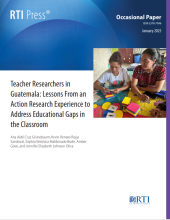
Teacher Researchers in Guatemala: Lessons from an action research experience to address educational gaps in the classroom

Submitted by admin on
Description/Abstract
The purpose of the article "Teacher Researchers in Guatemala: Lessons from an action research experience to address educational gaps in the classroom" is to describe the learnings of primary school teachers in rural Guatemala as a result of an action research experience. This experience took place in the context of the “Basic Education Quality and Transitions” activity, or BEQT, funded by the United States Agency for International Development (USAID) and implemented by RTI International and its partners Funcafé, Funsepa, Wayfree, and the Universidad del Valle de Guatemala (UVG). UVG’s Centro de Investigaciones Educativas (CIE), as an RTI partner, developed and implements the “Teacher Researchers” program. The action research program engages teachers in identifying and bridging gaps in students’ learning of mathematics, reading, and/or writing with students in grades 1–3. During the portion of the program described in this paper, teachers reflected on the lessons learned and strengthened their research skills in an effort to identify gaps in content, as well as applying and reflecting on potential solutions that they then translated into adjustments in lesson planning and implementation of teaching strategies. A categorical analysis of the teachers’ reflections on these experiences showed how strengthened research skills helped teachers identify areas of opportunity in using teaching strategies to improve the quality of teaching, thus allowing them to reflect on their own teaching practices.

Assoc. Photo (Port.)
BEQT Article Teacher researchers in Guatemala Port.png
Country
Resource Type
Featured projects
Resource Language
Month and Year
Publisher Or Client
USAID, RTI Press

Teaching by the book: Teacher decision-making while using structured lesson plans

Submitted by admin on
Description/Abstract
The purpose of this paper is to present a methodology for understanding materials usage in primary classrooms in Sub-Saharan Africa that centers teachers’ actions and voices. The United Nation’s Sustainable Development Goal 4 focuses on improved primary education around the world. To meet this goal, many large, donor-funded interventions aim to improve education through provision of teacher’s guides and student textbooks. However, what many of these interventions lack is a systematic way to understand how and why teachers are making pedagogical decisions while using materials. There is a large body of work that seeks to understand how teachers make decisions as they teach, and the ways these decisions are influenced by their knowledge and beliefs. Drawing from this work, we describe a methodology and set of tools that uses observations and interviews to identify key decisions that teachers make in the classroom and why teachers made those decisions. We piloted and iteratively refined this methodology over the course of three studies and use examples from these studies to illustrate the methodology. By closely observing and listening to teachers, we gain insights that allow us to continually refine and improve materials to ultimately improve the quality of classroom instruction.
Assoc. Photo (Port.)
Country
Resource Type
Resource Language
Month and Year
Publisher Or Client
IARTEM E-Journal

Influences on teachers’ use of the prescribed language of instruction: Evidence from four language groups in the Philippines.

Submitted by admin on
Description/Abstract
In 2009 the Philippines introduced a mother tongue-based multilingual education language policy requiring the “mother tongue” as the language of instruction (LOI) in kindergarten through grade 3. Using teacher classroom language data collected from four LOI groups in 2019, we compared the frequency of teachers’ use of the target LOI in different contexts, including urban versus rural classrooms, classrooms with relatively homogeneous student language backgrounds versus more heterogeneous classrooms, and classrooms with materials in the target language versus classrooms without. We also examined language usage against characteristics of the teacher populations, including language background, years of experience, training, and beliefs about the best language for initial literacy. The results strongly suggest that the most influential levers for increasing teacher usage of a designated LOI in these contexts are ensuring that teachers are assigned to schools where the LOI matches their own first language and providing teaching and learning materials in the target LOI, especially teacher’s guides. These two factors were more strongly and more consistently correlated with teacher use of the LOI than all other variables examined. The linguistic homogeneity of the student population also showed a statistically significant though lower impact on teacher language usage. This document was developed with support from the American people through the United States Agency for International Development.
Assoc. Photo (Port.)
Eijann G1.jpg
Country
Resource Type
Resource Language
Month and Year
Publisher Or Client
Education Quarterly Reviews

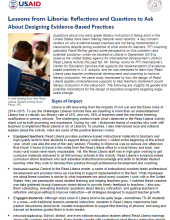
Reflections and questions to ask about designing evidence-based practices: Lessons from Liberia:

Submitted by admin on
Description/Abstract
This brief described how the design of the Read Liberia Activity applied comprehensive supports to help teachers implement sound literacy instruction in the classroom. Insights from Read Liberia's model may have potential implications for the design of education programs targeting large-scale change.
Assoc. Photo (Port.)
lessons from Liberia.png
Resource (File)
Country
Resource Type
Resource Language
Month and Year

Short Message Service (SMS)–Based Remote Support and Teacher Retention of Training Gains in Malawi

Submitted by admin on
Description/Abstract
Chapter 5 of the book Cultivating Dynamic Educators: Case Studies in Teacher Behavior Change in Africa and Asia. This chapter critically reviews the design, implementation, and evaluation of an attempt to study an exploratory short message service (SMS)–based intervention conducted under the auspices of the United States Agency for International Development’s (USAID’s) Malawi Early Grade Reading Activity (EGRA).1 The overall EGRA program, which was implemented from July 2013 to October 2016 in 1,614 schools across 11 educational districts, was designed to support Malawi’s Ministry of Education, Science, and Technology (MOEST) to improve reading outcomes in both Chichewa. and English languages among children in grades 1–3. The

Assoc. Photo (Port.)
Malawi Chapter 5.PNG
Resource (File)
Country
Sub-topic
Resource Type
Resource Language
Month and Year
Publisher Or Client
RTI Press

Assessing Soft Skills in Youth Through Digital Games

Submitted by admin on
Description/Abstract
The acquisition and use of so-called “soft skills”, including problem solving, resilience, and self-regulation have been associated with better performance at school and in the workplace [1], [2]. Problem-solving is defined as the ability to acquire or use prior knowledge in order to solve new problems. Strengthening this skill is a concern to educators and employers as the 21st century labor market is increasingly unpredictable and requires skills that go beyond mastering and executing familiar processes. Students need to identify and solve problems that they have never encountered before, formulate a solution plan specific to that problem, and execute the plan. Thus far, the body of research that has measured these relationships relies on traditional self-reporting measurement questionnaires. This methodology is prone to bias since youth may respond in a way they know is desirable, rather than the way they actually behave [3]. Stealth assessment attempts to gather more authentic measurement of skills by asking children to demonstrate them in a structured environment where data collection is unobtrusive [4]. Digital games can be used for stealth assessment, with data on decisions and strategies collected in the application during game play. Since 2017, RTI has been developing games that target a range of soft skills by simulating real-world tasks in a virtual environment. The game designed to measure problem-solving skills gathers metrics on task completion, time management, accepting instruction, problem identification, solution identification, and self-regulation. This paper describes the multi-year process of development and testing of this game, the results obtained from pilots in the Philippines and Morocco, and the implications for strengthening problem-solving skills among youth worldwide. Cite this paper: Pouezevara, S., Powers, S. Strigel, C., McKnight, K. (2019). Assessing soft skills in youth through digital games. ICERI2019 Proceedings. 12th Annual International Conference on Education, Research and Innovation (ICERI), Seville, Spain. p. 3057-3066. https://doi.org/10.21125/iceri.2019.0774
Assoc. Photo (Port.)
Softskills_port.jpg
Resource Type
Resource Language
Month and Year

USA Country Report: Scaling Access and Impact - Realizing the Power of EdTech

Submitted by admin on
Description/Abstract
This series of reports was produced by Omidyar Network’s Education initiative, whose mission is to unlock human potential through learning by catalyzing people, ideas, and systems – so every individual thrives and contributes in a changing and interdependent world. The Omidyar Network team included Eliza Erikson, Erin Simmons, Rebecca Hankin, and Eshanthi Ranasinghe. The data underpinning this report come from interviews, surveys, site visits, and desk research by a team of researchers and EdTech practitioners led by RTI International, drawing on local expertise in each of the case study countries. The team conducted more than 100 interviews with teachers, school principals, education administrators, policymakers, and EdTech experts. This study sought to understand the conditions that have thus far enabled EdTech initiatives to scale in the USA. This case study involved interviewing and surveying more than 20 EdTech stakeholders in the US. These experts provided recommendations on which states or districts could serve as examples of effective EdTech scale-up (at the access, use, or impact level). Suggestions included Utah, California, Maine, Rhode Island, New York, North Carolina, and Florida. Two specific ‘deep dives’ are included in this report: the state of North Carolina and the Miami-Dade County public school district in the state of Florida. Both North Carolina and Florida have, in the past decade, aggressively transformed education and implemented policies and initiatives to improve education opportunities for all students with the help of EdTech.
Assoc. Photo (Port.)
USA scaling portrait.png
Resource (File)
Country
Resource Type
Resource Language
Month and Year
Publisher Or Client
Omidyar Network

China Country Report: Scaling Access and Impact - Realizing the Power of EdTech

Submitted by admin on
Description/Abstract
This series of reports was produced by Omidyar Network’s Education initiative, whose mission is to unlock human potential through learning by catalyzing people, ideas, and systems – so every individual thrives and contributes in a changing and interdependent world. The Omidyar Network team included Eliza Erikson, Erin Simmons, Rebecca Hankin, and Eshanthi Ranasinghe. The data underpinning this report come from interviews, surveys, site visits, and desk research by a team of researchers and EdTech practitioners led by RTI International, drawing on local expertise in each of the case study countries. The team conducted more than 100 interviews with teachers, school principals, education administrators, policymakers, and EdTech experts. This study sought to understand the conditions that have thus far enabled EdTech initiatives to scale in China. The study found that there is a multibillion dollar business opportunity for EdTech entrepreneurs that leverage widespread access to mobile internet and performance pressure generated by cultural values and government standards. Reaching rural and ethnic minority schools with equal access to high quality lessons through virtual teaching and blended models of instruction.
Assoc. Photo (Port.)
China scaling portrait.png
Resource (File)
Country
Resource Type
Resource Language
Month and Year
Publisher Or Client
Omidyar Network

Chile Country Report: Scaling Access and Impact - Realizing the Power of EdTech

Submitted by admin on
Description/Abstract
This series of reports was produced by Omidyar Network’s Education initiative, whose mission is to unlock human potential through learning by catalyzing people, ideas, and systems – so every individual thrives and contributes in a changing and interdependent world. The Omidyar Network team included Eliza Erikson, Erin Simmons, Rebecca Hankin, and Eshanthi Ranasinghe. The data underpinning this report come from interviews, surveys, site visits, and desk research by a team of researchers and EdTech practitioners led by RTI International, drawing on local expertise in each of the case study countries. The team conducted more than 100 interviews with teachers, school principals, education administrators, policymakers, and EdTech experts. This study sought to understand the conditions that have thus far enabled EdTech initiatives to scale in Chile. This case study is the result of more than 20 interviews and site visits and a document review conducted in Chile over a 2-month period in 2018. The case demonstrates that long-term, top-down vision implemented in partnership with university networks or other NGOs who specialize in adaptive management, active learning and knowledge sharing.
Assoc. Photo (Port.)
Chile Portrait scaling.png
Resource (File)
Country
Resource Type
Resource Language
Month and Year
Publisher Or Client
Omidyar Network

Indonesia Country Report: Scaling Access and Impact - Realizing the Power of EdTech

Submitted by admin on
Description/Abstract
This series of reports was produced by Omidyar Network’s Education initiative, whose mission is to unlock human potential through learning by catalyzing people, ideas, and systems – so every individual thrives and contributes in a changing and interdependent world. The Omidyar Network team included Eliza Erikson, Erin Simmons, Rebecca Hankin, and Eshanthi Ranasinghe. The data underpinning this report come from interviews, surveys, site visits, and desk research by a team of researchers and EdTech practitioners led by RTI International, drawing on local expertise in each of the case study countries. The team conducted more than 100 interviews with teachers, school principals, education administrators, policymakers, and EdTech experts. This study sought to understand the conditions that have thus far enabled EdTech initiatives to scale in Indonesia. Focusing on K–12 education, and drawing on interviews with 22 practitioners in the field, we found that Indonesia is paving the way for modern learning using digital and connected technology. As Indonesia overcomes the challenge of access to EdTech, the near future will require greater attention to its impact through research, evaluation, and evidence-based product design.
Assoc. Photo (Port.)
Indo scaling Portrait.png
Country
Resource Type
Resource Language
Month and Year
Publisher Or Client
Omidyar Network