Publications

Contextualizing the goals of social and emotional learning curricula and materials

Submitted by admin on
Author
Description/Abstract
Programs to promote social and emotional learning (SEL) risk making assumptions about the global relevance of core competences. Because scholarship is lacking about SEL in many parts of the world, new approaches are needed to contextualize the goals of SEL programs in a realistic time frame. Previous work in anthropology and developmental psychology can help us predict which competences are likely to be valued, given the sociodemographic characteristics of a society. In rural environments where subsistence agriculture is common, for example, communities are likely to value social responsibility, respect, and obedience. Attention should look beyond the needs of the here and now, however, to speculate what competences today’s children will require in the future. Looking at the current variation of competences within a society—for example, the values that teachers, but not parents, place on confidence and curiosity—can help identify immediate pathways for developing new competences. In all of these considerations, the goals of an SEL program must be negotiated with the communities themselves in order to ensure relevance, effectiveness, and acceptance. The hope is that such considerations can help prevent global homogenization of SEL programs, instead ensuring that they genuinely meet the needs of the communities they aim to serve.
Assoc. Photo (Port.)
7 jukes portrait.png
Resource Type
Resource Language
Month and Year
Publisher Or Client
NISSEM Global Briefs

The central role of school culture and climate in fostering social and emotional learning: Evidence from Malawi and Uganda

Submitted by admin on
Description/Abstract
The central role that the school and classroom environment or ‘school climate’ plays in social and emotional learning (SEL) is well documented, albeit mostly from US-based studies. RTI International sought to understand how schools in Malawi and Uganda organized themselves to provide positive and supportive places for children to learn and to develop socially and emotionally. The narratives captured in this study help explain how teacher behaviors and school culture serve to nurture social and emotional (SE) skills. Teachers, students, parents, and school management committee (SMC) members discussed the importance of teacher encouragement, friendliness and approachability, appreciation, understanding of and listening to student viewpoints, and modeling of cooperative teacher–teacher interactions to support SEL. School qualities identified as important for SEL included cooperation, student clubs and sports, a violence-free environment, freedom of expression, and commitment to equality. The findings yield insights into what schools can do to develop a culture of SEL, in and outside the classroom.
Assoc. Photo (Port.)
8 randolph portrait.png
Country
Resource Type
Resource Language
Month and Year
Publisher Or Client
NISSEM Global Briefs

Effective pedagogy in cultural context: Preaching to the introverted [CIES 2019 Presentation]

Submitted by admin on
Author
Description/Abstract
Several forces are at play in determining whether pedagogical approaches are optimally adapted to the culture of children’s behaviour and of teacher-child interaction in the classroom. Teachers’ expectations for children’s behaviour may differ from the way in which children are raised at home (Jukes et al, 2018). Teaching activities may be designed by experts from outside the beneficiary education system or who may be removed from the culture of rural schools. The evidence for the effectiveness of recommended teaching practices may be based on children and teachers from a different culture. The current study sought to understand the role of cultural factors in the teaching of early grade reading in Tanzania. The aim was to investigate teacher’s pedagogical choices and the implicit theory of teaching and learning that underpinned these choices. We also aimed to understand teachers’ perceptions of students’ social and emotional skills and how this influenced their pedagogical choices. The current study took place in three regions of Tanzania – Zanzibar, Mtwara and Iringa – in the context of the USAID supported Tusome Pamoja (“let’s read together”) project. Researchers observed one lesson from each of 36 teachers and recorded key teaching activities. A subsequent qualitative interview with the teachers examined the decisions they made during the lesson and how their perception of students’ competencies influenced their decisions. Two themes emerged from the results. First, teachers said that children who did not participate in classroom activities lacked confidence and curiosity, particularly in rural areas. These two qualities - confidence and curiosity - were identified in previous work as traits valued more by teachers than parents in the context of learning. Second, teachers said the independent activities were not effective because pupils always cooperate with others in life. There was a strong preference for activities that involved the whole class and against students learning by doing, independent of the teacher. Schools can respond by conducting more activities that build curiosity and confidence. Children becoming more confident and curious in rural Africa represents a cultural change. But one that emerges from the community - not imposed upon it. Instructional design should consider the strong cultural preference for group-orientation and work with - rather than against - this preference where possible.
Assoc. Photo (Port.)
Jukes cies.jpeg
Resource Type
Month and Year

Mathematics from the Beginning: Evaluating the Tayari Preprimary Program’s Impact on Early Mathematics Skills

Submitted by admin on
Description/Abstract
Given the dearth of research on early numeracy interventions in low- and middle-income countries, this paper presents the instructional methodology and impact results of the Tayari program. Tayari is a preprimary intervention in Kenya (2014–2019) that prepares children aged four and five for entry into primary school by providing materials for students, training for teachers, and continuous in-classroom support. The Tayari methodology was built on the Kenyan government’s preprimary syllabus to produce instruction that was developmentally sequenced, linked to out-of-school experiences, and supportive of children’s number sense. Tayari was evaluated using a randomized controlled trial (RCT) and collection of longitudinal data from 2,957 children in treatment and control schools at three time points. Pupil assessment items were drawn from a growing body of research on preprimary numeracy in developing contexts, plus instruments and techniques from the Measuring Early Learning and Quality Outcomes (MELQO) program (UNESCO, UNICEF, Brookings Institution, & World Bank Group, 2017). The impact evaluation of the longitudinal RCT results showed statistically significant effects in the numeracy tasks of producing sets, identifying numbers, and naming shapes, while revealing no initial effects in the areas of oral and mental addition. We present recommendations for Tayari’s improvement in terms of mathematics instruction, as well as preprimary policy implications for Kenya and similar contexts.
Assoc. Photo (Port.)
Screen Shot 2019-01-04 at 11.31.14 AM.png
Country
Resource Type
Resource Language
Month and Year
Publisher Or Client
Global Education Review

Capturing Children’s Mathematical Knowledge: An Assessment Framework.

Submitted by admin on
Description/Abstract
This paper explores an innovative assessment framework for measuring children’s formal and informal mathematical knowledge. Many existing standardized measures, such as the Early Grade Mathematics Assessment, measure children’s performance in early primary grade skills that have been identified by researchers and policy makers as foundational and predictive of later academic achievement (Platas, Ketterlin-Geller, & Sitabkhan, 2016; RTI International, 2014). However, these standardized assessments only provide information on children’s mathematical ability as it pertains to skills and concepts that are a focus of school instruction, referred to as formal mathematics. While valuable, they leave unmeasured the mathematics that children use and develop as part of their everyday life, such as the strategies they use to solve simple arithmetical problems that arise as they move through their day (Khan, 1999; Saxe, 1991; Taylor, 2009). In this article, we draw from mixed methods studies which focus on capturing the informal mathematical skills that children develop outside of school in various contexts (Guberman, 1996; Nasir, 2000; Sitabkhan, 2009; Sitabkhan, 2015). We describe how the use of observations of children’s mathematical activities in natural settings and in subsequent cognitive interviews using mathematical tasks derived from those observations, can illuminate mathematical knowledge and skills that may otherwise remain hidden. We found that an assessment framework that focuses on both standardized measures of formal mathematical learning and contextualized measures of children’s everyday mathematics can provide a more complete and nuanced picture of children’s knowledge, and taken together can inform the development of curricular materials and teacher training focused on early learning.

Assoc. Photo (Port.)
Screen Shot 2019-01-04 at 11.26.35 AM.png
Country
Resource Type
Resource Language
Month and Year
Publisher Or Client
Global Education Review

Cultivating Dynamic Educators: Case studies in teacher behavior change in Africa and Asia

Submitted by admin on
Description/Abstract
Cultivating Dynamic Educators: Case Studies in Teacher Behavior Change in Africa and Asia responds to growing recognition by international education professionals, policy makers, and funding partners of the need for qualified teachers and interest in the subject of teacher professional development (also referred to as “teacher behavior change”). The book responds to important questions that are fundamental to improving teaching quality by influencing teaching practice. These questions include: How do we provide high-quality training at scale? How do we ensure that training transfers to change in practice? What methods are most cost-effective? How do we know what works? The book includes case studies from seven countries--Ethiopia, India, Indonesia, Malawi, Nigeria, Philippines and Zambia--describing different approaches to teacher behavior change and illustrates how specific implementation choices were made for each context. Individual chapters document lessons learned as well as methodologies used for discerning lessons. The key conclusion is that no single effort is enough on its own; teacher behavior change requires a system-wide view and concerted, coordinated inputs from a range of stakeholders.
Assoc. Photo (Port.)
TBC book front coer.jpg
Resource Type
Resource Language
Month and Year
Publisher Or Client
RTI Press

Using Activity Theory to Understand Teacher Peer Learning in Indonesia

Submitted by admin on
Description/Abstract
Chapter 7 of Edited Volume: Pouezevara, S. R. (Ed.) (2018). Cultivating dynamic educators: Case studies in teacher behavior change in Africa and Asia. (RTI Press Publication No. BK-0022-1809). Research Triangle Park, NC: RTI Press. DOI: 10.3768/rtipress.2018.bk.0022.1809 This case study explores the methods and implementation considerations of peer-learning approaches to changing teaching practice in the Indonesian context, where cluster-based training is deeply embedded in the education system. These clusters were leveraged by USAID/PRIORITAS to disseminate professional development through a structured lesson-study approach. To understand more about how teachers were learning to improve their practice through peer mentoring, data were collected through interviews and school visits in August 2016. The main purpose of the case study was to understand the scope and implementation considerations of school-based and peer-to-peer approaches to teacher behavior change, with particular focus on improving reading instruction. We particularly have tried to uncover the implementation factors that influenced the possibility of success of peer mentoring in Indonesia under USAID/PRIORITAS, including issues of intrinsic and extrinsic motivation, readiness for self-directed learning, and the relative importance of the foundation laid by the preexisting school- cluster structure described in the Methodology section.
Assoc. Photo (Port.)
activity theory.jpg
Country
Resource Type
Resource Language
Month and Year
Publisher Or Client
RTI Press

Measuring Executive Function Skills in Young Children in Kenya

Submitted by admin on
Description/Abstract
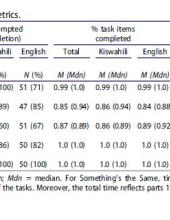
Interest inmeasuring executive function skills in young children in lowand middle-income country contexts has been stymied by the lack of assessments that are both easy to deploy and scalable. This study reports on an initial effort to develop a tablet-based battery of executive function tasks, which were designed and extensively studied in the United States, for use in Kenya. Participants were 193 children, aged 3–6 years old, who attended early childhood development and education centers. The rates of individual task completion were high (65–100%), and 85% of children completed three or more tasks. Assessors indicated that 90% of all task administrations were of acceptable quality. An executive function composite score was approximately normally distributed, despite higher-than-expected floor and ceiling effects on inhibitory control tasks. Children’s simple reaction time (β = –0.20, p = .004), attention-related behaviors during testing (β = 0.24, p = .0005), and age (β = –0.24, p = .0009) were all uniquely related to performance on the executive function composite. Results are discussed as they inform efforts to develop valid and reliable measures of executive function skills among young children in developing country contexts.
Assoc. Photo (Port.)
Table 1 EF Touch.JPG
Country
Resource Type
Resource Language
Month and Year
Publisher Or Client
Child Neuropsychology

Early Mathematics Counts: Promising Instructional Strategies for Low- and Middle- Income Countries

Submitted by admin on
Description/Abstract
This paper examines common instructional strategies in early grade mathematics interventions through a review of studies in classrooms in low- and middle-income countries. Twenty-four studies met the criteria for inclusion, and analyses reveal four sets of instructional strategies for which there is evidence from multiple contexts. Of the 24 studies, 16 involved the use of multiple representations, 10 involved the use of developmental progressions, 6 included supporting student use of explanation and justification, and 5 included integration of informal mathematics. Based on the review, we provide conclusions and recommendations for future research and policy.
Assoc. Photo (Port.)
Picture1.png
Resource (File)
Sitabkhan_Platas_2018.pdf
Country
Resource Type
Resource Language
Month and Year
Publisher Or Client
RTI Press

Stumbling at the First Step: Efficiency implications of poor performance in the foundational first five years

Submitted by admin on
Description/Abstract
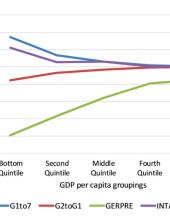
This paper highlights patterns in school enrollment indicators that affect the efficiency and effectiveness of education systems in a set of low-income countries: those that have expanded access quickly in the last decade or two, but have not yet absorbed that expansion efficiently. Although the patterns in these indicators are observable in the first few years of schooling, they could constitute a cause of low learning outcomes at the end of primary school. The data show strong empirical relationships between an early primary enrollment bulge, low levels of pre-primary participation, and poor performance on early grade cognitive skills. This work does not attribute causal precedence to these patterns but instead argues that the indicators are reflections of each other, constituting a ‘‘knot’’ of issues undermining the foundations of the affected education systems. The article presents some of the cost implications and suggests that many countries are already paying for pre-primary education without realizing it.
Assoc. Photo (Port.)
stumbling graph.jpg
Country
Resource Type
Resource Language
Month and Year
Publisher Or Client
Prospects