Life Skills

Facilitators Guide for Journeys Activity Handbook for Community Members

Submitted by admin on
Description/Abstract
Each Journeys Handbook has an accompanying Facilitator's Guide that serves as a manual for the facilitator responsible for leading a teacher training on Journeys. This particular Facilitator's Guide is meant to accompany the Journeys Activity Handbook for Community Members. The Facilitator's Guide is meant for training purposes only.
Assoc. Photo (Port.)
Facilitators Guide Journeys 2.jpg
Country
Sub-topic
Resource Type
Resource Language
Month and Year

Facilitator's Guide for Journeys Activity Handbook for Teachers and School Staff

Submitted by admin on
Author
Description/Abstract
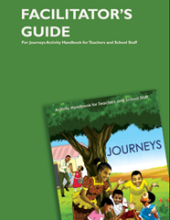
Each Journeys Handbook has an accompanying Facilitator's Guide that serves as a manual for the facilitator responsible for leading a teacher training on Journeys. This particular Facilitator's Guide is meant to accompany the Journeys Activity Handbook for Teachers. The Facilitator's Guide is meant for training purposes only.
Assoc. Photo (Port.)
facilitators guide 1.jpg
Country
Resource Type
Resource Language
Month and Year

Towards the Development of An Assessment of Employability Skills

Submitted by admin on
Author
Description/Abstract
As the world faces higher and higher unemployment rates among its youth, there is increasing interest in evaluating whether schools are adequately preparing their youth to enter the workforce. Do early school leavers (those leaving by Grade 9) possess the “foundational” and “employability” skills needed to effectively enter the workforce? Assessment instruments for literacy and mathematics appropriate to the end of the primary cycle do exist. However these tend to be in depth, large scale, regional or national assessments and not the rapid assessments that EGRA/EGMA are. In addition, these tools only measure some foundational skills, such as reading and math. Previous investigation on employability skills identified three “clusters” of commonly cited skills in the international literature: cognitive, interpersonal, and intrapersonal skills. These three clusters align favorably with the three domains specified by the Committee on Deeper Learning and 21st Century Skills, convened by the US-based National Research Council, as well as other prominent models. A subset of these skills could be assessed, in combination with foundational skills such as literacy and mathematics, in order to ascertain whether or not youth of secondary school age (i.e. around 15–18 years of age) are finishing their tenure in formal schooling with at least a modicum of “work readiness” skills. This report describes a framework for understanding and measuring employability skills.
Assoc. Photo (Port.)
employability_port.png
Resource (File)
Country
Resource Type
Resource Language
Month and Year
Publisher Or Client
RTI International

Assessing Soft Skills in Youth Through Digital Games [Presentation]

Submitted by admin on
Description/Abstract
Presentation for the 2019 ICERI conference (Seville, Spain.)

Assoc. Photo (Port.)
Screen Shot 2020-04-09 at 12.37.45 PM.png
Country
Resource Type
Resource Language
Month and Year

Assessing Soft Skills in Youth Through Digital Games

Submitted by admin on
Description/Abstract
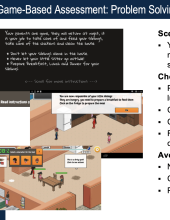
The acquisition and use of so-called “soft skills”, including problem solving, resilience, and self-regulation have been associated with better performance at school and in the workplace [1], [2]. Problem-solving is defined as the ability to acquire or use prior knowledge in order to solve new problems. Strengthening this skill is a concern to educators and employers as the 21st century labor market is increasingly unpredictable and requires skills that go beyond mastering and executing familiar processes. Students need to identify and solve problems that they have never encountered before, formulate a solution plan specific to that problem, and execute the plan. Thus far, the body of research that has measured these relationships relies on traditional self-reporting measurement questionnaires. This methodology is prone to bias since youth may respond in a way they know is desirable, rather than the way they actually behave [3]. Stealth assessment attempts to gather more authentic measurement of skills by asking children to demonstrate them in a structured environment where data collection is unobtrusive [4]. Digital games can be used for stealth assessment, with data on decisions and strategies collected in the application during game play. Since 2017, RTI has been developing games that target a range of soft skills by simulating real-world tasks in a virtual environment. The game designed to measure problem-solving skills gathers metrics on task completion, time management, accepting instruction, problem identification, solution identification, and self-regulation. This paper describes the multi-year process of development and testing of this game, the results obtained from pilots in the Philippines and Morocco, and the implications for strengthening problem-solving skills among youth worldwide. Cite this paper: Pouezevara, S., Powers, S. Strigel, C., McKnight, K. (2019). Assessing soft skills in youth through digital games. ICERI2019 Proceedings. 12th Annual International Conference on Education, Research and Innovation (ICERI), Seville, Spain. p. 3057-3066. https://doi.org/10.21125/iceri.2019.0774
Assoc. Photo (Port.)
Softskills_port.jpg
Resource Type
Resource Language
Month and Year

Contextualizing the goals of social and emotional learning curricula and materials

Submitted by admin on
Author
Description/Abstract
Programs to promote social and emotional learning (SEL) risk making assumptions about the global relevance of core competences. Because scholarship is lacking about SEL in many parts of the world, new approaches are needed to contextualize the goals of SEL programs in a realistic time frame. Previous work in anthropology and developmental psychology can help us predict which competences are likely to be valued, given the sociodemographic characteristics of a society. In rural environments where subsistence agriculture is common, for example, communities are likely to value social responsibility, respect, and obedience. Attention should look beyond the needs of the here and now, however, to speculate what competences today’s children will require in the future. Looking at the current variation of competences within a society—for example, the values that teachers, but not parents, place on confidence and curiosity—can help identify immediate pathways for developing new competences. In all of these considerations, the goals of an SEL program must be negotiated with the communities themselves in order to ensure relevance, effectiveness, and acceptance. The hope is that such considerations can help prevent global homogenization of SEL programs, instead ensuring that they genuinely meet the needs of the communities they aim to serve.
Assoc. Photo (Port.)
7 jukes portrait.png
Resource Type
Resource Language
Month and Year
Publisher Or Client
NISSEM Global Briefs

The central role of school culture and climate in fostering social and emotional learning: Evidence from Malawi and Uganda

Submitted by admin on
Description/Abstract
The central role that the school and classroom environment or ‘school climate’ plays in social and emotional learning (SEL) is well documented, albeit mostly from US-based studies. RTI International sought to understand how schools in Malawi and Uganda organized themselves to provide positive and supportive places for children to learn and to develop socially and emotionally. The narratives captured in this study help explain how teacher behaviors and school culture serve to nurture social and emotional (SE) skills. Teachers, students, parents, and school management committee (SMC) members discussed the importance of teacher encouragement, friendliness and approachability, appreciation, understanding of and listening to student viewpoints, and modeling of cooperative teacher–teacher interactions to support SEL. School qualities identified as important for SEL included cooperation, student clubs and sports, a violence-free environment, freedom of expression, and commitment to equality. The findings yield insights into what schools can do to develop a culture of SEL, in and outside the classroom.
Assoc. Photo (Port.)
8 randolph portrait.png
Country
Resource Type
Resource Language
Month and Year
Publisher Or Client
NISSEM Global Briefs

"Those Things Don't Work Here!" Forum/Community Theatre Drama Skit Script

Submitted by admin on
Description/Abstract
Forum Theatre / Community Theatre Drama Skit Script titled "Those Things Don't Work Here!" created by USAID/Uganda's Literacy Achievement and Retention Activity (LARA) as part of their Social and Behavior Change Communication (SBCC) materials to reduce primary teachers' use of corporal punishment in school.
Assoc. Photo (Port.)
Capture12.PNG
Resource (File)
Country
Resource Type
Resource Language
Month and Year

School Culture and Climate (and Love) Matter: Voices from Malawi and Uganda [CIES 2019 Presentation]

Submitted by admin on
Description/Abstract
This study sought to identify the factors in the organizational culture and environment of a small sample primary schools in Malawi and Uganda that make them more (or less) conducive to children’s social and emotional development. The research team postulated that social and emotional learning are not products of the implementation of an “SEL” curriculum, but rather are inherently dependent on and result from the nature of the school climate.
Assoc. Photo (Port.)
GWU presentation front cover.JPG
Resource (File)
Country
Sub-topic
Resource Type
Month and Year