Pouezevara, S.

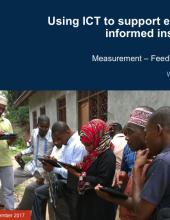
Using ICT to support evidence-informed instruction [Presentation]

Submitted by admin on
Description/Abstract
This presentation was delivered by Wendi Ralaingita at the Open Learning Exchange (OLE) conference in Kathmandu, Nepal (November 2017). It provides an overview of RTI's evidence-based approach to ICT integration, based largely on the Improvement Science literature, particularly Edward Deming. Describes uses of Tangerine open-source software for teacher coaching (Tangerine:Tutor) and classroom continuous assessment (Tangerine:Class) as well as hearing and vision screening tools integrated with EGRA and EGMA assessments.
Assoc. Photo (Port.)
OLE ICT Conference_RTI Presentation 2017.jpg
Resource (File)
Country
Resource Type
Resource Language
Month and Year
Publisher Or Client
RTI International

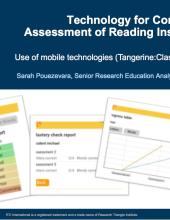
Technology for Continuous Assessment of Reading Instruction

Submitted by admin on
Description/Abstract
This is a presentation about Tangerine:Class, which was delivered at the 2016 Pacific Circle Consortium in Saipan.
Assoc. Photo (Port.)
TanClass PPC pres.jpg
Resource (File)
Country
Resource Type
Resource Language
Month and Year
Publisher Or Client
RTI International

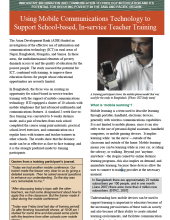
Using Mobile Communications Technology to Support School-based, In-service Teacher Training

Submitted by admin on
Description/Abstract
The Asian Development Bank (ADB) funded an investigation of the effective use of information and communication technology (ICT) in rural areas of Nepal, Bangladesh, Mongolia, and Samoa. In these areas, the multidimensional elements of poverty diminish access to and the quality of education for the poorest people. The study assessed the potential for ICT, combined with training, to improve these education factors for people whose educational opportunities are severely limited. In Bangladesh, the focus was on creating an opportunity for school-based in-service teacher training with the support of mobile communications technology. RTI equipped a cluster of 10 schools with mobile telephones that had advanced multimedia and communications features. A standard 2-week face-to-face training was converted to 6-weeks distance mode, and a pair of teachers from each school completed the course using print materials, practical school-level exercises, and communication on a regular basis with trainers and teacher trainees in other schools. The results show that the distance mode can be as effective as face-to-face training, and it is the strongly preferred mode by training participants.
Assoc. Photo (Port.)
bangla brochure.png
Resource (File)
Country
Resource Type
Resource Language
Month and Year
Publisher Or Client
ADB

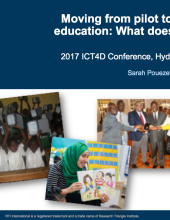
Moving from pilot to scale in education: What does it take?

Submitted by admin on
Description/Abstract
Presentation delivered at the ICT4D 2017 Conference in Hyderabad. Taking successful pilot projects to scale should be the goal of any pilot program; yet often projects address scale only as an afterthought. The challenges of realizing large-scale impact, and of seeing that impact sustained, are not new to development. However, they are being approached with renewed interest and attention in the education sector. This presentation examines the issue of scale up in basic education programs in seven countries where interventions to improve early grade reading are being taken to scale--some with project support, some through government initiative. Management Systems International's framework for taking projects to scale, and the framework defined in the Brookings Institute's Millions Learning report are used to examine how scale has been and is occurring in selected countries, and we look at how scale is achieved in ICT projects. The presenter invites participants to be active discussants in this presentation, sharing their experiences and providing feedback on the relevancy of the proposed frameworks for ICT at scale
Assoc. Photo (Port.)
ict4d.png
Resource (File)
Country
Resource Type
Resource Language
Month and Year

Revisiting the "M" in m-learning: Making the most of mobile environments for teaching and learning

Submitted by admin on
Description/Abstract
Published in the conference proceedings for E-Learn 2015 - October 19-22, 2015 (Kona, Hawaii). A version of this paper was also presented at the mobile learning conference in Helsinki, 2013. Educational innovations in developing countries are expanding due to pressure to achieve quality outcomes at scale and changing markets, where mobile devices are increasingly affordable. m-Learning as a concept has existed prior to the acceleration of these forces, but has gained increasing attention because of them. Growth in mobile phone ownership in developing countries has made mobile-phone enabled education (a form of e-learning) commonplace in formal and informal education. This paper draws on a broad review of existing m-learning programs to illustrate how instructional strategies are being employed, and explore whether these strategies are appropriate for learners in these contexts. It urges thinking differently about the ‘m’ in m-learning, and moving the conversation away from broad notions of mobile learning for any and all purposes to more detailed guidance on how to implement mobile learning from an informed pedagogical perspective that includes attention to local cultures
Assoc. Photo (Port.)
mlearning.png
Country
Resource Type
Resource Language
Month and Year

Mobile Learning and Numeracy: Filling gaps and expanding opportunities for early grade learning

Submitted by admin on
Description/Abstract
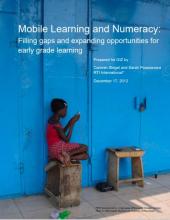
The present study on Mobile Learning and Numeracy examines how mobile learning (m-learning) could influence and improve numeracy education at early grade levels (ages 4-10) especially in low-income countries. Key questions to guide the research include: 1) What are the benefits and challenges of integrating mobile learning into early grade numeracy education? 2) What is the role of a teacher with regard to mobile learning and numeracy education? 3) How can the community and the parents actively contribute to/participate in the child’s numeracy education with the use of mobile devices? and 4) How can mobile technology be used effectively in measuring/assessing numeracy gains? The conclusions and recommendations of this study have been informed by an international working group that met over two days during the first International Numeracy Conference in Berlin in December 2012. We would like to acknowledge the following participants of this working group for their thoughtful contributions: Michaela Brinkhaus (BMZ); Dorothea Coppard (GIZ); Melanie Stilz (Konnektiv Büro für Bildung und Entwicklung); Jens von Roda-Pulkowski (KfW); Abigail Bucuvalas (Sesame Workshop); Mr. Kann Puthy (Primary Education Department, MoEYS Cambodia); Edward Barnett (DFID).

Assoc. Photo (Port.)
mnumeracy_port.JPG
Country
Resource Language
Month and Year
Publisher Or Client
GIZ

Malawi Reading Intervention: EGRA Impact Evaluation Report

Submitted by admin on
Description/Abstract
In 2010, the United States Agency for International Development (USAID), in collaboration with the Malawi Ministry of Education, Science and Technology (MoEST), developed a project to improve primary education and implementation of the National Primary Curriculum. The Malawi Teacher Professional Development Support (MTPDS) project, as it is known, included five major results areas related to improving teaching policy, teacher performance, early grade literacy, primary teaching and learning materials, and monitoring and evaluation (M&E) systems. While many of the inputs designed to support these objectives took place on a national scale, a specific reading improvement program was designed and delivered in two districts in order to determine its effectiveness on a small scale. This report describes the impact of the intervention, evaluated based on a rigorous three-year randomized control trial (RCT) design.
Assoc. Photo (Port.)
Resource (File)
Country
Resource Type
Resource Language
Month and Year
Publisher Or Client
USAID

Malawi National Early Grade Reading Assessment (EGRA) - Final report

Submitted by admin on
Description/Abstract
The United States Agency for International Development (USAID) Malawi Teacher Professional Development Support (MTPDS) project is a three-year activity supporting the professional development of teachers in Malawi and implementation of the National Primary Curriculum (NPC) with the goal of improving early grade reading and performance of learners. This report presents the results from a nationally representative study of primary school learners’ early grade reading skills in the Chichewa language, undertaken near the beginning of the school year, in November 2012. It is the third in a series of national samples designed to identify overall skills and gaps in order to inform national-level policies and strategies and determine the influence of policies and projects to address reading over time.
Assoc. Photo (Port.)
Resource (File)
Country
Resource Type
Resource Language
Month and Year
Publisher Or Client
USAID

Rapport d'Analyse: Evaluation des Compétences Fondamentales en Lecture au Sénégal

Submitted by admin on
Description/Abstract
This report describes the results of an early Grade Reading Assessment (EGRA) conducted in Senegal in two languages: French and Wolof. The research was supported by the William and Flora Hewlett Foundation and included teacher interviews and classroom observations that captured the language of instruction being used in the classroom in order to explain the context of the findings.
Assoc. Photo (Port.)
senegal.jpg
Resource (File)
EGRA2009_FINAL_SN.pdf
Country
Resource Type
Resource Language
Month and Year
Publisher Or Client
RTI International

Research on Reading in Morocco: Analysis of Teachers’ Perceptions and Practices

Submitted by admin on
Description/Abstract
This report is one of three undertaken in the context of a situation analysis of reading in Morocco. The present report analyzes in detail teachers’ attitudes and practices. As a starting point, it addresses the following questions: What are the perceptions that have the most influence on the teaching of reading in the early grades? How do these perceptions impact the professional development of teachers? How do teachers respond to questions about the language of teaching? Are they receptive to the learning of reading in local languages? This third research component studies the perceptions of language use in general and the behavior of teachers specifically. It analyses teachers’ perceptions of the teaching of reading in Arabic and how these perceptions influence their practice.
Assoc. Photo (Port.)
morocco attitudes.png
Resource (File)
Country
Resource Type
Resource Language
Month and Year
Publisher Or Client
USAID