Pouezevara, S.

Chile Country Report: Scaling Access and Impact - Realizing the Power of EdTech

Submitted by admin on
Description/Abstract
This series of reports was produced by Omidyar Network’s Education initiative, whose mission is to unlock human potential through learning by catalyzing people, ideas, and systems – so every individual thrives and contributes in a changing and interdependent world. The Omidyar Network team included Eliza Erikson, Erin Simmons, Rebecca Hankin, and Eshanthi Ranasinghe. The data underpinning this report come from interviews, surveys, site visits, and desk research by a team of researchers and EdTech practitioners led by RTI International, drawing on local expertise in each of the case study countries. The team conducted more than 100 interviews with teachers, school principals, education administrators, policymakers, and EdTech experts. This study sought to understand the conditions that have thus far enabled EdTech initiatives to scale in Chile. This case study is the result of more than 20 interviews and site visits and a document review conducted in Chile over a 2-month period in 2018. The case demonstrates that long-term, top-down vision implemented in partnership with university networks or other NGOs who specialize in adaptive management, active learning and knowledge sharing.
Assoc. Photo (Port.)
Chile Portrait scaling.png
Resource (File)
Country
Resource Type
Resource Language
Month and Year
Publisher Or Client
Omidyar Network

Indonesia Country Report: Scaling Access and Impact - Realizing the Power of EdTech

Submitted by admin on
Description/Abstract
This series of reports was produced by Omidyar Network’s Education initiative, whose mission is to unlock human potential through learning by catalyzing people, ideas, and systems – so every individual thrives and contributes in a changing and interdependent world. The Omidyar Network team included Eliza Erikson, Erin Simmons, Rebecca Hankin, and Eshanthi Ranasinghe. The data underpinning this report come from interviews, surveys, site visits, and desk research by a team of researchers and EdTech practitioners led by RTI International, drawing on local expertise in each of the case study countries. The team conducted more than 100 interviews with teachers, school principals, education administrators, policymakers, and EdTech experts. This study sought to understand the conditions that have thus far enabled EdTech initiatives to scale in Indonesia. Focusing on K–12 education, and drawing on interviews with 22 practitioners in the field, we found that Indonesia is paving the way for modern learning using digital and connected technology. As Indonesia overcomes the challenge of access to EdTech, the near future will require greater attention to its impact through research, evaluation, and evidence-based product design.
Assoc. Photo (Port.)
Indo scaling Portrait.png
Country
Resource Type
Resource Language
Month and Year
Publisher Or Client
Omidyar Network

Uganda Impact Study Report of Tangerine:Coach

Submitted by admin on
Description/Abstract

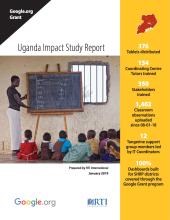
This report describes the results of a program designed to expand use of Tangerine:Tutor (now known as Tangerine: Coach), a model scaled successfully in Kenya, to Ugandan coaches. The first aim of the program was to improve the quality of interactions between Coordinating Centre Tutors (CCTs, or “coaches” for convenience) and teachers, as well as the quantity of those interactions (increase the frequency of school visits). During this pilot effort, which lasted approximately 18 months, we studied the added value of a digital case management tool and job aids to improve coaching activities in two Early Grade Reading (EGR) programs in Uganda. The iterative, user-centered design and monitoring focused on changes in the quality and quantity of coach and teacher interactions.The second aim was to improve the quality of communication between CCTs and Teacher Training Colleges (TTCs), between CCTs and districts and between local stakeholders and institutions (i.e., schools, TTCs and district offices) and the Ministry of Education and Sports (MoES). This aim was to be accomplished through a Web-accessible dashboard based on the digital tools that quickly communicated school support coverage, as well as teacher and learner attendance. The pilot effort successfully introduced the case management tool and job aids, built a dashboard to communicate progress and trained users across four regions of Uganda.
Assoc. Photo (Port.)
uganda portrait.jpeg
Resource (File)
Country
Resource Type
Month and Year
Publisher Or Client
Google.org

Cultivating Dynamic Educators [CIES 2019 Presentation]

Submitted by admin on
Description/Abstract
This presentation introduces the panel of authors who presented at CIES 2019 about their chapter of the book.
Assoc. Photo (Port.)
Sarah CIES 2019 Panel Presentation.jpg
Resource (File)
Resource Type
Resource Language
Month and Year
Publisher Or Client
RTI International

Scaling Access & Impact: Realizing the Power of EdTech (Executive Summary)

Submitted by admin on
Description/Abstract
Omidyar Network commissioned Scaling Access & Impact: Realizing the Power of EdTech to evaluate what might be necessary to enable, scale, and sustain Equitable EdTech on a national basis. We examined initiatives in Chile, China, Indonesia, and the USA that demonstrate how EdTech reached a broad spectrum of students. Download the executive summary to learn more about some of the events, actions, and initiatives that have contributed to the equitable scaling of EdTech as well as help inform policies using the highest-impact interventions.
Assoc. Photo (Port.)
edtech ecosystems jpg.jpg
Resource (File)
Resource Type
Resource Language
Month and Year
Publisher Or Client
Omidyar Network

Strengthening the Textbook Production Chain in Morocco: Study Conclusions and Recommendations Appendix A: Analysis of Textbook Procurement Chain and Market for Supplemental Reading Materials (research conducted in 2015)

Submitted by admin on
Description/Abstract
This is Part 2 of a four-part comprehensive evaluation of the public textbook procurement system in Morocco. It documents the Ministry of Education's textbook procurement system processes and presents the results of a survey of supplemental early reading materials in Arabic available in the Moroccan market. It also offers recommendations on how to increase the use of supplemental reading materials in the classroom.
Assoc. Photo (Port.)
2_English_Textbooks Morocco_2015 Results.jpg
Country
Resource Type
Resource Language
Month and Year
Publisher Or Client
USAID/Morocco

Cultivating Dynamic Educators: Case studies in teacher behavior change in Africa and Asia

Submitted by admin on
Description/Abstract
Cultivating Dynamic Educators: Case Studies in Teacher Behavior Change in Africa and Asia responds to growing recognition by international education professionals, policy makers, and funding partners of the need for qualified teachers and interest in the subject of teacher professional development (also referred to as “teacher behavior change”). The book responds to important questions that are fundamental to improving teaching quality by influencing teaching practice. These questions include: How do we provide high-quality training at scale? How do we ensure that training transfers to change in practice? What methods are most cost-effective? How do we know what works? The book includes case studies from seven countries--Ethiopia, India, Indonesia, Malawi, Nigeria, Philippines and Zambia--describing different approaches to teacher behavior change and illustrates how specific implementation choices were made for each context. Individual chapters document lessons learned as well as methodologies used for discerning lessons. The key conclusion is that no single effort is enough on its own; teacher behavior change requires a system-wide view and concerted, coordinated inputs from a range of stakeholders.
Assoc. Photo (Port.)
TBC book front coer.jpg
Resource Type
Resource Language
Month and Year
Publisher Or Client
RTI Press

Using Activity Theory to Understand Teacher Peer Learning in Indonesia

Submitted by admin on
Description/Abstract
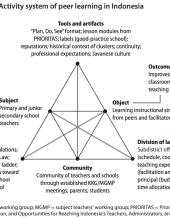
Chapter 7 of Edited Volume: Pouezevara, S. R. (Ed.) (2018). Cultivating dynamic educators: Case studies in teacher behavior change in Africa and Asia. (RTI Press Publication No. BK-0022-1809). Research Triangle Park, NC: RTI Press. DOI: 10.3768/rtipress.2018.bk.0022.1809 This case study explores the methods and implementation considerations of peer-learning approaches to changing teaching practice in the Indonesian context, where cluster-based training is deeply embedded in the education system. These clusters were leveraged by USAID/PRIORITAS to disseminate professional development through a structured lesson-study approach. To understand more about how teachers were learning to improve their practice through peer mentoring, data were collected through interviews and school visits in August 2016. The main purpose of the case study was to understand the scope and implementation considerations of school-based and peer-to-peer approaches to teacher behavior change, with particular focus on improving reading instruction. We particularly have tried to uncover the implementation factors that influenced the possibility of success of peer mentoring in Indonesia under USAID/PRIORITAS, including issues of intrinsic and extrinsic motivation, readiness for self-directed learning, and the relative importance of the foundation laid by the preexisting school- cluster structure described in the Methodology section.
Assoc. Photo (Port.)
activity theory.jpg
Country
Resource Type
Resource Language
Month and Year
Publisher Or Client
RTI Press

Measures of quality through classroom observation for the Sustainable Development Goals: Lessons from low-and-middle-income countries

Submitted by admin on
Description/Abstract
Background paper prepared for the 2016 Global Education Monitoring Report Education for people and planet: Creating sustainable futures for all With the adoption of the United Nations General Assembly’s Sustainable Development Goals (SDGs), global education agencies are grappling with how quality can and should be measured for global reporting purposes. Several factors at the education system, school, and classroom levels shape education quality, including the limited information available at the global level about what is happening in the classroom. Such information can only come through observation-based measures that record teacher practices, either through routine monitoring conducted by system actors or through surveys. Classroom observation is used extensively in not only teacher education and professional development, but also in evaluation studies. However, there are fewer cases where classroom observations are used for system monitoring purposes—particularly in low- and middle- income countries. This paper reviews what has been learned from observation instruments in low- and middle-income countries and what opportunities (i.e., scope) there are to systematize these countries to that they can monitor quality at both the school and system levels.
Assoc. Photo (Port.)
gmr.png
Resource (File)
Country
Resource Language
Month and Year
Publisher Or Client
UNESCO Global Monitoring Report

Implementing large-scale instructional technology in Kenya: Changing instructional practice and developing accountability in a National Education System

Submitted by admin on
Description/Abstract
Article published in the IJEDICT, Vol. 13, No. 3 (2017). Published Abstract: "Previous large-scale education technology interventions have shown only modest impacts on student achievement. Building on results from an earlier randomized controlled trial of three different applications of information and communication technologies (ICTs) on primary education in Kenya, the Tusome Early Grade Reading Activity developed the National Tablets Program. The National Tablets Program is integrated into the Tusome activity by providing tablets to each of more than 1,200 instructional coaches in the country to use when they visit teachers. This enables a national database of classroom instructional quality, which is used by the education system to monitor overall education quality. The tools provided on the tablets are designed to help coaches increase the quality of their instructional support to teachers, and deepen the shallow accountability structures in Kenya’s education system. Using results of a national survey, we investigated the ability of the National Tablets Program to increase the number of classroom observations done by coaches and to improve student learning outcomes. Survey results showed high levels of tablet program utilization, increased accountability, and improvements in learning outcomes. We share recommendations regarding large-scale ICT interventions and literacy programs.
Assoc. Photo (Port.)
ijedict.jpg
Country
Resource Type
Featured projects
Resource Language
Month and Year
Publisher Or Client
International Journal of Education and Development Using ICTs