Pouezevara, S.

2019 Regional Early Grade Reading Assessment (EGRA): Bahasa Sug, Chavacano, Magindanawn, and Mëranaw

Submitted by admin on
Description/Abstract
This study measured students’ reading ability and gathered basic demographic information from children and teachers. Some standard context information was also gathered from children about their exposure to reading in the home. Thus, the data allow us to describe one outcome of the current schools sampled—children’s reading ability—but they do not provide any empirical measurement of the inputs that contribute to this outcome. To explain the current state of reading performance as measured by this study, we must rely on other contextual data from our concurrent Language Usage Study and general knowledge of mother-tongue-based multilingual education (MTB-MLE) implementation, as documented by policy and other studies carried out by other researchers. In the absence of direct measurement of “implementation fidelity” to a particular reading instruction program or materials, we must also rely on global evidence of how reading skills develop in alphabetic languages. To put it simply, children can learn to read, but only if they are taught to read. Teachers can only teach reading if they have been prepared to do so through training and are equipped with appropriate materials. Teachers and students must be present and making productive use of class time. The purpose of using EGRA as a system diagnostic is primarily to establish a baseline against which future progress can be measured and to identify priority areas for instructional improvement and teacher training. Cite this report: Betts, K., Punjabi, M., Pouezevara, S. & Cummiskey, C. (2019). 2019 Regional Early Grade Reading Assessment (EGRA): Bahasa Sug, Chavacano, Magindanawn, and Mëranaw. Prepared for USAID under the All Children Reading-Philippines Project, AID-OAA-TO- 16-00017. Research Triangle Park, NC: RTI.
Assoc. Photo (Port.)
Screen Shot 2020-05-28 at 3.20.25 PM.png
Resource (File)
Country
Resource Type
Resource Language
Month and Year
Publisher Or Client
USAID

Philippines Education Technology Ecosystem Profile [Brief]

Submitted by admin on
Description/Abstract
A one page description of the Education Technology Ecosystem in the Philippines.
Assoc. Photo (Port.)
ecosys1_port.png
Resource (File)
Country
Resource Type
Featured projects
Resource Language
Month and Year
Publisher Or Client
USAID

Teacher Professional Development on ICT in Education in the Philippines [Brief]

Submitted by admin on
Description/Abstract
This topic brief is based on information from interviews with officials and staff of the DepEd Information and Communications Technology Service, BLD, NEAP, and DOST-SEI; head of the education programs of private companies; and faculty members from three higher education institutions in the Philippines engaged in teacher professional development. Relevant policy documents were also reviewed. This brief was prepared by Monalisa T. Sasing, under a subcontract issued to FIT-ED, Philippines. It was edited by Sarah Pouezevara (RTI) prior to publication.
Assoc. Photo (Port.)
TPD Brief Portrait.JPG
Resource (File)
TeacherDev_Brief_FINAL.pdf
Country
Resource Type
Resource Language
Month and Year
Publisher Or Client
USAID

Going the Last Mile: Equitable Access to Enabling Infrastructure in Philippine Schools [Brief]

Submitted by admin on
Description/Abstract
This topic brief is based on information from interviews with officials and staff of DepEd regional and division offices in the Cordillera Administrative Region and Baguio City, the Department of Information and Communications Technology, the Department of Science and Technology-Science Education Institute, the United Nations Development Programme Philippines office, two private telecommunications companies (Globe Telecommunications and Smart Communications), two private EdTech service providers, and two non-profit organizations working in EdTech. Relevant policy documents were also reviewed. This brief was prepared by Liezl F. Dunuan, under a subcontract issued to the Foundation for Information Technology in Education (FIT-Ed), Philippines. It was edited by Sarah Pouezevara (RTI) prior to publication.” (2 April 2020).
Assoc. Photo (Port.)
Inf_port.png
Resource (File)
LastMile_Brief_FINAL.pdf
Country
Resource Type
Resource Language
Month and Year
Publisher Or Client
USAID

Open Educational Resources in Philippine Schools [Brief]

Submitted by admin on
Description/Abstract
This policy brief is based on information from interviews with officials and staff of the ICTS Unit and the BLR of DepEd, participants in the OER teacher training workshops under the Digital Rise Program led by ICTS, and experts from two higher education institutions in the Philippines that are engaged in teacher training in using OER. In addition, relevant policy documents and projects reports were reviewed. This brief was prepared by Patricia B. Arinto, under a subcontract issued to the FIT-Ed, Philippines.
Assoc. Photo (Port.)
oer_port.png
Resource (File)
OER_Brief_FINAL.pdf
Country
Resource Type
Resource Language
Month and Year
Publisher Or Client
USAID

Philippines Education Technology Ecosystem Profile

Submitted by admin on
Description/Abstract
This report is an analysis of the education technology (EdTech) ecosystem in the Philippines. This report seeks to identify opportunities for EdTech alternatives to help the Philippines break away from the status quo in teaching and learning. It will contribute to ongoing policy review and curricular reforms intended to improve country-wide achievement in basic education. The information was gathered by a team of researchers from the Foundation for Information Technology Education and Development, Inc. (FIT-ED), and RTI over the course of four months in the second half of 2019. The study team interviewed over 50 key informants from government, civil society, and the private sector and visited schools, consulted relevant documents, and administered a large survey, all designed to answer the questions: what technology is being used in education, how is it being promoted and adopted, what are the effects, and how can good practices be scaled up? The result is the following ecosystem profile, based on the Scaling Equitable Education Technology (EdTech) Ecosystem Model published by Omidyar Network, now Imaginable Futures,1in 2019 (Omidyar Network, 2019a). Cite this report: Pouezevara, S. (2020). Philippines EdTech ecosystem profile. Prepared for USAID under the All Children Reading-Philippines Project, AID-OAA-TO-16-00017. Research Triangle Park, NC: RTI
Assoc. Photo (Port.)
Ecosystem Report_port.png
Resource (File)
Country
Resource Type
Featured projects
Resource Language
Month and Year
Publisher Or Client
USAID

Assessing Soft Skills in Youth Through Digital Games [Presentation]

Submitted by admin on
Description/Abstract
Presentation for the 2019 ICERI conference (Seville, Spain.)

Assoc. Photo (Port.)
Screen Shot 2020-04-09 at 12.37.45 PM.png
Country
Resource Type
Resource Language
Month and Year

Assessing Soft Skills in Youth Through Digital Games

Submitted by admin on
Description/Abstract
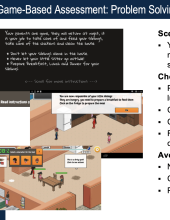
The acquisition and use of so-called “soft skills”, including problem solving, resilience, and self-regulation have been associated with better performance at school and in the workplace [1], [2]. Problem-solving is defined as the ability to acquire or use prior knowledge in order to solve new problems. Strengthening this skill is a concern to educators and employers as the 21st century labor market is increasingly unpredictable and requires skills that go beyond mastering and executing familiar processes. Students need to identify and solve problems that they have never encountered before, formulate a solution plan specific to that problem, and execute the plan. Thus far, the body of research that has measured these relationships relies on traditional self-reporting measurement questionnaires. This methodology is prone to bias since youth may respond in a way they know is desirable, rather than the way they actually behave [3]. Stealth assessment attempts to gather more authentic measurement of skills by asking children to demonstrate them in a structured environment where data collection is unobtrusive [4]. Digital games can be used for stealth assessment, with data on decisions and strategies collected in the application during game play. Since 2017, RTI has been developing games that target a range of soft skills by simulating real-world tasks in a virtual environment. The game designed to measure problem-solving skills gathers metrics on task completion, time management, accepting instruction, problem identification, solution identification, and self-regulation. This paper describes the multi-year process of development and testing of this game, the results obtained from pilots in the Philippines and Morocco, and the implications for strengthening problem-solving skills among youth worldwide. Cite this paper: Pouezevara, S., Powers, S. Strigel, C., McKnight, K. (2019). Assessing soft skills in youth through digital games. ICERI2019 Proceedings. 12th Annual International Conference on Education, Research and Innovation (ICERI), Seville, Spain. p. 3057-3066. https://doi.org/10.21125/iceri.2019.0774
Assoc. Photo (Port.)
Softskills_port.jpg
Resource Type
Resource Language
Month and Year

USA Country Report: Scaling Access and Impact - Realizing the Power of EdTech

Submitted by admin on
Description/Abstract
This series of reports was produced by Omidyar Network’s Education initiative, whose mission is to unlock human potential through learning by catalyzing people, ideas, and systems – so every individual thrives and contributes in a changing and interdependent world. The Omidyar Network team included Eliza Erikson, Erin Simmons, Rebecca Hankin, and Eshanthi Ranasinghe. The data underpinning this report come from interviews, surveys, site visits, and desk research by a team of researchers and EdTech practitioners led by RTI International, drawing on local expertise in each of the case study countries. The team conducted more than 100 interviews with teachers, school principals, education administrators, policymakers, and EdTech experts. This study sought to understand the conditions that have thus far enabled EdTech initiatives to scale in the USA. This case study involved interviewing and surveying more than 20 EdTech stakeholders in the US. These experts provided recommendations on which states or districts could serve as examples of effective EdTech scale-up (at the access, use, or impact level). Suggestions included Utah, California, Maine, Rhode Island, New York, North Carolina, and Florida. Two specific ‘deep dives’ are included in this report: the state of North Carolina and the Miami-Dade County public school district in the state of Florida. Both North Carolina and Florida have, in the past decade, aggressively transformed education and implemented policies and initiatives to improve education opportunities for all students with the help of EdTech.
Assoc. Photo (Port.)
USA scaling portrait.png
Resource (File)
Country
Resource Type
Resource Language
Month and Year
Publisher Or Client
Omidyar Network

China Country Report: Scaling Access and Impact - Realizing the Power of EdTech

Submitted by admin on
Description/Abstract
This series of reports was produced by Omidyar Network’s Education initiative, whose mission is to unlock human potential through learning by catalyzing people, ideas, and systems – so every individual thrives and contributes in a changing and interdependent world. The Omidyar Network team included Eliza Erikson, Erin Simmons, Rebecca Hankin, and Eshanthi Ranasinghe. The data underpinning this report come from interviews, surveys, site visits, and desk research by a team of researchers and EdTech practitioners led by RTI International, drawing on local expertise in each of the case study countries. The team conducted more than 100 interviews with teachers, school principals, education administrators, policymakers, and EdTech experts. This study sought to understand the conditions that have thus far enabled EdTech initiatives to scale in China. The study found that there is a multibillion dollar business opportunity for EdTech entrepreneurs that leverage widespread access to mobile internet and performance pressure generated by cultural values and government standards. Reaching rural and ethnic minority schools with equal access to high quality lessons through virtual teaching and blended models of instruction.
Assoc. Photo (Port.)
China scaling portrait.png
Resource (File)
Country
Resource Type
Resource Language
Month and Year
Publisher Or Client
Omidyar Network