Pouezevara, S.

Developing eResources for Early Literacy and Numeracy [Presentation]

Submitted by admin on
Description/Abstract
This presentation was delivered at the 2021 mEducation Alliance Symposium in a panel on the subject of education technologies for basic education in the Philippines.
Assoc. Photo (Port.)
philportrait_1.jpeg
Resource (File)
Country
Resource Type
Featured projects
Resource Language
Month and Year
Publisher Or Client
USAID

Language Complexity in the Philippines [CIES Presentation]

Submitted by admin on
Description/Abstract
Presentation delivered at CIES.This study attempts to determine whether or not the complexity of the L1 should be a factor in interpreting reading achievement in multilingual contexts, as well as in planning early grade reading teaching and learning materials and curricula in settings with complex languages.
Assoc. Photo (Port.)
sarah CIES presentation_0.png
Resource (File)
Country
Resource Type
Featured projects
Resource Language
Month and Year

School-based technology and the shift to remote learning during COVID-19: Exploring remote learning readiness of school districts in the Philippines

Submitted by admin on
Description/Abstract
This research dives into the results of a 2019 survey of district ICT coordinators, school ICT coordinators and teachers in the Philippines, which collected information on the use of ICT in schools before the pandemic and school closures. The authors ask the questions: “How might the investment in school-based technology have prepared teachers to transition to various forms of remote, home-based teaching and learning?”, and “If experience with ICT in schools is assumed to be an asset in transitioning to remote learning, how many school districts in the Philippines were well-positioned when COVID-19 school closures hit.” Grounded in literature on remote learning readiness, the study authors selected questions from the original survey that could be considered assets in the rapid pivot to remote learning (e.g., skills, resources, policies, and plans).
Assoc. Photo (Port.)
ICT study portrait.png
Resource (File)
Country
Resource Type
Featured projects
Resource Language
Month and Year

Reading achievement in the Philippines: The role of language complexity

Submitted by admin on
Description/Abstract
This study looks at the impact of first language (L1, or “mother tongue”) complexity on reading achievement in the Philippines using Grade 3 Early Grade Reading Assessment (EGRA) data collected in 2013 and 2019. EGRA data were collected from 232 schools in 2013, when students learned to read in the national languages of Filipino and English. These data on English and Filipino performance were collected again in the same schools in 2019, when students would have, according to policy, learned to read first in their mother tongue.
Assoc. Photo (Port.)
Language Complexity Port.png
Resource (File)
Country
Resource Type
Featured projects
Resource Language
Month and Year
Publisher Or Client
USAID

Measuring Early Reading Achievement in the Philippines: How Data Can Support Policy-Making? (2019 National EGRA results)

Submitted by admin on
Description/Abstract
This presentation describes results from the 2019 National EGRA study, comparing it to the same study that was done in 2013. It was presented at the International Mother Languages Conference and Festival, organized in the Philippines in 2021.
Assoc. Photo (Port.)
findings.PNG
Resource (File)
Country
Resource Type
Featured projects
Resource Language
Month and Year
Publisher Or Client
USAID

2019 National Early Grade Reading Assessment (EGRA): English and Filipino, Grade 3 [Brief]

Submitted by admin on
Description/Abstract
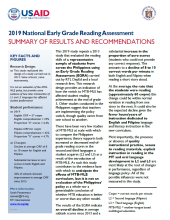
An overview of the results of a nationally-representative Early Grade Reading Study conducted in 2019 in the Philippines. The full report is available.
Assoc. Photo (Port.)
egra brief port.PNG
Resource (File)
Country
Resource Type
Month and Year
Publisher Or Client
USAID

2019 National Early Grade Reading Assessment (EGRA): English and Filipino, Grade 3 Findings Report

Submitted by admin on
Description/Abstract
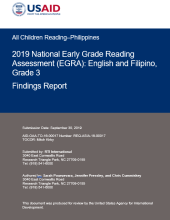
This study explores the extent to which mother-tongue-based multilingual education (MTB-MLE), as implemented at scale in the Philippines, is having an impact on students’ reading and writing skills in English and Filipino at the end of Grade 3. This 2019 study repeats a 2013 study that evaluated the reading skills of a representative sample of students from across the Philippines using an Early Grade Reading Assessment (EGRA) carried out by RTI, the Philippines Department of Education (DepEd), and a local research firm. In both cases, the study was administered by RTI-trained assessors made up of local education authorities and professional survey researchers. For the 2013 study, the Grade 3 students assessed had completed lower primary under the pre-MTB-MLE curriculum, which used only English and Filipino as the medium of instruction. For this 2019 study, the Grade 3 students had 3 years of learning under the MTB-MLE curriculum, which was designed to teach lower primary students in their mother-tongue language before transitioning into learning in Filipino and English as mediums of instruction in upper primary. [508 Compliant version to be updated].
Assoc. Photo (Port.)
National EGRA_0.png
Resource (File)
Country
Resource Type
Featured projects
Month and Year
Publisher Or Client
USAID

eResources Review Toolkit

Submitted by admin on
Description/Abstract
This toolkit was developed for the All Children Reading Philippines project to support Department of Education staff in developing and reviewing electronic resources for the DepEd Commons (online OER repository).
Assoc. Photo (Port.)
err_toolkit.JPG
Resource (File)
Country
Resource Type
Month and Year
Publisher Or Client
USAID

Mobile Learning and Numeracy: Filling gaps and expanding opportunities for early grade learning [Arabic]

Submitted by admin on
Description/Abstract
The present study on Mobile Learning and Numeracy examines how mobile learning (m-learning) could influence and improve numeracy education at early grade levels (ages 4-10) especially in low-income countries. Key questions to guide the research include: 1) What are the benefits and challenges of integrating mobile learning into early grade numeracy education? 2) What is the role of a teacher with regard to mobile learning and numeracy education? 3) How can the community and the parents actively contribute to/participate in the child’s numeracy education with the use of mobile devices? and 4) How can mobile technology be used effectively in measuring/assessing numeracy gains? The conclusions and recommendations of this study have been informed by an international working group that met over two days during the first International Numeracy Conference in Berlin in December 2012. We would like to acknowledge the following participants of this working group for their thoughtful contributions: Michaela Brinkhaus (BMZ); Dorothea Coppard (GIZ); Melanie Stilz (Konnektiv Büro für Bildung und Entwicklung); Jens von Roda-Pulkowski (KfW); Abigail Bucuvalas (Sesame Workshop); Mr. Kann Puthy (Primary Education Department, MoEYS Cambodia); Edward Barnett (DFID).
Assoc. Photo (Port.)
Screen Shot 2020-06-24 at 5.41.40 PM.png
Country
Resource Type
Resource Language
Month and Year
Publisher Or Client
GTZ

Early Childhood Services for Young Refugee Children: Cross-Country Analysis

Submitted by admin on
Description/Abstract
This report presents a cross-country analysis of three qualitative case studies completed in Jordan, Uganda, and Bangladesh in late 2019. It reflects a snapshot of information about the refugee experience of early childhood services, based on interviews, focus group discussions, site visits and policy document review. The crosscountry analysis investigates individual and group stories and experiences to synthesize common themes with the goal of identifying recommendations to improve the provision of early childhood services for young refugee children and their families.
Assoc. Photo (Port.)
Crosscase cover.PNG
Resource (File)
Resource Type
Resource Language
Month and Year
Publisher Or Client
Moving Minds Alliance