Global

One Page Brief on Executive Functioning (EF) Touch

Submitted by admin on
Description/Abstract
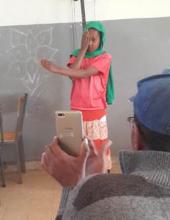
EF Touch is a tablet-administered assessment designed to measure children’s three key executive function skills: working memory, inhibitory control, and cognitive flexibility. These functions are important for organizing information, planning, solving problems, sustaining attention, and coordinating action and thoughts in support of goal-directed behaviors. Consequently, these functions are integral to children’s ability to learn how to learn. Most of what we know about executive functions has been gathered from studies in high-income countries. However, EF Touch is now being adapted and tested with young children living in LMICs, including Kenya and Liberia.
Assoc. Photo (Port.)
EF Touch.jpg
Country
Sub-topic
Resource Type
Month and Year

One Page Brief on Group-Administered Literacy Assessment (GALA)

Submitted by admin on
Description/Abstract
GALA is an assessment tool for measuring early literacy skills in a group setting. It consists of two main components: student booklets with multiple choice questions and a tool providing assessors with a complete protocol for test administration.

Assoc. Photo (Port.)
GALA.jpg
Country
Resource Type
Month and Year

One Page Brief on Tangerine:Class

Submitted by admin on
Description/Abstract
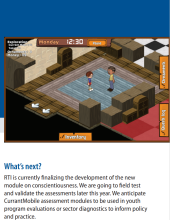
Tangerine:Class is easy-to-use software that assists teachers to systematically collect, analyze, and use students’ results from continuous curriculum-based assessments to inform instructional decisions on grouping, pacing, and materials use. It is optimized for Android devices and offline use.
Assoc. Photo (Port.)
Tangerine.jpg
Country
Resource Type
Month and Year

One-page Brief on Electronic Vision and Hearing Screening Applications

Submitted by admin on
Author
Description/Abstract
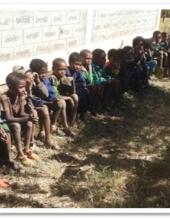
Peek Acuity and hearScreen® are mobile, electronic screening tools that provide data on vision and hearing impairments. The tools were designed to be administered in schools and classrooms so that teachers and schools can better accommodate visually- or hearing-impaired students to increase their opportunities of succeeding in school.
Assoc. Photo (Port.)
Vision_ethiopia.jpg
Country
Resource Type
Month and Year

Carmen Strigel Presentation on RTI Screening Technology Experiences

Submitted by admin on
Author
Description/Abstract
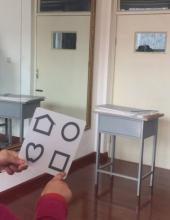
Presentation by Carmen Strigel, Director, Technology for Education and Training, RTI International. Delivered at the RTI Panel Discussion "Vision and Hearing Screening in LMICs: Challenges and Opportunities" held Wed, September 26, 2018 in Washington, D.C. For related resources, see also the topic "Assessments" using the "by Topic" link in the menu above.
Assoc. Photo (Port.)
Tangerine photo.jpg
Country
Resource Type
Month and Year
Publisher Or Client
RTI International

Kristen Layton Presentation on Eye Health Initiatives

Submitted by admin on
Author
Description/Abstract
Presentation by Kristen Layton, Director, Strategy, Innovation and Learning Unit, Perkins International. Delivered at the RTI Panel Discussion "Vision and Hearing Screening in LMICs: Challenges and Opportunities" held Wed, September 26, 2018 in Washington, D.C. For related resources, see also the topic "Assessments" using the "by Topic" link in the menu above.

Assoc. Photo (Port.)
Kristen.jpg
Resource (File)
Country
Sub-topic
Resource Type
Month and Year

Early Mathematics Counts: Promising Instructional Strategies for Low- and Middle- Income Countries

Submitted by admin on
Description/Abstract
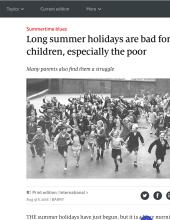
There is a large body of evidence substantiating the importance of mathematical literacy and the key role of foundational mathematics in early years of education on later academic outcomes (Duncan et al., 2007; Duncan & Magnuson, 2011; Hanushek & Woessmann, 2008; Siegler et al., 2012). Despite this, we have little evidence from low- and middle-income countries on how to better ensure that students are learning the foundational skills in pre-primary through lower primary grades. Given that quality of instruction is key, we examined the evidence for the types of instructional strategies used in low- and middleincome contexts. We cannot link the effective instructional strategies to learning outcomes, given the limited information provided in reports we reviewed. However, understanding which strategies are used, and how they manifest in different contexts, is an important first step to understanding which strategies are effective for learning. This brief summarizes our review paper (Sitabkhan & Platas, 2018).
Assoc. Photo (Port.)
EarlyMathBrief_071818.jpg
Resource (File)
EarlyMathBrief_071818.pdf
Country
Resource Type
Resource Language
Month and Year
Publisher Or Client
RTI

Long summer holidays are bad for children, especially the poor [The Economist]

Submitted by admin on
Author
Description/Abstract
This article in The Economist cites RTI researcher Benjamin Piper, and an article he co-authored with RTI colleague Timothy Slade on summer learning loss in Malawi. "Benjamin Piper, of RTI International, an American research institute, suspects that the scale of summer learning loss may be worse in the developing world, where it has largely gone unnoticed and unstudied. In rural areas in particular, reading material can be hard to come by and some children still spend their holidays helping their families in the fields. A study Mr Piper co-authored in 2017, on Malawian children taking part in an American-funded literacy programme, may be the only one on summer learning loss in sub-Saharan Africa. It found that the loss was almost as big as the gains the literacy programme generated during the school year. Mr Piper says that international donors, who spent $1.4bn on basic education aid in Africa in 2015, risk “losing what they invested”."

Assoc. Photo (Port.)
economist.jpg
Country
Resource Language
Month and Year
Publisher Or Client
The Economist

Early Mathematics Counts: Promising Instructional Strategies for Low- and Middle- Income Countries

Submitted by admin on
Description/Abstract
This paper examines common instructional strategies in early grade mathematics interventions through a review of studies in classrooms in low- and middle-income countries. Twenty-four studies met the criteria for inclusion, and analyses reveal four sets of instructional strategies for which there is evidence from multiple contexts. Of the 24 studies, 16 involved the use of multiple representations, 10 involved the use of developmental progressions, 6 included supporting student use of explanation and justification, and 5 included integration of informal mathematics. Based on the review, we provide conclusions and recommendations for future research and policy.
Assoc. Photo (Port.)
Picture1.png
Resource (File)
Sitabkhan_Platas_2018.pdf
Country
Resource Type
Resource Language
Month and Year
Publisher Or Client
RTI Press