In the News and Impact Stories

Jordan Early Grade Assessment Framework The Early Grade Reading and Math Initiative (RAMP)

Submitted by admin on
Author
Description/Abstract
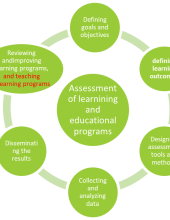
In 2021, Jordan’s Ministry of Education (MOE) is committed to modernizing education assessment and enhancing learning outcomes. The Early Grades Reading and Mathematics Initiative (RAMP) played a crucial role in conceptualizing the early grade assessment framework. The MOE recognized the need for a more effective and cohesive assessment system. it highlights the issues of misalignment and lack of coordination between national and international assessments, resulting in an inability to accurately measure student performance across different grades. It emphasizes the need for a comprehensive assessment system and policies to ensure consistency and monitor the quality of education in MOE's schools. As part of the RAMP sustainability plan, a comprehensive framework for early-grade assessment was developed to incorporate the latest trends in student learning assessment and enhance educational outcomes. The Directorate of Tests, in collaboration with RAMP experts, conducted an analysis of the current early-grade assessment system, identifying areas requiring improvement. A joint Ministry and RAMP team, in consultation with international evaluation experts from the RTI organization, created the framework and provided recommendations to address existing gaps. Subsequently, this framework was shared with MOE's technical departments and the National Curriculum Development Center for final approval. The Early Grades Assessment Framework has significantly benefited the MOE at both the central and field levels, including schools and field districts, by: 1. Defining and communicating clear learning expectations at all levels, including learning standards and indicators. 2. Preventing excessive evaluation practices. 3. Offering capacity-building programs for supervisors and teachers related to formative and summative assessments. 4. Utilizing assessment data to enhance student learning and promote inclusive teaching and learning for all children. 5. Formulating regulations and procedural guidelines for national assessments in early grades, thereby ensuring their sustainability and securing financial resources for implementation. The MOE introduced a structured assessment process, incorporating the Early Grade Reading Assessment (EGRA/EGMA) and the Lot Quality Assurance Sampling (LQAS) methodology to gauge students' foundational knowledge and skills. This approach helped identify areas where students needed additional support. Extending foundational learning assessment to the classroom level allowed for tailored support to students in need, fostering inclusivity. The revamped assessment approach brought about positive changes. LQAS results informed support strategies for districts, individual schools, and teachers. Classroom-level assessments allowed differentiated support to students. The Ministry of Education's (MOE) commitment to aligning the assessment framework with expected learning outcomes has yielded positive results and has paved the way for further improvements in Jordan's education system. As evidence of this commitment, the results of the EGRA/EGMA end-line survey conducted in May 2023 demonstrate significant improvements in the reading and mathematics skills of Grade 2 (G2) and Grade 3 (G3) students compared to 2019 and 2021. For example, G2 students in traditional MoE schools have shown remarkable progress, with their reading proficiency increasing from 10.7% in 2021 to 42.4%, while G3 students improved from 39.4% to 60.3%. The MOE's unwavering commitment to aligning assessment with learning outcomes has yielded tangible, positive results. As Jordan continues its journey towards educational excellence, the comprehensive assessment framework for early grades stands as a testament to the dedication and innovation of the MOE and its partners. By placing learning outcomes at the forefront, Jordan is not just shaping a brighter future for its students but also setting a remarkable example for education systems worldwide. Stay tuned for more updates as Jordan's education transformation unfolds. The future looks promising, indeed.
Assoc. Photo (Port.)
Picture1.png
Resource (File)
Country
Featured projects
Resource Language
Month and Year
Publisher Or Client
USAID and UKaid

Learning Continuity Innovations

Submitted by admin on
Description/Abstract
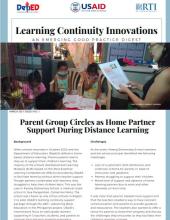
Learning Community Innovations, an Emerging Good Practice Digest. March 2021 Digest No. 1. Includes parent engagement successes.
Assoc. Photo (Port.)
learning cont abc.jpg
Resource (File)
Country
Month and Year
Publisher Or Client
USAID/Philippines, Philippines Department of Education

Is It Possible to Improve Learning at Scale? Reflections on the Process of Identifying Large-Scale Successful Education Interventions

Submitted by admin on
Description/Abstract
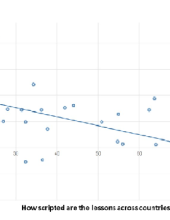
Improving learning outcomes at scale is hard. That may seem obvious, but only recently have policymakers and donors become aware of just how dire—and broad—the learning crisis is. Most of their efforts to improve learning have been pilot programs, and although in some cases it has been possible to improve outcomes at this small scale, it is an entirely different challenge at scale, which can involve thousands of schools—the level at which change must happen to fix the crisis.
Assoc. Photo (Port.)
scale.png
Country
Month and Year

Guiding Teachers Rather than Scripting Them

Submitted by admin on
Description/Abstract
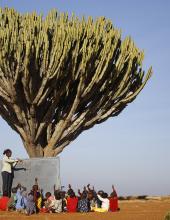
It is difficult to imagine an effective teacher who does not have mastery of the content nor command of the pedagogical skills needed to teach literacy. Yet many teachers, particularly in low- and middle-income countries, lack these very skills. In those same countries, students exit school without the essential capabilities they need. How can we help teachers to teach more effectively?
Assoc. Photo (Port.)
scripted.png
Country
Resource Language
Month and Year

Successes from Tayari ECD Program in Kenya

Submitted by admin on
Author
Description/Abstract
‘Tayari’, a Swahili word meaning ‘ready’, aims to increase the proportion of pre-primary children transiting to primary school with requisite school readiness competencies. The expected result of the Tayari pilot program is improved learning outcomes. The program impacts approximately 130,000 children in 2,200 early childhood centers in Kenya within four selected counties, namely: Uasin Gishu, Laikipia, Nairobi and Siaya. Tayari implemented the pilot program over four years by working with government officers to strengthen the existing pre-primary system. This compilation of Tayari success stories has been documented by the staff who implemented the program implementing staff. The success stories demonstrate the impact the program has had on its beneficiaries and highlights their experiences. It contains stories from teachers (who are the real classroom implementers), coaches and Sub-County Early Childhood Development and Education officers that have seen how Tayari has positively influenced teachers, learners and the larger community.
Assoc. Photo (Port.)
Laikipia (76).JPG
Resource (File)
Tayari Success stories.pdf
Country
Resource Language
Month and Year

Long summer holidays are bad for children, especially the poor [The Economist]

Submitted by admin on
Author
Description/Abstract
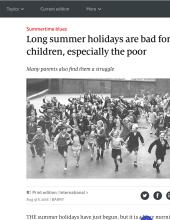
This article in The Economist cites RTI researcher Benjamin Piper, and an article he co-authored with RTI colleague Timothy Slade on summer learning loss in Malawi. "Benjamin Piper, of RTI International, an American research institute, suspects that the scale of summer learning loss may be worse in the developing world, where it has largely gone unnoticed and unstudied. In rural areas in particular, reading material can be hard to come by and some children still spend their holidays helping their families in the fields. A study Mr Piper co-authored in 2017, on Malawian children taking part in an American-funded literacy programme, may be the only one on summer learning loss in sub-Saharan Africa. It found that the loss was almost as big as the gains the literacy programme generated during the school year. Mr Piper says that international donors, who spent $1.4bn on basic education aid in Africa in 2015, risk “losing what they invested”."

Assoc. Photo (Port.)
economist.jpg
Country
Resource Language
Month and Year
Publisher Or Client
The Economist

Principles for Digital Development - Tangerine: Mobile Assessments Made Easy

Submitted by admin on
Author
Description/Abstract
This case study was selected by the Digital Principles for Development as a model illustrating the principles of "design with the user in mind" and "be data driven".
Assoc. Photo (Port.)
prin.png
Country
Resource Language
Month and Year
Publisher Or Client
Principles for Digital Development

Significant improvements recorded in early grade students' performance

Submitted by admin on
Description/Abstract
The following article from the Jordan Times describes positive results of the USAID and DFID co-funded RAMP program implemented by RTI in Jordan.

Assoc. Photo (Port.)
0259A036-78E0-4E43-81B9-25C59B894998.jpeg
Country
Featured projects
Resource Language
Month and Year
Publisher Or Client
Jordan Times

Protection of children from all forms of violence including corporal punishment [Ministry circular]

Submitted by admin on
Description/Abstract
This circular from the Uganda Ministry of Education and Sports (MoES) describes a new mandatory requirement under the "National Strategy and Action Plan on Violence Against Children in Schools (VACiS), the Reporting, Tracking, Referral and Response (RTRR) Guidelines on Violence Against Children in Schools, and the Alternative to Corporal Punishment Guidelines" to use the Journey's handbooks developed by RTI under the USAID/LARA program in primary schools. The circular makes recommendations for including a range of education sector stakeholders in ensuring sufficient time spent using the materials.
Assoc. Photo (Port.)
Screen Shot 2018-01-05 at 5.11.38 PM.png
Resource (File)
Country
Resource Language
Month and Year
Publisher Or Client
Ministry of Education and Sports Embassy House

RTI International wins 2018 Digital Edge 50 award for education tool

Submitted by admin on
Description/Abstract
RTI International has been honored with a 2018 Digital Edge 50 Award for being a leader in digital innovation. The prestigious award recognizes a new open-source tool recently developed by RTI to measure executive function (EF) skills in pre-school aged children The tool, EF Touch, is administered using Tangerine®, RTI’s open source software that was designed to transform the way teachers, coaches and researchers assess and observe literacy and numeracy teaching and learning.
Assoc. Photo (Port.)
tangerine_use_of_the_tablets_510.jpg
Country
Resource Language
Month and Year