Liberia

Country Code
LBR

Improving children's reading in Liberia: results from the NORC impact evaluation of the Read Liberia Activity

Submitted by admin on
Description/Abstract
This brief highlights data from Read Liberia's external impact evaluation conducted by NORC
Assoc. Photo (Port.)
improving reading.png
Resource (File)
Country
Resource Type
Featured projects
Resource Language
Month and Year

Increasing caregiver and community support for early grade reading: results from Read Liberia

Submitted by admin on
Description/Abstract
Read this brief to learn more about Read Liberia's community engagement component and the data from its evaluation.

Assoc. Photo (Port.)
Increasing Caregiver.png
Country
Resource Type
Featured projects
Resource Language
Month and Year

Supporting children to learn during forced school closures: Lessons from Read Liberia

Submitted by admin on
Description/Abstract
In Liberia, as elsewhere around the world, recent school closures disrupted learning for all students. The effects of the COVID-19 pandemic have exacerbated pre-existing education inequality, especially disadvantaging girls, students with disabilities, people living in extreme poverty, and other marginalized groups. For Read Liberia’s technical team, the recent pandemic was a catalyst for innovation. The project quickly adapted to a new virtual implementation model to continue trainings, community engagement, and teacher instructional coaching. Read this brief to learn more about what the Activity did to ensure Liberia's students continued to learn during the pandemic.
Assoc. Photo (Port.)
support children 1.jpeg
Country
Resource Type
Resource Language
Month and Year

Developing and publishing early grade teaching and learning materials: lessons from Read Liberia

Submitted by admin on
Description/Abstract
This briefer provides ten lessons learned from developing, printing and distributing teaching and learning materials for the early grades in Liberia
Assoc. Photo (Port.)
TLMs.PNG
Country
Resource Type
Featured projects
Month and Year

Mobile money: A new way to compensate teachers in Liberia

Submitted by admin on
Description/Abstract
In 2019, Read Liberia transitioned to the use of mobile money to remit per diem payments to teachers upon completion of twice-yearly trainings. Mobile money had a significant impact on Read Liberia's operations, training continuity, and its teachers. Read this brief to find out how.
Assoc. Photo (Port.)
Mobile Money.png
Country
Resource Type
Featured projects
Resource Language
Month and Year

Using non-monetary incentives to motivate schools and teachers: innovation from Read Liberia

Submitted by admin on
Description/Abstract
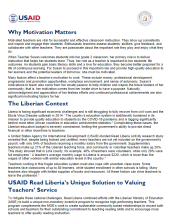
Motivated teachers are vital for successful and effective classroom instruction. They show up consistently and inspire and engage their students. Enthusiastic teachers assess students’ abilities, give feedback, and collaborate with other teachers. They are passionate about the important role they play and enjoy what they do. Many factors affect a teacher’s motivation to work. Read this brief to find out what Read Liberia learned about motivating and inspiring teachers.
Assoc. Photo (Port.)
non-monetary incentives.png
Country
Resource Type
Featured projects
Resource Language
Month and Year

A Monitoring, Evaluation, and Learning (MEL) Framework for Technology-Supported Remote Trainings [CIES Presentation]

Submitted by admin on
Description/Abstract
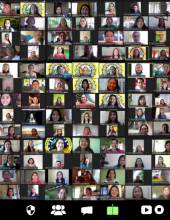
Existing research on the uptake of technologies for adult learning in the global South is often focused on the use of technology to reinforce in-person learning activities and too often involves an oversimplified “with or without” comparison (Gaible and Burns 2005, Slade et al. 2018). This MEL Framework for Technology-Supported Remote Training (MEL-Tech Framework) features a more nuanced perspective by introducing questions and indicators that look at whether the technology-supported training was designed based on a solid theory of learning; whether the technology was piloted; whether there was time allocated to fix bugs and improve functionality and user design; how much time was spent using the technology; and whether in-built features of the technology provided user feedback and metrics for evaluation. The framework presents minimum standards for the evaluation of technology-supported remote training, which, in turn, facilitates the development of an actionable evidence base for replication and scale-up. Rather than “just another theoretical framework” developed from a purely academic angle, or a framework stemming from a one-off training effort, this framework is based on guiding questions and proposed indicators that have been carefully investigated, tested, and used in five RTI monitoring and research efforts across the global South: Kyrgyz Republic, Liberia, Malawi, the Philippines, and Uganda (Pouezevara et al. 2021). Furthermore, the framework has been reviewed for clarity, practicality, and relevance by RTI experts on teacher professional development, policy systems and governance, MEL, and information and communications technology, and by several RTI project teams across Africa and Asia. RTI drew on several conceptual frameworks and theories of adult learning in the design of this framework. First, the underpinning theory of change for teacher learning was informed by the theory of planned behavior (Ajzen 1991), Guskey’s (2002) perspective on teacher change, and Clarke and Hollingsworth’s (2002) interconnected model of professional growth. Second, Kirkpatrick’s (2021) model for training evaluation helped determine many of the categories and domains of evaluation. However, this framework not only has guiding questions and indicators helpful for evaluating one-off training events focusing on participants’ reactions, learning, behavior, and results (as is the focus in Kirkpatrick’s model) but also includes guiding questions and indicators reflective of a “fit for purpose” investigation stage, a user needs assessment and testing stage, and long-term sustainability. Furthermore, this framework’s guiding questions and indicators consider participants’ attitudes and self-efficacy (based on the research underpinning the theory of planned behavior), as well as aspects of participants’ post-training, ongoing application and experimentation, and feedback (Clarke and Hollingsworth; Darling-Hammond et al. 2017; Guskey). Lastly, the framework integrates instructional design considerations regarding content, interaction, and participant feedback that are uniquely afforded by technology.
Assoc. Photo (Port.)
Photo credit- ABC+ Philippines_1.png
Resource (File)
Resource Type
Resource Language
Month and Year
Publisher Or Client
RTI International

MEL-Tech Case Studies: Lessons Learned from Technology-Supported Remote Trainings in Five Countries During the Pandemic

Submitted by admin on
Description/Abstract
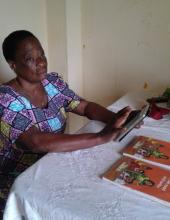
This report presents case studies of five remote training activities conducted by USAID-funded and RTI-implemented programs: the Advancing Basic Education Project (ABC+) in the Philippines, the Malawi Early Grade Reading Improvement Activity (MERIT), Read Liberia, Okuu Keremet! in the Kyrgyz Republic, and the Uganda Literacy Achievement and Retention Activity (LARA). The case studies seek to apply a more process-based and learning-oriented approach, drawing from the MEL-Tech Framework, to understand technology-supported remote teacher training introduced in response to COVID-19.
Assoc. Photo (Port.)
photo credit- Uganda SHRP_4.JPG
Resource (File)
Resource Type
Featured projects
Resource Language
Month and Year
Publisher Or Client
RTI International

MEL Framework for Technology Supported Remote Teacher Training

Submitted by admin on
Description/Abstract
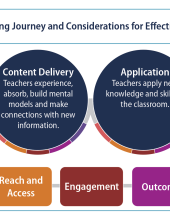
This MEL Framework for Technology-Supported Remote Training seeks to help education program implementers, governments, and program evaluators more effectively design, implement, and learn lessons from remote training activities. It places special consideration on the unique characteristics of technology-supported interventions in the global South. The framework presents minimum standards for the evaluation of technology-supported remote training, which, in turn, facilitates the development of an actionable evidence base for replication and scale-up. Rather than “just another theoretical framework” developed from a purely academic angle, or a framework stemming from a one-off training effort, this framework is based on guiding questions and proposed indicators that have been carefully investigated, tested, and used in five RTI monitoring and research efforts across the global South: Kyrgyz Republic, Liberia, Malawi, the Philippines, and Uganda (Pouezevara et al. 2021). Furthermore, the framework has been reviewed for clarity, practicality, and relevance by several RTI project teams across Africa and Asia.
Assoc. Photo (Port.)
Teacher Learning Journey - graphic_0.png
Resource (File)
MEL_Framework_FINAL.pdf
Resource Type
Resource Language
Month and Year
Publisher Or Client
RTI International

Read Liberia Activity: Teacher Instruction Guide-Grade 2, Volume 2

Submitted by admin on