Early Grade Reading Assessment (EGRA)

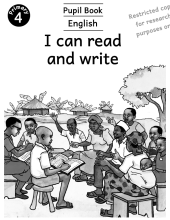
Pupil Book: English I can read and write, Primary 4

Submitted by admin on
Description/Abstract
The primary 4 English lessons are structured around a genre that is explored in reading and writing activities. Activities are provided for word study, vocabulary, grammar, oral language, and the writing process. Transition lessons are a distinct section to support learning academic language. They use informational text structure, glossaries, graphics and bold terms which will be helpful when engaging with textbooks in other subjects.
Assoc. Photo (Port.)
SHRP book.png
Resource (File)
Country
Resource Language
Month and Year
Publisher Or Client
USAID

ACR-Asia: Research Report: Investing in Early Grade Reading in Lower and Middle-income Countries in Asia

Submitted by admin on
Description/Abstract
USAID/Washington, via the All Children Reading (ACR)—Asia task order, commissioned RTI International to conduct research on whether lower and middle-income countries in Asia should invest in early grade reading. To do so, we consider the relationship between increased literacy and employment and social outcomes. We also investigate evolving job opportunities in developing Asian economies, their literacy requirements, and the relationship of Asian growth to the US economy. We then examine data on the current literacy levels among school-going and young-adult populations in Asian countries to see if they meet the needs revealed by job market trends in Asia. The analyses presented in this report show conclusively that it continues to be important for lower and middle income countries in Asia to invest in improving the teaching and learning of literacy skills in early grades. Emphasis should be placed not only on foundational skills, but also on applied skills, such as reading for comprehension across subject areas and applying information gleaned through reading various types of text to understand and solve increasingly complex problems. Education systems therefore must address the full continuum of reading skills development, beginning in the early years and throughout primary school.
Assoc. Photo (Port.)
asia.png
Resource (File)
Country
Resource Type
Featured projects
Resource Language
Month and Year

All Children Reading-Asia: EGRA Benchmarks and Standards Research Report

Submitted by admin on
Description/Abstract
The Early Grade Reading Assessment (EGRA) is widely used to assess reading proficiency in developing countries. Benchmarks were introduced to simplify EGRA results into a single indicator against which countries could measure their children’s reading progress. This report is about the process, rational and considerations for setting benchmarks (a desired level of performance on a reading task) and targets (the percent of students intended to reach the performance level). The report addresses three purposes of benchmarking: 1. Country purpose: Track progress in reading within a national education system and provide data to inform efforts to improve education quality. 2. Agency purpose: Help USAID monitor the progress of projects and countries working to reach specific children-reading goals. 3. The global purpose: Measure progress in reading for all; provide a basis for global advocacy; and provide
Assoc. Photo (Port.)
ACR benchmarks portrait.jpeg
Country
Resource Type
Featured projects
Resource Language
Month and Year

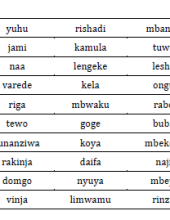
2017 Tanzania National EGRA, EGMA, SSME, and Life Skills Instruments

Submitted by admin on
Description/Abstract
Final, validated instruments used in the 2017 Tanzania National EGRA. The EGRA and SSME were made possible with funding from USAID. The EGMA component was made possible by funding from Global Affairs Canada. The Life Skills component was funded by UNICEF Tanzania.
Assoc. Photo (Port.)
tz egra.png
Resource (File)
Resource Language
Month and Year
Publisher Or Client
USAID, Global Affairs Canada,

Malawi MERIT SD2 Teachers Guide, Chichewa

Submitted by admin on
Description/Abstract
Teachers Guide for Standard 2
Assoc. Photo (Port.)
ST2 teachers guide.png
Resource (File)
Country
Resource Language
Month and Year
Publisher Or Client
USAID

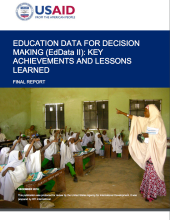
Education Data for Decision Making(EdDataII): Key Achievements and Lessons Learned

Submitted by admin on
Description/Abstract
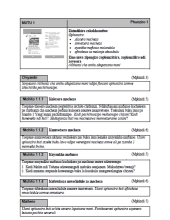
USAID's Education Data for Decision Making (EdData II) was implemented over a 12 year period beginning in 2004. EdData II had at its core the goal of improving access to data for USAID Missions and host country ministries, to use for making informed policy decisions. The tools and research developed under EdData II whelped to inform the development of learning metrics under the Sustainable Development Goals (2015); provide evidence to support the design and monitor the implementation of USAID's 2011-2017 Education strategy, and provide actionable, high-quality data to inform policy and practice in around 35 countries. The report reflects on EdData II and the project's impact, providing a summary of the most salient and impactful project activities, and drawing key lessons from their development and implementation.
Assoc. Photo (Port.)
core report.png
Resource (File)
Country
Resource Type
Month and Year
Publisher Or Client
USAID

USAID/Uganda School Health and Reading Program Early Grade Reading Assessment Results: Cluster 1, End of Primary 4

Submitted by admin on
Description/Abstract
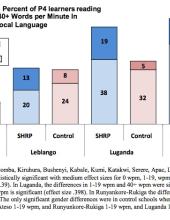
The USAID/Uganda School Health and Reading Program is a large scale, systemic reform effort to increase reading and provide health information in primary schools. This is one of the first Early Grade Reading Studies in Africa to combine rigorous research methods with a large scale reform working through Ministry of Education Systems. This briefer highlights the findings from a Randomized Control Trial/Early Grade Reading Assessment for the first 4 languages (of 12 total program local languages and English) to start the program in Primary 1 in 2013: Ateso, Leblango, Luganda, and Runyunkore-Rukiga. Findings: At the end of Primary 4, learners are between 1.5 and 6 times more likely to be reading 40 or more words per minute in the local language in program schools compared to control schools (all statistically significant differences with effect sizes ranging from 0.39 to 0.75). Program learners were also significantly more likely to be reading 60 or more words per minute in English in 3 of the 4 languages.
Assoc. Photo (Port.)
uganda image.jpg
Resource (File)
Country
Resource Type
Resource Language
Month and Year
Publisher Or Client
United States Agency for International Development

Tusome External Evaluation Midline Report

Submitted by admin on
Description/Abstract
Management Systems International (MSI) led the Tusome baseline study using multiple data collection methods, including an early grade reading assessment (EGRA); surveys of pupils, teachers, head teachers, curriculum support officers (CSO) and households; and classroom observation. The EGRA assessment tool was developed during the baseline and includes eight subtasks in English and six subtasks in Kiswahili. The midline included developing additional data collection tools, revising the baseline surveys, recruiting and training supervisors and enumerators, administering the tool and surveys in the same sample schools as the baseline, ensuring quality control, establishing the reliability of the assessment tool and analyzing the data. For the midline, the evaluation team assessed pupils from the same 204 schools sampled for the baseline. Through discussions with USAID, MOE and RTI, the evaluation team created the sampling frameworks and set up the design for a national sample in 2015. Using a three-stage cluster sampling procedure from a sampling frame of 22,154 formal public schools and 1,000 non-formal (or Alternative Provision of Basic Education and Training – APBET) schools, the evaluation team drew a clustered, random sample, resulting in a target of 4,896 total pupils comprising 2,448 boys and 2,448 girls divided equally between Class 1 and Class 2. The evaluation team reached the following conclusions: • The Tusome approach is having a strong, positive influence on reading outcomes, with relationships between project implementation and reading outcomes. • Reading outcomes for Class 1 and 2 pupils greatly improved during the one-year period between the baseline and midline evaluations. While impressive gains have been made, continuing with the Tusome approach will be critical to sustaining or improving on those gains. The Tusome project has achieved a high level of national implementation of the activities at each level of the education system. Given that project activities such as CSO observations, in-service training and access to materials are associated with higher ORF scores, the high level of implementation across all schools appears to be a key part of its success. The effect sizes seen during the PRIMR pilot have been at least sustained, and in most cases strengthened, in the national scale-up of Tusome. • The evaluation methodology and implementation resulted in valid, reliable data for the midline evaluation, including the changes from baseline to midline.

Assoc. Photo (Port.)
tusome midline.jpg
Country
Resource Type
Featured projects
Resource Language
Month and Year
Publisher Or Client
USAID

Ghana 2015 EGRA and EGMA: Report of Findings

Submitted by admin on
Description/Abstract
The National Education Assessment Unit (NEAU) of the Ghana Education Service (GES) conducted a national Early Grade Reading Assessment (EGRA) and Early Grade Mathematics Assessment (EGMA) in July 2015. This was the second administration of EGRA and EGMA in Ghana; the first took place in 2013, and both were conducted as part of the USAID Partnership for Education: Testing activity. This report describes the findings.
Assoc. Photo (Port.)
Resource (File)
Country
Resource Type
Resource Language
Month and Year
Publisher Or Client
USAID

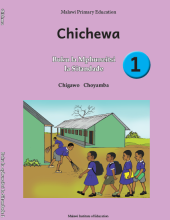
Malawi National Reading Programme Training Manual for Chichewa Standard 1

Submitted by admin on
Description/Abstract
The government of Malawi, through the MoEST, with support from the United States Agency for International Development (USAID) and the Department for International Development (DFID) is implementing a National Reading Program (NRP). This reading program aims at improving early grade learners’ literacy skills. Central to achieving this goal is building teachers’ capacity to teach foundational reading skills that are key for successful reading and comprehension abilities needed for learning content across the curriculum. The NRP introduces teachers to effective reading instruction through the five essential components of Phonological Awareness, alphabetic principle, vocabulary, fluency and comprehension. In addition, the NRP also includes oral language, development and writing as part of the reading instruction. This training manual contains: • A daily schedule, including training objectives, content of the day’s training, and reference materials. • Specific activities to go through with participants to help them understand the National Reading Programme strategies. • Opportunities to determine whether participants grasped the day’s learning through debriefing and exit slips. • A sample of an exit slip.
Assoc. Photo (Port.)
Chichewa S1 Cover.png
Resource Type