Early Grade Reading Assessment (EGRA)

Indonesia 2014 EGRA and SSME Instruments

Submitted by admin on
Description/Abstract
Indonesia 2014: The National Early Grade Reading Assessment (EGRA) and Snapshot of School Management Effectiveness (SSME) Survey Instruments
Assoc. Photo (Port.)
indo.png
Resource (File)
Country
Resource Language
Month and Year

Moving the needle on reading achievement in Uganda

Submitted by admin on
Author
Description/Abstract
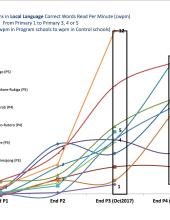
This brief presents Early Grade Reading Assessment (EGRA) data from a randomized control trial conducted in conjunction with the USAID/Uganda School Health and Reading Program (SHRP). SHRP supports reading in 3,700 government schools working through the systems that support these schools and was the catalyst for reform efforts which now cover 80% of Uganda's government primary schools. The assessment collected baseline data at the beginning of Primary 1 for 12 language cohorts and follow up at the end of every school year. These data collected in October, 2017 track progress at the school level (and differences between program and control schools) until the end of Primary 4, Primary 5 or Primary 6 (depending on the year the language was phased into the program). Learning for Uganda and beyond • Registering significant programmatic gains in reading achievement takes time. In the case of Uganda, this is partially attributable to the low baseline levels of reading (94% of learners across the 12 languages could read no words in English at the beginning of P1) and other systemic challenges within Ugandan schools not uncommon in other settings including teacher and learner absenteeism. • When learners learn to read in a local language, the gains realized in the local language are transferred to learning to read in English Major messages - When children learn to read (decode) in their local language, they are able to transfer this skill to decoding English. However, more work needs to be done to improve English comprehension. - Although SHRP has been able to move more learners to higher reading levels and they are on their way to becoming fluent readers, there are still too many learners not acquiring foundation skills. - It takes more time to move children from the foundation threshold than anticipated but when you move them from that level, the gains take off as can be seen from P3 onwards. - Reading gains in large scale interventions working through government structures take time due to systemic and contextual challenges.
Assoc. Photo (Port.)
UG SHRP.jpg
Resource (File)
Country
Resource Type
Resource Language
Month and Year
Publisher Or Client
USAID

The role of language instruction in schools as a tool among marginalized groups in Kenya- CIES 2018 Presentation

Submitted by admin on
Author
Description/Abstract
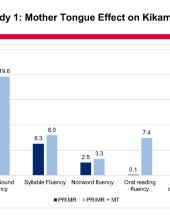
CIES 2018 Presentation, given by Ben Piper. This paper examines the influence of Mother Tongue (MT) as a medium of instruction in lower primary schools in 4 zones of Machakos County based on the PRIMR program. The relationship between MT implementation at the classroom level and its impact on pupil’s literacy outcomes are explored.
Assoc. Photo (Port.)
Pages from Piper, Ben_CIES2018_Mother Tongue Kenya.jpg
Resource (File)
Country
Resource Type
Featured projects
Month and Year

Understanding whether and how the Tusome program worked: Evidence from the national scale-up of a tested literacy program in Kenya- CIES 2018 Presentation

Submitted by admin on
Author
Description/Abstract
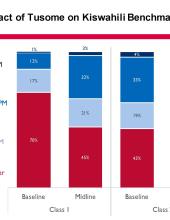
CIES 2018 Presentation, given by Ben Piper. The Tusome national literacy program has been implemented in each of Kenya’s more than 22,000 public primary schools and 1500 low cost private schools in the slums since 2015. In addition to showing the comparisons between before and after Tusome’s implementation, this presentation will examine Tusome implementation data to reveal key characteristics of the scale-up framework that Tusome was designed to respond to. In particular, we share the extent of classroom utilization of the Tusome materials, the size of the classroom observational structures that Tusome tried to revitalize, and the responses of the community to the Tusome intervention. The findings suggest that Tusome had a substantial impact on literacy outcomes in both Kiswahili and English, in both Grade 1 and 2, in both public and low cost private settings, and in both urban and rural settings. This means that the program’s effect meant that nearly 1 million more children were able to be considered readers by the midterm intervention.
Assoc. Photo (Port.)
Pages from Piper, Ben_CIES 2018_Understanding whether & how Tusome program worked.jpg
Country
Resource Type
Featured projects
Month and Year

Letting go of the gradual release model in literacy instruction in Kenya- CIES 2018 Presentation

Submitted by admin on
Author
Description/Abstract
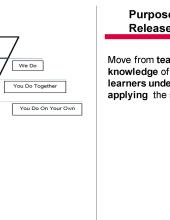
CIES 2018 Presentation, given by Jessica Mejia. The gradual release of responsibility model has been a primary instructional approach in many early grade literacy programs, including the Tusome Early Grade Reading Activity in Kenya. The use of this model dominates literacy instruction for English and Kiswahili in grades one and two. It has been proven successful teaching the very basic skills of literacy at a national scale, rapidly improving learning outcomes in Kenya. The expansion of Tusome to grade 3 by the Kenyan Ministry of Education 2017 required a careful examination of whether and how a precise adherence to the gradual release model is appropriate for higher order skills such as vocabulary, comprehension strategies and writing in Grade 3. Instead, these skills and this grade level lend themselves to a less rigid hold on the gradual release model. When designing Tusome’s Grade 3 instructional materials, a combination of gradual release for the word study and grammar activities and direct instruction for the vocabulary, comprehension and writing activities was used. The leadership of Tusome worked closely with the Kenya Institute for Curriculum Development to develop this new set of teaching and learning materials for Grade 3 which will be implemented in the 2018 academic year. This presentation discusses the rationale for a reduction in the adherence to the gradual release model in the design of the Grade 3 materials.
Assoc. Photo (Port.)
Pages from Mejia, Jessica_CIES2018_Gradual Release Model in Kenya.jpg
Country
Resource Type
Featured projects
Month and Year

Linguistic differences in mother tongue reading performance in Uganda- CIES 2018 Presentation

Submitted by admin on
Author
Description/Abstract
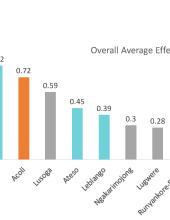
CIES 2018 Presentation, given by Rachel Jordan. In Uganda, and many other settings, too few children are learning how to read. In response, countries have embarked on national reading programs. Unfortunately, these programs are rarely evaluated rigorously at a large scale. This paper is based on larger research that efforts looked at the impact of a large-scale mother tongue reading program in Uganda using a randomized control trial in twelve language communities. It also looked at the differences in mother tongue reading acquisition attributed to linguistic differences, differences in program implementation and socioeconomic differences in the communities. The research points to language complexity as an important predictor of reading acquisition. Aspects of this complexity (transparency, tonal markings, agglutination) will be discussed in the 12 languages supported by current early grade reading reform efforts. Tying into language mapping efforts, the paper will also discuss the realities of language mapping on the ground where, for example, regardless of the predominant language spoken by the school community the school language of instruction is decided at the district level.
Assoc. Photo (Port.)
Pages from Jordan, Rachel_CIES2018_Uganda SHRP Mother Tongue Effects.jpg
Country
Resource Type
Month and Year

The Early Grade Reading Barometer: Increasing access to and use of data on learning outcomes- CIES 2018 Presentation

Submitted by admin on
Description/Abstract
CIES 2018 Presentation, given by Amber Gove and Helen Jang. The Early Grade Reading Barometer offers a wealth of actionable Early Grade Reading Assessment (EGRA) data to help to change the lives of young children. With 40 datasets from 19 places, the Barometer supports data transparency. The Barometer is designed for USAID education officers, policy makers, education staff in host countries, implementation partners, education researchers, and practitioners. It is designed primarily for users who may have limited knowledge about early grade reading, and no or little sophisticated statistical knowledge. This presentation was an interactive demonstration of the Barometer, highlighting the vast amount of data available to the public and how the information can be used to improve learning outcomes.
Assoc. Photo (Port.)
Pages from Jang, Helen; Gove, Amber_CIES2018_Barometer.jpg
Resource (File)
Country
Resource Type
Resource Language
Month and Year

Persistence and Fadeout of Preschool Effects: Evidence from 16 LMICs- CIES 2018 Presentation

Submitted by admin on
Author
Description/Abstract
CIES 2018 Presentation, given by Amber Gove. With few exceptions (Aboud & Hossain, 2011; Gertler et al., 2013), much of the published research on the impact of preprimary participation stems from high-income countries (Campbell et al., 2014; Heckman, Moon, Pinto, Savelyev, & Yavitz, 2010). Few studies have examined preschool and later learning across multiple countries (Raikes, Devercelli, & Kutaka, 2015). This paper seeks to fill this gap by examining the relationship between preprimary participation and early primary reading outcomes, as measured by Early Grade Reading Assessment (EGRA) (Dubeck & Gove, 2015; RTI International, 2016). Drawing on a unique set of data using student-level learning assessments from sixteen low and middle income countries, we use preprimary participation to explain primary reading outcomes.
Assoc. Photo (Port.)
Pages from Gove, Amber_CIES2018_Persistence Fadeout of Preschoolpdf.jpg
Country
Resource Type
Month and Year

Jordan RAMP initiative midline survey- CIES 2018 presentation

Submitted by admin on
Description/Abstract
Jordan RAMP, funded by USAID and UKAID, is a nationwide initiative of the Jordanian Ministry of Education (MoE) designed to improve the reading and mathematics skills of students in kindergarten 2 through grade 3 (K2–G3). RAMP, which is being carried out over five years (2015 to 2019), expects to deliver improved reading and mathematics instruction to all public school students in Jordan in grades K2–G3—about 400,000 students. This CIES 2018 presentation, given by Aarnout Brombacher, Senior Technical Advisor on the RAMP initiative, shares findings from the midline study of the project, which was conducted at the end of the 2016–2017 academic year (May 2017). The study included the EGRA and EGMA assessments as well as a range of teacher and pupil questionnaires.
Assoc. Photo (Port.)
Pages from Brombacher, Aarnout_CIES2018_Jordan RAMP midline survey.jpg
Country
Resource Type
Featured projects
Resource Language
Month and Year

IE Selected Publications (2015 - 2018)

Submitted by admin on
Description/Abstract
This is a list of select peer-reviewed publications by International Education staff between 2015 and 2018. For some of the publications, links to information about the documents and related resources can be found on this websiate. Where possible, the DOI has been included in the attached brief.
Assoc. Photo (Port.)
publications2.jpg
Resource (File)
Country
Resource Type
Resource Language
Month and Year
Publisher Or Client
RTI International