Early Grade Reading Assessment (EGRA)

Student Performance on the Early Grade Reading Assessment (EGRA) in Yemen-Executive Summary

Submitted by admin on
Description/Abstract
Assessments of student learning in the primary grades, such as the Early Grade Reading Assessment (EGRA), offer an opportunity to determine whether students are developing the fundamental skills upon which all other literacy skills build, and, if not, where efforts might be best directed. A closer evaluation of students’ mastery of foundational reading skills would help reveal to Yemen’s MOE why learning outcomes have not improved as much as would be desired. To that end, USAID and the Yemen MOE tasked RTI International with administering EGRA to a stratified random sample of 735 students in grades 2 and 3. Students were selected from 40 schools across the three governorates of Amran, Lahj, and Sana’a.
Assoc. Photo (Port.)
Country
Resource Type
Month and Year

Presentation on the State of Literacy in Africa

Submitted by admin on
Description/Abstract
This presentation discusses a desk study which was designed to advance knowledge of which countries have and have not conducted early grade reading assessments, while also providing information on where literacy issues remain critical and where improvement in underway.
Assoc. Photo (Port.)
overview.png
Resource (File)
Country
Resource Type
Resource Language
Month and Year
Publisher Or Client
USAID

Student Performance in Reading and Mathematics, Pedagogic Practice, and School Management in Doukkala Abda, Morocco

Submitted by admin on
Description/Abstract
Assessments of student learning in the primary grades, such as the Early Grade Reading Assessment (EGRA) and Early Grade Mathematics Assessment (EGMA), offer an opportunity to determine whether children are developing the fundamental skills upon which all other literacy and mathematical skills build, and, if not, where efforts might be best directed. To answer these questions about learning and the factors influencing it in Morocco, a study was carried out in a sample of schools in the Doukkala Abda region. The study investigated early grade reading and math skills and the learning environments that support them. It was completed as part of the Education Data for Decision Making (EdData II) project, funded by the U.S. Agency for International Development (USAID), in partnership with USAID/Morocco and with the national and regional (AREF Doukkala Abda) levels of Morocco’s Ministry of Education (MOE). Student assessment and school survey protocols developed under the EdData II project were tailored to the Moroccan context during an adaptation workshop with national and regional MOE staff. Reading and math assessments (EGRA/EGMA) were administered to a total of 773 grade 2 and grade 3 students randomly selected from within 40 schools. The 40 participating schools had been randomly selected from within the 1400 schools located in the Doukkala Abda region. In addition to student assessments, researchers interviewed Headteachers, teachers, students, and parents; conducted classroom and school inventories; and observed reading and math lessons. The fieldwork was carried out by MOE data collection teams under the supervision of RTI’s partner ETM in May 2011.
Assoc. Photo (Port.)
Screen Shot 2020-10-26 at 1.08.41 PM.png
Country
Resource Type
Resource Language
Month and Year
Publisher Or Client
USAID

National Early Grade Literacy and Numeracy Survey in Jordan: Remedial Pilot Research Activity Report

Submitted by admin on
Description/Abstract
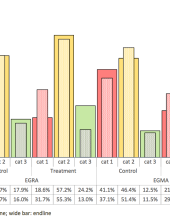
This report discusses Jordan's remedial pilot research program which was designed to assist teachers in improving the performance of those children who had fallen behind the general performance level of the rest of the class. The program focused on Arabic reading and mathematics in grades 1, 2, and 3. The rationale of the program is that children who are not performing at the general level of the class can benefit from additional instructional support that is aimed at their individual level of learning.
Assoc. Photo (Port.)
fine grain.png
Country
Resource Type
Resource Language
Month and Year
Publisher Or Client
USAID

Education Data for Decision Making (EdData II) National Early Grade Literacy and Numeracy Survey -- Jordan: Intervention Impact Analysis Report

Submitted by admin on
Description/Abstract
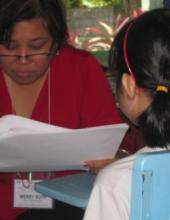
This report discusses the impact and results of the pilot intervention that was implemented during the 2013-2014 school year across 43 schools reaching more than 400 teachers and approximately 12,000 students in Jordan.
Assoc. Photo (Port.)
jordan survey.png
Country
Resource Type
Month and Year

Data for Education Programming in Asia and Middle East: Philippines EGRA Four Language Study – 2015 Follow-On

Submitted by admin on
Description/Abstract
A year after the first baseline EGRA was completed in four language regions, a follow-up survey was administered to samples of 30 to 40 teachers and 375 to 400 students per grade in the same regions (randomly sampled). The sampled teachers were asked about their preparation for, level of comfort with, and understanding of MTB-MLE, and their instructional practice during a reading lesson was observed. Timed observation instruments provided an opportunity to analyze time on task, and the relationship to reading achievement. Students completed an assessment of their letter sound knowledge, decoding skills, oral reading fluency, and reading comprehension in their mother tongue, and their listening comprehension and ability to read familiar words in Filipino, as well as their oral understanding of common English vocabulary words and phrases.
Assoc. Photo (Port.)
course2.1.jpg
Resource (File)
Country
Resource Type
Resource Language
Month and Year
Publisher Or Client
USAID

PhilEd Data II: Early Grade Reading Assessment Results: A cross-language look at MTB-MLE implementation in the Philippines

Submitted by admin on
Description/Abstract
Following the study completed in 2013, measuring English, Filipino and Ilokano reading skills, this 2014 EGRA study is serves as a baseline for monitoring the government's Mother Tongue-Based Multilingual Education (MTB-MLE) program by conducting EGRA assessments in four mother-tongue languages—Cebuano (Sinugbuanong Binisaya), Hiligaynon, Ilokano and Maguindanaoan. The survey also included classroom observations of teaching practice and teacher interviews to gather contextual information about the extent of MTB-MLE implementation.
Assoc. Photo (Port.)
Resource (File)
Country
Resource Type
Resource Language
Month and Year
Publisher Or Client
USAID

PhilEd Data: Strengthening Information for Education, Policy, Planning and Management in the Philippines. Early Grade Reading Assessment Results (Grades 3 English and Filipino, Grade 1 Ilokano)

Submitted by admin on
Description/Abstract
The present report describes the results of two reading assessments that were carried out to measure performance of a representative national sample of children reading English and Filipino at the end of grade 3 (Objective 1, above) and a regional sample of children reading Ilokano in grade 1 (Objective 2, above). The first included a national sample of 2,463 students, selected in a stratified, random framework to be representative of six geographic areas: North Luzon, Metro Manila, South Luzon, Visayas, Mindanao, and the Autonomous Region of Muslim Mindanao (ARMM). The second was a regional sample of 494 children in 50 schools selected randomly in Region 1 from all schools who reported having begun implementation of Ilokano instruction in school year 2012–2013 or 2011–2012.
Assoc. Photo (Port.)
513_Philippines_F11_p38.jpg
Resource (File)
Country
Resource Type
Resource Language
Month and Year
Publisher Or Client
USAID