Teacher Coaching

USAID Early Grade Reading (EGR) EGR Final Report

Submitted by admin on
Author
Description/Abstract
Improving early grade reading and writing outcomes has implications more far-reaching than simply raising scores on national and international assessments. Reading is a fundamental tool for thinking and learning, which has an integrated and cumulative effect on comprehension in all subject areas. Providing students with a strong foundation in reading increases the likelihood of future academic and workforce success. By providing Palestinian teachers with additional strategies and resources to build essential primary students’ reading and writing skills, the US Agency for International Development (USAID) Early Grade Reading (EGR) Project supported the goal of the USAID mission in the West Bank/Gaza of “providing a new generation of Palestinians with quality education and competencies that would enable them to thrive in the global economy and empower them to participate actively in a well-governed society.” Specifically, EGR addressed USAID’s strategic Sub-objective 3.1.5 to improve “service delivery in the education sector through increased access to quality education, especially in marginalized areas of the West Bank; a higher quality of teaching, learning and education management practices; and improved quality and relevancy of the education system at all levels.” EGR also directly supports USAID’s global goal to improve early grade reading skills. In support of the overarching goals, EGR’s project goal was to facilitate change in classroom delivery of early grade reading and writing instruction through three inter-connected component areas including evidence-based standards and curriculum revisions, instructional improvements, and parental engagement activities designed to improve student reading and writing competencies in Kindergarten (KG)–Grade 2 in the West Bank. EGR offered a scalable model of early grade reading instruction in 104 West Bank public schools among 351 teachers who taught 9,679 students. EGR collected data through reviews of curricular and standards’ documents, studies in schools, and assessments of students’ reading competencies. The project developed book leveling criteria to ensure the age- and grade-level appropriateness of reading materials, which facilitated the development or procurement of over 100,000 books for schools. EGR provided the Ministry of Education and Higher Education (MOEHE) with training modules in early grade reading and writing skills, a reading remediation manual, and a school-based professional development model. The project created innovative materials for parents to use to enhance their children’s reading skills. Despite its abbreviated timeframe, the project provided the MOEHE with a wealth of educational data, materials, and resources, including many interventions offered for the first time in the Palestinian educational system.
Assoc. Photo (Port.)
Final Report photo.JPG
Resource Type
Resource Language
Month and Year
Publisher Or Client
USAID/West Bank and Gaza

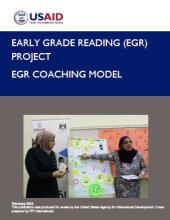
Early Grade Reading (EGR) Project EGR Coaching Model

Submitted by admin on
Author
Description/Abstract
RTI International and its partner AMIDEAST supported the Ministry of Education and Higher Education (MOEHE) in the implementation of the United States Agency for International Development (USAID)/West Bank Early Grade Reading (EGR) project. The EGR program goal was to facilitate change in classroom delivery of early grade reading and writing instruction through an integrated process of instruction and assessment designed to improve student reading and writing competencies in Kindergarten (KG)–Grade 2 in the West Bank. EGR worked to equip the coaches, teachers, and principals with the tools and strategies that would enable them to provide effective reading and writing instruction that results in changing classroom delivery of early grade reading and writing instruction. The EGR coaching model outlined the support provided to teachers to implement new instructional strategies that were introduced in EGR training sessions to strengthen students’ reading and writing skills. A good coach helps teachers grow professionally and develop their skills. EGR views coaching as an interactive process that supports teachers to set goals, strengthen classroom practices, and provide encouragement to overcome challenges and celebrate successes. As an interactive process, coaching goes beyond training teachers; it involves continuously checking in with the teachers to ensure they have the support and guidance needed to be successful in the classroom. EGR’s coaching model includes classroom observations followed by delivery of descriptive feedback, teacher-to-teacher collaboration through participation in teacher learning circles, and access to a variety of online resources.
Assoc. Photo (Port.)
Coaching report photo 2.JPG
Resource Type
Resource Language
Month and Year
Publisher Or Client
USAID/West Bank and Gaza

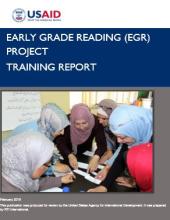
Early Grade Reading (EGR) Project EGR Training Report

Submitted by admin on
Description/Abstract
In cooperation with the MOEHE Training Technical Working Group (TWG), EGR developed training modules in the five basic reading skills: phonemic awareness, phonics, fluency, vocabulary, and reading comprehension as well as a comprehensive module in writing skills. The project initially planned to introduce one module at each training session conducted throughout the academic year. However, when EGR learned that the project would close prematurely due to legislative restrictions and funding issues, project staff compressed the trainings on the five basic skills into four over a period of four months. The shortened timeframe did not allow EGR to offer training in the four basic writing skills, but the project developed one comprehensive writing module, which was provided to the coaches in January 2019. EGR supplemented the training modules with additional instructional resources. Project specialists developed three instructional videos to reinforce the strategies introduced in the training modules. Additional activities to support the five basic reading skills were compiled in one resource book. EGR provided four interactive posters for teachers to use in their classrooms and a variety of complementary reading materials. The project’s goal was to equip coaches and teachers with the tools needed to implement a quality early grade reading program.
Assoc. Photo (Port.)
Tranng report photo.JPG
Resource Type
Resource Language
Month and Year
Publisher Or Client
USAID/West Bank and Gaza

USAID Early Grade Reading (EGR) EGR Year 1 Annual Report

Submitted by admin on
Description/Abstract
The US Agency for International Development (USAID) Early Grade Reading (EGR) Project in the West Bank completed its first year successfully with the completion of assessments and surveys, curriculum and standards reviews, and instructional materials in preparation for Year 2 implementation in schools. EGR worked closely with the Ministry of Education and Higher Education (MOEHE) to ensure their partnership in project activities. EGR administered two important assessments: a Time on Task (TOT) study, which determined the amount of time classroom teachers spent on reading and writing instruction, and the project baseline assessment, which provided a snapshot of the strengths and weaknesses of the students in the EGR-supported schools. The team also conducted a comprehensive review of the MOEHE’s standards and curricular documents related to early grade reading and writing to inform the development of the training materials and the complementary reading materials. By the end of the first year, EGR had established to support the MOEHE to implement a high-quality reading and writing program in 104 EGR-supported primary schools.
Assoc. Photo (Port.)
Annual Report cover.JPG
Resource (File)
Resource Type
Resource Language
Month and Year
Publisher Or Client
USAID/West Bank and Gaza

Tayari At A Glance

Submitted by admin on
Author
Description/Abstract
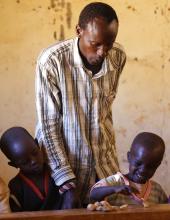
This "At A Glance" guide presents an overview of the Kenya Tayari program in Kenya. This four year program has supported the Kenyan Ministry of Education and County Governments to improve quality of early childhood development and education (ECDE) for over 240,000 young children.
Assoc. Photo (Port.)
ECD Umoja (125).JPG
Resource (File)
Country
Resource Type
Resource Language
Month and Year

Tayari Brochure

Submitted by admin on
Author
Description/Abstract
This brochure describes the CIFF-funded Kenya Tayari program, which aimed to improve the quality of pre-primary education in four counties in Kenya.
Assoc. Photo (Port.)
Laikipia (148).JPG
Resource (File)
Country
Resource Type
Resource Language
Month and Year

Tayari Brochure

Submitted by admin on
Author
Description/Abstract
This brochure describes the CIFF-funded Kenya Tayari program, which aimed to improve the quality of pre-primary education in four counties in Kenya.
Assoc. Photo (Port.)
Laikipia (148).JPG
Resource (File)
Country
Resource Type
Resource Language
Month and Year

Enhancing pre-service teacher education in Uganda to sustain early grade reading initiatives- CIES 2018 Presentation

Submitted by admin on
Author
Description/Abstract
CIES 2018 Presentation, given by Scholastica Tiguryera. While in-service training is an essential component of early grade reading (EGR) projects, it only addresses the current force of teachers and is usually a one-time, resource intensive undertaking. In these efforts, pre-service teacher education is often not addressed overlooking the next generation of teachers who will also need to know how to teach the new reading curriculum. This presentation will discuss how the Uganda Ministry of Education and Sports (MoES) has worked with two USAID-funded EGR projects (School Health and Reading Program [SHRP] and Literacy Achievement and Retention Activity [LARA]), a government-run EGR project funded by the Global Partnership for Education (GPE), Kyambogo University, and other local partners to develop an addendum to the Primary Teacher Education Curriculum to ensure the early grade reading initiatives introduced by the projects are incorporated into the pre-service teacher training program.
Assoc. Photo (Port.)
Pages from Tiguryera, Scholastica_CIES2018_Enhancing Preservice Education.jpg
Country
Resource Type
Month and Year

Instructional models in early mathematics: Can the "I do, we do, you do" model support the development of mathematical thinking? CIES 2018 Presentation

Submitted by admin on
Author
Description/Abstract
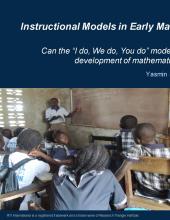
CIES 2018 Presentation, given by Yasmin Sitabkhan. The purpose of this presentation is to explore the applicability of the direct instruction (DI) model (also known as the “I do, We do, You do” model) for early grades mathematics instruction in low-income contexts through data gathered on two projects, the Tayari Early Childhood Project in Kenya and the Liberia Teacher Training Project (LTTP2). The results from the two studies point to the effectiveness of the gradual release of responsibility model for early mathematics instruction. The model as it is, with an explicit I do, we do, and you do” section for each concept, does not align with best practices in early mathematics instruction. However, the workshop model, which essentially is a “we do, you do” model, may foster more productive instruction that encourages critical thinking and problem-solving behavior.
Assoc. Photo (Port.)
Pages from Sitabkhan, Yasmin_CIES2018_MathInstructionModel.jpg
Country
Resource Type
Month and Year

National level classroom monitoring: the impact of Kenya Tusome on learning outcomes and accountability: CIES 2018 Presentation

Submitted by admin on
Author
Description/Abstract
CIES 2018 Presentation, given by Ben Piper. Tusome is supporting the Ministry’s systems to increase the utilization of monitoring data, and to expand the accountability structures of the government using the data provided by the national literacy program. Of particular interest is the classroom observation data collected by government-paid coaches, in Kenya these officers are called Curriculum Support Officers (CSOs). The data presented in this panel shows how the instructional support structures in Kenya have worked over time, with particular interest in the availability and usage of classroom support data.
Assoc. Photo (Port.)
Pages from Piper, Ben_CIES2018_National Level Classroom Monitoring.jpg
Country
Resource Type
Featured projects
Month and Year