Teacher Coaching

Remedial Instruction Program for School Pupils

Submitted by admin on
Description/Abstract
The purpose of the facilitator’s Guide for Remedial Instruction Program for School Pupils is to provide guidance to facilitators during the teacher training to make it more practical and active, and ensure that the training meets participants’ needs. As trainers you must familiarize yourself with the facilitator’s Guide, and ensure that you review the session’s plans before every session. This guide provides you with a time table and session plans for all days of training. There are a variety of activities, including demonstrations and pair practice. The guide was developed to provide opportunities for participants to practice skills, and the emphasis throughout the training should always be participants practice.
Assoc. Photo (Port.)
Remedial Instruction Teacher Training Guide.PNG
Country
Resource Type
Resource Language
Month and Year

Remedial Teaching Teacher's Toolkit

Submitted by admin on
Description/Abstract
This tool kit is a reference guide. It includes information on the following: • Ideas to start a remedial program, • Assessment guidelines and tools, and • Suggested remedial activities.
Assoc. Photo (Port.)
Remedial Instruction Teacher Tool Kit.PNG
Resource (File)
Country
Resource Type
Resource Language
Month and Year

Facilitator Guide for Intensive Coaching Program for Pedagogical Leaders

Submitted by admin on
Description/Abstract
This guide provides you with activity plans for three days of intensive coaching training. Some activities require participants to work individually, in pairs or in small groups to prepare and make presentations thereafter. Others are led by a trainer and provide the content needed for successful small group work.
Assoc. Photo (Port.)
Facilitators Guide for Intensive Coaching.PNG
Country
Sub-topic
Resource Type
Resource Language
Month and Year

Intensive Coaching Manual for Pedagogical Leaders

Submitted by admin on
Description/Abstract
This manual will support the pedagogical leaders to acquire coaching competences mainly focusing on listening skills, questioning techniques, giving technical advice and constructive feedback.
Assoc. Photo (Port.)
Intensive Coaching for Pedagogical.PNG
Country
Resource Type
Resource Language
Month and Year

Uganda LARA: Psychosocial Support training facilitators' guide

Submitted by admin on
Description/Abstract
In March 2020, the government of Uganda closed all schools and other educational institutions to mitigate the wide spread of COVID-19. This exposed significant risk especially to rural areas where there is limited access to reading materials or virtual learning platforms to continue learning. Ministry of Education and Sports’ (MoES) Preparedness and Response Plan for COVID-19 (April 2020) outlined measures of continuing learning through radio, take home packages and digital learning. MoES also decided to provide psychosocial support to minimize the adverse effects of COVID-19 on pupils, teachers and the education system at large, through support from USAID/Uganda Literacy Achievement and Retention Activity (LARA).The project planned to support MoES to enhance capacity of Primary Teachers college tutors and administrators to cascade psychosocial support training to head teachers and teachers in 43 districts. The objective of the training was to i) equip participants with knowledge and skills on psychosocial support, ii) identify psychosocial needs and discuss appropriate interventions and iii) apply psychosocial support intervention skills. The Facilitator guide provides information which will help reduce COVID-19 related stress, anxiety and prepare teachers for school reopening. In addition, teachers will be able to protect and provide counselling to pupils.
Assoc. Photo (Port.)
Screen Shot 2020-12-21 at 12.12.50 PM.png
Country
Resource Type
Resource Language
Month and Year
Publisher Or Client
USAID/Uganda Literacy Achievement & Retention Activity

Uganda/LARA EGR Monitoring and Support Supervision Tools

Submitted by admin on
Description/Abstract
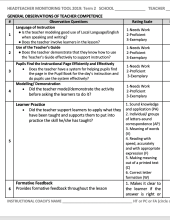
There are two sets of monitoring and support supervision (MSS) tools that the project has been using throughout the implementation period. These are; (i) the Lesson Observation Tools; and (ii) the Head teacher/CCT Coaching Tool. The lesson observation tools are used by the support supervision actors (e.g., school inspectors, CCTs, head teachers and project staff) during support supervision visits to schools. Specifically, the tools gather monitoring data on the uptake of EGR instructional methods by teachers to understand what teachers are doing well and areas where they need support. LARA developed a lesson observation tool for every grade (P1 – P4). Each tool has a section to assess the teacher’s preparedness for the lesson they are going to teach; a check list to assess the teacher’s instructional practices during the lesson; and the post observation section where the support supervision actor summarizes what the teacher did well and areas that the teacher needs to improve. The lesson observation tool for each grade is accompanied by a learner check which is administered to a sample of 4-6 learners per grade. The purpose of a learner check is to quickly show the classroom teacher and or head teacher the reading abilities of the learners present in the observed EGR lesson. The learner checks are designed from the content of the previous weeks and the teacher is able to gauge and determine the areas to prioritize when carrying out revision or remedial sessions. The Head teacher/CCT Coaching Tool is used by the zonal head teachers and CCTs to support head teachers so that they can in turn effectively support teachers in their schools. The zonal head teachers and CCTs observe and support head teachers to provide effective instructional support to teachers. The tool has a pre-observation section which assesses how the head teacher is prepared to support the teacher in class; a lesson observation section used by the zonal head teachers and CCTs to evaluate the actions of the head teacher while in the class observing the lesson; and post observation section to appraise how the head teacher conducts the post observation discussion with the teacher.
Assoc. Photo (Port.)
Screen Shot 2020-12-18 at 7.54.47 AM.png
Country
Month and Year
Publisher Or Client
USAID/Uganda Literacy Achievement & Retention Activity

Do’s and Don’ts of Improving Teaching Through Instructional Support: Findings from a Multi-country study of coaching and communities of practice

Submitted by admin on
Description/Abstract
RTI’s multi-country study examines a range of instructional support packages that include a variety of designs for coaching and communities of practice across all of RTI’s existing programs in order to determine what modes of coaching support are most effective. This includes coaches at both the school level and external to the school, as well as government officers compared with project hired coaches. This research is able to compare the relative effectiveness of coaching approaches with educational support provided by communities of practice meetings held at the school or the school cluster level. These findings have provided existing and future programs with best practices for how to more effectively implement coaching support structures at scale.This presentation was delivered by RTI at CIES (April 2020) as part of a panel focused on how literacy improvement efforts work at scale, and what types of coaching designs and behaviors impact teacher pedagogy more effectively than others.
Assoc. Photo (Port.)
RTI_Uganda_SHRPLARA.png
Resource (File)
Country
Resource Type
Resource Language
Month and Year

Teacher Coaching at National Scale: Insights into Using Technology and Data for Decision- Making in Kenya

Submitted by admin on
Description/Abstract
This presentation summarizes qualitative data from user observations and semi-structured interviews with teachers and coaches, as well as Kenyan education officials on their use of Tangerine:Coach (previously Tangerine:Tutor) data for decision-making and teacher support. Tangerine:Coach is open-source software developed by RTI International that has been deployed in support of over 25,000 schools nationwide in Kenya since 2015, and is currently being introduced or scaled up also in Cambodia, Jordan, Liberia, Sierra Leone, West Bank, and Uganda. In Kenya, a typical coach visit to a school includes taking stock of classroom conditions, observing teacher practice, appraising student ability, and providing pedagogical support to teachers. Tangerine:Coach is designed with the intent of supporting this process - the software applies logic to combine data from surveys, classroom observations, and student assessments into a feedback report tailored for each coaching conversation. Coaches regularly upload their data to a central server which are then published to an online dashboard and sent by email to education officials. In theory, this data-sharing enables ongoing monitoring of coach activities and student progress and allows for timely targeted support (e.g., through additional school visits or professional development) to schools, teachers, or coaches as needed. Yet, how are these different actors actually using the data and dashboards? What changes are they making in their coaching or resource allocations? What data format is most accessible to actors across the different levels of the education system?   This prevention was developed by Lucy Wambari, Timothy Slade, and Carmen Strigel for the 2018 mEducation Alliance Symposium.
Assoc. Photo (Port.)
mEdAlliancePresentation_IntroSlide_Nov2018.jpg
Resource (File)
Country
Sub-topic
Resource Type
Month and Year

Implementing Malawi’s national reading program: Opportunities, achievements, and challenges [Conference Panel Recording]

Submitted by admin on
Description/Abstract
Despite successes in improving access to primary education, the Malawi education system has struggled to produce high levels of learning. The country has consistently ranked at or near the bottom in regional learning assessments, and an Early Grade Reading Assessment conducted in 2010 showed that 76 percent of Standard 2 learners could not identify any letters. To address the low reading performance, The United States Agency for International Development (USAID) partnered with the Government of Malawi to pilot several projects aimed at improving reading performance. The lessons from these pilot projects led to the development of a National Reading Strategy (NRS) and a National Reading Program (NRP). With support from USAID, the NRP’s goal is to improve the reading skills of all students in Chichewa and English in the first four years of primary school. It does this through reforms to the curriculum, teacher professional development and coaching, development and distribution of teaching and learning materials, continuous assessment and remediation, and targeted support for learners. USAID supports the NRP by providing finance and technical assistance through several activities including MERIT: Malawi Early Grade Reading Improvement Activity (MERIT), Yesani Ophunzira (YESA), Strengthening Early Grade Reading in Malawi (SEGREM) and Reading for All Malawi (REFAM). This is the recording of the #vCIES 2020 conference session, which includes representatives from the MoEST and NRP implementation partners discussing their roles in supporting the NRP and sharing lessons around their approach, achievements, and challenges as they collaborate to get all children learning. The combined experiences of the partners will be useful for other projects, organizations, and governments who are looking to make a wide-scale change in their education systems.
Assoc. Photo (Port.)
1  NRP Overview - TitleSlide.jpg
Country
Resource Type
Month and Year

Effectiveness of Coaching as a Teacher Professional Development Strategy in Low-Income Countries [Conference Panel Recording]

Submitted by admin on
Author
Description/Abstract
Recording of #vCIES 2020 conference panel presentation entitled: Effectiveness of Coaching as a Teacher Professional Development Strategy in low-income countries
Assoc. Photo (Port.)
Slide1.JPG
Resource Type
Month and Year