Global

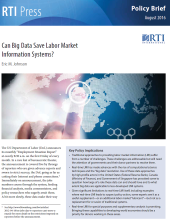
Can big data save labor market information systems?

Submitted by admin on
Author
Description/Abstract
Labor markets desperately need information to function effectively and efficiently, making labor market information systems critical public investments. Yet government systems face significant challenges in collecting quality data, turning it into useable market intelligence, and disseminating it in a timely, relevant manner, a situation more acute in developing countries. The rise of private, real-time labor market information (LMI), such as web-based job posting analytics, social network inferences, crowdsourcing, and mobile phone polling, has garnered interest and questioned the dominance of traditional approaches. This brief explores the use of real-time LMI and presents interviews conducted with international donor officials to gain their perspectives on its applicability in developing countries. I suggest that real-time LMI is unlikely to supplant traditional LMI collection anytime soon, and I dispel notions that these new approaches might leapfrog current data collection challenges. Real-time LMI can provide useful in special cases and for supplemental analysis, an additional lubricant for labor markets that suffer from weak data. Policy that supports the improvement of traditional LMI and promotes access to real-time LMI is warranted.
Assoc. Photo (Port.)
rti press 2.png
Resource (File)
Country
Sub-topic
Resource Type
Month and Year

Linking Learning to Employment: An Answer to the Global Search for Education Quality and Relevance?

Submitted by admin on
Description/Abstract
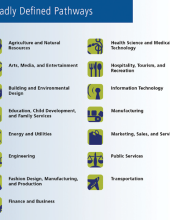
Current approaches to secondary school are producing high numbers of dropouts and low numbers of students well prepared for college and careers. Given global demand for better education quality and relevance, a reform movement in the US that blends rigorous academic learning and applied technical study may be of interest to other countries. Yet the transport of a successful approach from one country to another must be carefully considered and implemented, with attention paid to local political economy and education system variables. This policy brief discusses the successful US approach—called Linked Learning—and RTI International's approach to adapting it for other country contexts.
Assoc. Photo (Port.)
rti press 1.png
Resource (File)
Country
Sub-topic
Resource Type
Month and Year

Improving Learning Outcomes through Mother Tongue-Based Education

Submitted by admin on
Description/Abstract
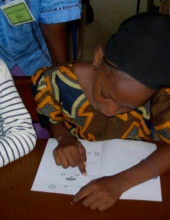
This four-page brief provides an overview of the learning and other advantages of providing educational instruction in mother tongue, or familiar, languages. The brief also contains information on factors to consider when developing a mother tongue-based education program.
Assoc. Photo (Port.)
language use.png
Country
Resource Type
Resource Language
Month and Year
Publisher Or Client
USAID

Early Grade Reading Assessment (EGRA) Toolkit, Second Edition in Arabic

Submitted by admin on
Description/Abstract
The attached document is the Arabic-adapted Early Grade Reading Assessment (EGRA) Toolkit, Second Edition. The Early Grade Reading Assessment (EGRA) Toolkit, Second Edition is the product of ongoing collaboration among a large community of scholars, practitioners, government officials, and education development professionals to advance the cause of early reading assessment and acquisition among primary school children in low-income countries. In the interest of consolidating diverse experiences and developing a reasonably standardized approach to assessing children’s early reading acquisition, this “toolkit,” or user manual, serves as a guide for countries beginning to work with EGRA in such areas as local adaptation of the instrument, fieldwork, and analysis of results This toolkit is intended for use by Ministry or Department of Education staff, donor staff, practitioners, and professionals in the field of education development working specifically in Arabic-speaking contexts. The document seeks to summarize a large body of research in an accessible manner. The procedures described in this toolkit are to be used in all USAID-funded administrations of EGRA and, it is hoped, in all other EGRA administrations as well.
Assoc. Photo (Port.)
Arabic Toolkit_0.png
Resource (File)
Country
Resource Type
Month and Year

Evaluation Des Competences Fondamentales en Lecture (EGRA) Manuel, Deuxieme Edition (French EGRA Toolkit, Second Edition)

Submitted by admin on
Description/Abstract
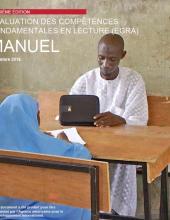
The attached document is the French-adapted Early Grade Reading Assessment (EGRA) Toolkit, Second Edition. It is the product of ongoing collaboration among a large community of scholars, practitioners, government officials, and education development professionals to advance the cause of early reading assessment and acquisition among primary school children in low-income countries. In the interest of consolidating diverse experiences and developing a reasonably standardized approach to assessing children’s early reading acquisition, this “toolkit,” or user manual, serves as a guide for countries beginning to work with EGRA in such areas as local adaptation of the instrument, fieldwork, and analysis of results. This toolkit is intended for use by Ministry or Department of Education staff, donor staff, practitioners, and professionals in the field of education development working specifically for French-speaking contexts. The document, seeks to summarize a large body of research in an accessible manner. The procedures described in this toolkit are to be used in all USAID-funded administrations of EGRA and, it is hoped, in all other EGRA administrations as well.
Assoc. Photo (Port.)
French Toolkit.jpg
Resource (File)
EGRA-French-Final.pdf
Country
Resource Type
Resource Language
Month and Year

Reading Skills and Gender: An Analysis

Submitted by admin on
Description/Abstract
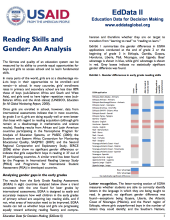
A brief summary of EGRA results across countries (through 2011) highlighting differences in achievement by gender.
Assoc. Photo (Port.)
gender brief.png
Country
Resource Type
Resource Language
Month and Year
Publisher Or Client
USAID

The First 1,000 Days and Beyond: Integrated Approaches to Early Childhood Development (Video recording)

Submitted by admin on
Description/Abstract
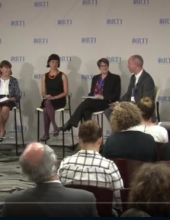
In October 2016, experts from RTI International, USAID, the Inter-American Development Bank, and the Children’s Investment Fund Foundation participated in a panel discussion examining how stakeholders in early childhood education, health and nutrition can break down the silos represented by these fields and build an integrated approach to early childhood development. The panel took place following the release of a new Series on early childhood development published in The Lancet which found that more than two in five children in low- and middle-income countries (an estimated 43 percent, or 250 million) are at risk of not reaching their development potential due to extreme poverty and chronic undernutrition. Maureen Black, PhD, distinguished fellow at RTI International, is lead author of the first paper in the Series.
Assoc. Photo (Port.)
ece webinar.png
Country
Resource Type
Resource Language
Month and Year

Measurement of Early Childhood Development and Learning under the Sustainable Development Goals

Submitted by admin on
Description/Abstract
Article published in the Journal of Human Development and Capabilities Volume 17, 2016 - Issue 4: Investing in Early Childhood Development. Published abstract: "Children’s early development serves as the foundation for later health, learning and well-being. The inclusion of early childhood development (ECD) in the Sustainable Development Goals implies that countries must report on the percentage of children under 5 years of age who are “developmentally on track.” This note briefly reflects on the history of global ECD goals and their measurement and outlines the challenge ahead: creating a workable strategy for ECD measurement that balances the need for national relevance with globally comparable data. The global variation in the timing and nature of early childhood skills acquisition presents an important opportunity as countries set their own standards for what it means to be developmentally on track. Country-driven measurement and standard setting, derived from measurement approaches that meet international expectations for quality, can have an important influence on policy and practice. Countries can measure the development of their youngest citizens in a way that is most relevant and useful to them, so that they may use those data to ensure that all children have the opportunity to fulfill their potential."
Assoc. Photo (Port.)
publications icon purchased sm.png
Country
Resource Type
Resource Language
Month and Year
Publisher Or Client
Journal of Human Development and Capabilities

"Study: Early interventions urgently needed to improve development for 250 million children", RTI.org newsroom (5 October 2016)

Submitted by admin on
Author
Description/Abstract
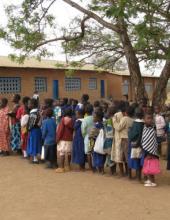
This article describes the launch of the Lancet series on early childhood education, and a study co-authored by Dr. Maureen Black, Distinguished Fellow at RTI International. See related resources for more information.
Assoc. Photo (Port.)
school_children_malawi_510.jpg
Country
Resource Language
Month and Year
Publisher Or Client
RTI International

Early childhood development coming of age: science through the life course

Submitted by admin on
Author
Description/Abstract
Article published in the journal The Lancet Early Childhood Development Series. Published Abstract: "Early childhood development programmes vary in coordination and quality, with inadequate and inequitable access, especially for children younger than 3 years. New estimates, based on proxy measures of stunting and poverty, indicate that 250 million children (43%) younger than 5 years in low-income and middle-income countries are at risk of not reaching their developmental potential. There is therefore an urgent need to increase multisectoral coverage of quality programming that incorporates health, nutrition, security and safety, responsive caregiving, and early learning. Equitable early childhood policies and programmes are crucial for meeting Sustainable Development Goals, and for children to develop the intellectual skills, creativity, and wellbeing required to become healthy and productive adults. In this paper, the first in a three part Series on early childhood development, we examine recent scientific progress and global commitments to early childhood development. Research, programmes, and policies have advanced substantially since 2000, with new neuroscientific evidence linking early adversity and nurturing care with brain development and function throughout the life course."
Assoc. Photo (Port.)
ece science through the life course.png
Country
Resource Type
Resource Language
Month and Year
Publisher Or Client
The Lancet