Monitoring, Evaluation, and Research

Survey of Student Perceptions of School Climate

Submitted by admin on
Description/Abstract
Survey of Student Perceptions of School Climate; developed by RTI under the Uganda LARA project in May 16 2018

Assoc. Photo (Port.)
SEL climate.png
Country
Sub-topic
Month and Year

Survey of Student Social and Emotional Competencies and Agency

Submitted by admin on
Description/Abstract
Survey of Student Social and Emotional Competencies and Agency; developed by RTI under the Uganda LARA project in May 2018
Assoc. Photo (Port.)
SEL Tool Uganda.png
Country
Sub-topic
Month and Year

One-page Brief on Rapid Automatic Naming (RAN) and Phonological Awareness

Submitted by admin on
Description/Abstract
In Malawi, a context where many students do not learn to read, we wanted a way to distinguish those who might struggle with reading acquisition regardless of instruction. Specifically, we wanted to know if students with deficits in both rapid automatic naming (RAN) and phonological awareness in Chichewa experience more difficulty with reading growth than students with single or no deficits. Prior to our study, the double deficit had been shown in opaque and transparent orthographies but had yet to be explored in Chichewa or other Bantu languages.
Assoc. Photo (Port.)
RAN tool.png
Resource (File)
Country
Sub-topic
Resource Type
Month and Year

Audio Computer-Assisted Self Interviewing [Flyer]

Submitted by admin on
Description/Abstract
For many children in low-income countries, schools are danger zones and places to be feared. Policy makers, funders and implementers lack accurate information regarding the prevalence of school-related genderbased violence (SRGBV) and the way it manifests in the lives of children. RTI funded a study in March 2018 in Uganda that tested a new model of SRGBV data collection—the ACASI method—that shows promise in generating more accurate data.
Assoc. Photo (Port.)
ACASI.png
Country
Sub-topic
Resource Type
Month and Year

One Page Brief on Executive Functioning (EF) Touch

Submitted by admin on
Description/Abstract
EF Touch is a tablet-administered assessment designed to measure children’s three key executive function skills: working memory, inhibitory control, and cognitive flexibility. These functions are important for organizing information, planning, solving problems, sustaining attention, and coordinating action and thoughts in support of goal-directed behaviors. Consequently, these functions are integral to children’s ability to learn how to learn. Most of what we know about executive functions has been gathered from studies in high-income countries. However, EF Touch is now being adapted and tested with young children living in LMICs, including Kenya and Liberia.
Assoc. Photo (Port.)
EF Touch.jpg
Country
Sub-topic
Resource Type
Month and Year

One Page Brief on Group-Administered Literacy Assessment (GALA)

Submitted by admin on
Description/Abstract
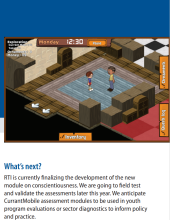
GALA is an assessment tool for measuring early literacy skills in a group setting. It consists of two main components: student booklets with multiple choice questions and a tool providing assessors with a complete protocol for test administration.
Assoc. Photo (Port.)
GALA.jpg
Country
Resource Type
Month and Year

Measuring Executive Function Skills in Young Children in Kenya

Submitted by admin on
Description/Abstract
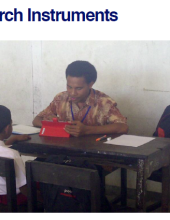
Interest inmeasuring executive function skills in young children in lowand middle-income country contexts has been stymied by the lack of assessments that are both easy to deploy and scalable. This study reports on an initial effort to develop a tablet-based battery of executive function tasks, which were designed and extensively studied in the United States, for use in Kenya. Participants were 193 children, aged 3–6 years old, who attended early childhood development and education centers. The rates of individual task completion were high (65–100%), and 85% of children completed three or more tasks. Assessors indicated that 90% of all task administrations were of acceptable quality. An executive function composite score was approximately normally distributed, despite higher-than-expected floor and ceiling effects on inhibitory control tasks. Children’s simple reaction time (β = –0.20, p = .004), attention-related behaviors during testing (β = 0.24, p = .0005), and age (β = –0.24, p = .0009) were all uniquely related to performance on the executive function composite. Results are discussed as they inform efforts to develop valid and reliable measures of executive function skills among young children in developing country contexts.
Assoc. Photo (Port.)
Table 1 EF Touch.JPG
Country
Resource Type
Resource Language
Month and Year
Publisher Or Client
Child Neuropsychology

Indonesia 2014 EGRA and SSME Instruments

Submitted by admin on
Description/Abstract
Indonesia 2014: The National Early Grade Reading Assessment (EGRA) and Snapshot of School Management Effectiveness (SSME) Survey Instruments
Assoc. Photo (Port.)
indo.png
Resource (File)
Country
Resource Language
Month and Year

Moving the needle on reading achievement in Uganda

Submitted by admin on
Author
Description/Abstract
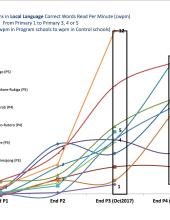
This brief presents Early Grade Reading Assessment (EGRA) data from a randomized control trial conducted in conjunction with the USAID/Uganda School Health and Reading Program (SHRP). SHRP supports reading in 3,700 government schools working through the systems that support these schools and was the catalyst for reform efforts which now cover 80% of Uganda's government primary schools. The assessment collected baseline data at the beginning of Primary 1 for 12 language cohorts and follow up at the end of every school year. These data collected in October, 2017 track progress at the school level (and differences between program and control schools) until the end of Primary 4, Primary 5 or Primary 6 (depending on the year the language was phased into the program). Learning for Uganda and beyond • Registering significant programmatic gains in reading achievement takes time. In the case of Uganda, this is partially attributable to the low baseline levels of reading (94% of learners across the 12 languages could read no words in English at the beginning of P1) and other systemic challenges within Ugandan schools not uncommon in other settings including teacher and learner absenteeism. • When learners learn to read in a local language, the gains realized in the local language are transferred to learning to read in English Major messages - When children learn to read (decode) in their local language, they are able to transfer this skill to decoding English. However, more work needs to be done to improve English comprehension. - Although SHRP has been able to move more learners to higher reading levels and they are on their way to becoming fluent readers, there are still too many learners not acquiring foundation skills. - It takes more time to move children from the foundation threshold than anticipated but when you move them from that level, the gains take off as can be seen from P3 onwards. - Reading gains in large scale interventions working through government structures take time due to systemic and contextual challenges.
Assoc. Photo (Port.)
UG SHRP.jpg
Resource (File)
Country
Resource Type
Resource Language
Month and Year
Publisher Or Client
USAID