School Management (SSME)

Education Data for Decision Making(EdDataII): Key Achievements and Lessons Learned

Submitted by admin on
Description/Abstract
USAID's Education Data for Decision Making (EdData II) was implemented over a 12 year period beginning in 2004. EdData II had at its core the goal of improving access to data for USAID Missions and host country ministries, to use for making informed policy decisions. The tools and research developed under EdData II whelped to inform the development of learning metrics under the Sustainable Development Goals (2015); provide evidence to support the design and monitor the implementation of USAID's 2011-2017 Education strategy, and provide actionable, high-quality data to inform policy and practice in around 35 countries. The report reflects on EdData II and the project's impact, providing a summary of the most salient and impactful project activities, and drawing key lessons from their development and implementation.
Assoc. Photo (Port.)
core report.png
Resource (File)
Country
Resource Type
Month and Year
Publisher Or Client
USAID

Tanzania National and Regional Dissemination Event Report for EGRA, EGMA, SSME Results

Submitted by admin on
Description/Abstract
Dissemination of the results from the 2015/2016 round of the Early Grade Reading Assessment (EGRA), the Early Grade Mathematics Assessment (EGMA), the Snapshot of School Management Effectiveness (SSME), and Life Skills occurred at four forums. First, a National Dissemination Workshop for education stakeholders, government representatives, and development partners occurred in mid-June 2016 in Dar es Salaam, Tanzania. This workshop was followed by three locally led, Regional Dissemination Workshops held in late October 2016 in three central regions and attracted practitioners and education representatives from surrounding districts and regions. Third, a Directors’ Meeting was held in mid-November 2016 in Dodoma, Tanzania. The Directors’ Meeting attracted high-level representatives from relevant branches of the Ministry of Education, Science, and Technology (MoEST) and key stakeholders to discuss the findings and their implications for education policy and planning for Tanzania. The final event was a two-hour presentation to the Ministry of Education in Zanzibar to present findings specific to the Zanzibar context. The four events are further discussed in the remainder of this report.
Assoc. Photo (Port.)
Resource Type

Findings Report, Tanzania National Early Grade Reading Assessment (EGRA)

Submitted by admin on
Description/Abstract
Findings report from the Tanzania National EGRA, EGMA, SSME, and Life Skills.
Assoc. Photo (Port.)
TZ egra.png
Resource (File)
Resource Type
Month and Year
Publisher Or Client
USAID, Government of Canada, UNICEF

Tanzania EGRA/EGMA/SSME (2016) Final, Validated Instruments

Submitted by admin on
Description/Abstract
Final, validated instruments used in the 2016 Tanzania National EGRA. The EGRA and SSME were made possible with funding from USAID. The EGMA component was made possible by funding from Global Affairs Canada. The Life Skills component was made possible by UNICEF Tanzania.
Assoc. Photo (Port.)
instruments report.png
Resource (File)
Resource Language
Month and Year

RDC, 2015 : Évaluation des compétences fondamentales en lecture (EGRA) et Aperçu de l'efficacité de la gestion des écoles (SSME) – Rapport des conclusions en 5e année, révisé

Submitted by admin on
Description/Abstract
L’objectif de l’étude est d’avoir une évaluation de référence des compétences en lecture et en mathématiques des élèves de 3e et 5e années d’école primaire en République démocratique du Congo (RDC). Plus concrètement, cette étude offre à l’Agence américaine pour le développement international (USAID) et le Gouvernement de la République démocratique du Congo (GRDC) des données portant sur les capacités des enfants et 3e année d’école primaire à lire dans les trois langues nationales de la RDC (notamment le lingala, le kiswahili ou le tshiluba) et sur les compétences de compréhension et de production orales en français des mêmes élèves. D’autres éléments de l’étude offrent des aperçus des compétences en mathématiques d’enfants en 3e année dans un des districts du Katanga. La présente étude offre aussi un certain contexte et des données portant sur les variables principales en rapport avec les élèves, les enseignants, les directeurs des écoles et les écoles, variables supposées être de bons prédicteurs de la performance des élèves de primaire en lecture et mathématiques. Ces informations diagnostiques aideront les décisionnaires à prendre des décisions éclairées par les données, décisions sur les stratégies correctives qui pourront améliorer la qualité des résultats de l’enseignement et de l’apprentissage des élèves dans les premières années de l’école primaire.
Assoc. Photo (Port.)
grade 5.png
Resource (File)
Resource Type
Resource Language
Month and Year

Egypt Grade 3 Early Grade Reading 2nd National Assessment: Classroom Observations (English and Arabic Versions)

Submitted by admin on
Description/Abstract
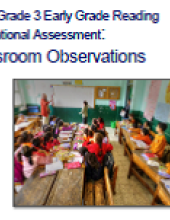
This report presents key findings of a national, stratified random sample of classroom observations of Grade 3 reading instruction in Ministry of Education (MOE) schools. Classroom observation was a component activity of the 2nd national Early Grade Reading Assessment (EGRA) for Grade 3 implemented in April 2014. The classroom observations were completed in a random sub-set of 39 schools from the larger EGRA sample of 200 schools: 40 primary schools from each of five sub-national regions encompassing 25 of Egypt’s 27 governorates.1 One Grade 3 class, randomly selected, was observed in each school. Each classroom observation applied a formal instrument to the observation of a full class period of Grade 3 Arabic reading plus separate interviews with the observed teacher, school principal and librarian. All observations were conducted by trained MOE staff with significant experience of both the ministry’s Early Grade Reading Program and reading assessment. Schools were not informed in advance of the classroom observation.
Assoc. Photo (Port.)
egypt3.png
Country
Resource Type
Resource Language
Month and Year

USAID/Zambia Education Project Baseline Report: Nonreading Indicators

Submitted by admin on
Description/Abstract
RTI International was asked to develop 10 nonreading indicators (NRI) related to improved early grade reading (EGR) in Zambia—or more generally, to improved learning outcomes. Accordingly, the desk study that was required as background research for this effort focused on the international literature related to high performing education systems and schools, or “effective schools”; and our own research and experience in the realm of systems reform and reform support for improved learning outcomes. While some of the findings of this desk study may not be immediately applicable to the Zambian context, they nevertheless helped to create an overall understanding of what is needed by a system to improve learning outcomes, and so inform our effort to develop 10 nonreading indicators. The general findings of this desk study are as follows.
Assoc. Photo (Port.)
zambia 2.png
Country
Resource Type
Month and Year