School Management (SSME)

Study on Gender Equality in Management Positions in the Education Sector in Senegal

Submitted by admin on
Author
Description/Abstract

This study was undertaken for the Renforcement de la Lecture Initiale pour Tous (RELIT) program in Senegal, an activity made possible by the American people through the United States Agency for International Development (USAID). It is an analysis of gender equality and equity in positionsThe report includes an executive summary in English is followed by the full data and analysis from the activity, in French.

Assoc. Photo (Port.)
gender sen.png
Resource (File)
Country
Resource Type
Featured projects
Resource Language
Month and Year
Publisher Or Client
USAID

RELIT Infos : Newsletter 2024.1

Submitted by admin on
Author
Description/Abstract
A newsletter produced for the RELIT project in 2024
Assoc. Photo (Port.)
RELIT infos PortPNG.PNG
Resource (File)
Country
Resource Type
Featured projects
Resource Language
Month and Year
Publisher Or Client
USAID

The role of Middle Tier Leadership in Supporting Improved Foundational Literacy and Numeracy [CIES 2024]

Submitted by admin on
Description/Abstract
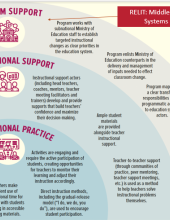
This presentation delivered at the CIES 2024 conference describes key implementation strategies used in USAID/MOE Government to Government Component of RELIT Program.
Assoc. Photo (Port.)
relit port.PNG
Country
Resource Type
Featured projects
Resource Language
Month and Year
Publisher Or Client
USAID

Can the Middle Tier Drive Foundational Learning at Scale?

Submitted by admin on
Author
Description/Abstract
An integral part of a decentralized education system hierarchy is the “middle tier” comprising subnational actors in charge of education delivery at the regional, provincial, state, district, municipality, city, or circuit and cluster levels. The general roles and responsibilities of the middle tier are described in research on district leadership in OECD countries. Their responsibilities range from planning, monitoring, and implementing reforms at the subnational and school levels, to ensuring school-based accountability through data and evidence, to innovating, supporting, and monitoring improvements in teaching and learning in schools through instructional leadership and fostering professional learning communities at the district and school levels. While rigorous academic evidence may be lacking on the ability of middle managers to bring about improvements in foundational literacy and learning outcomes at scale in LMICs, we have theoretical and programmatic evidence on (1) their role in instructional leadership, (2) the importance of building their capacity to drive teaching and learning, and (3) the importance of trust and support within the education system that fosters learning at scale. Thumbnail Credit: Pakistan Reading Program/IRC
Assoc. Photo (Port.)
Picture4_0.jpg
Resource (File)
Resource Type
Resource Language
Month and Year
Publisher Or Client
Center for Global Development / Bill and Melinda Gates Foundation

Reopening Classrooms Interview Series

Submitted by admin on
Description/Abstract
This playlist was part of a knowledge sharing activity organized by the All Children Reading (ACR) Philippines project regarding countries' experiences re-opening schools on the occasion of the 4th education forum of the Department of Education. This forum is a platform to share updates of major on-going reform initiatives of the Department with development partners including USAID and a venue to inform, deliberate on and coordinate efforts and actions towards quality basic education. Staff of ACR-Philippines interviewed education stakeholders in the Kingdom of Cambodia, the Dominican Republic, Romania, the United Arab Emirates and United States about what happened when they reopened classrooms. Representatives spoke with us about their experiences, including the preparations they have made—what worked and what did not work. They also describe the challenges that they have encountered and how they managed these issues.
Assoc. Photo (Port.)
DepEd Forum 11-11-21a.jpeg
Resource Type
Featured projects
Resource Language
Month and Year
Publisher Or Client
USAID/Philippines, Philippines Department of Education

Uganda/LARA: Journeys Impact Qualitative Assessment instruments

Submitted by admin on
Description/Abstract
LARA developed a set of qualitative tools to learn about the successes and challenges related to the implementation of Journeys and to understand what changes staff and pupils had observed since Journeys started in the program schools. The qualitative tools include individual interviews and focus group discussion (FGD) guides with head teachers, teaching and non-teaching staff, change agents and students. There are two individual interviews, one for the teachers and another for the head teachers. The individual interview for teachers investigates the value the Journeys program has brought to the teachers personally, to the school and the classroom, for example changes in the way teachers relate and interact with pupils and changes in disciplinary practices at the school. The individual interview for head teachers on the other hand investigate what has gone well and what the head teachers are struggling with regarding the implementation of Journeys for School Staff and Journeys for Pupils (the Uganda Kids Unite [UKU] Program). There are three FGD guides; (i) FGD guide for teaching and non-teaching staff provides information about the changes (for example interactions among students, teacher attendance, extent of SRGBV) in the school as a result of Journeys, initiatives undertaken by the school to make the school safe and positive and how the initiatives improved the school and/or reduced violence; (ii) FGD guide for head Teachers and school change agents (SCA) that gathers feedback on the successes and challenges associated with the implementation of Journeys program for the school staff and Journeys program for pupils as well as improvements needed to for the continuity of the Journeys program in the schools; and (iii) FGD guide for students that focuses mainly on what pupils enjoyed most about the UKU program and the specific UKU activities they loved. It also asks about what pupils did not enjoy in the UKU meetings, initiatives that UKU teams developed to improve the school, what pupils learned through the UKU program and how the school and classroom have changed since Journeys began.
Assoc. Photo (Port.)
Screen Shot 2020-12-18 at 8.06.09 AM.png
Country
Month and Year
Publisher Or Client
USAID/Uganda Literacy Achievement & Retention Activity

Modul Pengembangan Sekolah Secara Menyeluruh: Peran Kepala Sekolah dan Pengawas | Comprehensive School Development Module: The Role of School Principals and Supervisors

Submitted by admin on
Description/Abstract
Ini adalah Modul Pengembangan Sekolah Komprehensif Tentang Peran Kepala Sekolah dan Pengawas. Ini mencakup, Pembelajaran Aktif, Program Budaya Baca, Manajemen Berbasis Sekolah, Pemantauan Sekolah, Rencana tindak lanjut. | This is a Comprehensive School Development Module About The Role of School Principals and Supervisors. It covers, Active Learning, Reading Culture Programs, School Based Management, School Monitoring, Follow up plans.
Assoc. Photo (Port.)
Modul_Pengembangan_Sekolah_secara_Menyeluruh_-_Kepala_Sekolah_dan_Pengawas1.jpg
Country
Resource Type
Featured projects
Resource Language
Month and Year
Publisher Or Client
USAID

Tukomye Okutuntuza! Tekugunjula Posters

Submitted by admin on
Description/Abstract
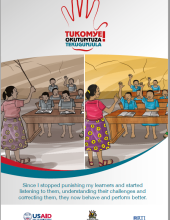
3 Corporal Punishment Posters from the USAID/Uganda Literacy Achievement and Retention Activity's (LARA) Social and Behavior Change Communication (SBCC) campaign in Uganda.
Assoc. Photo (Port.)
SBCC Poster.PNG
Resource (File)
Country
Resource Type
Month and Year

Indonesia 2014 EGRA and SSME Instruments

Submitted by admin on
Description/Abstract
Indonesia 2014: The National Early Grade Reading Assessment (EGRA) and Snapshot of School Management Effectiveness (SSME) Survey Instruments
Assoc. Photo (Port.)
indo.png
Resource (File)
Country
Resource Language
Month and Year

2017 Tanzania National EGRA, EGMA, SSME, and Life Skills Instruments

Submitted by admin on
Description/Abstract
Final, validated instruments used in the 2017 Tanzania National EGRA. The EGRA and SSME were made possible with funding from USAID. The EGMA component was made possible by funding from Global Affairs Canada. The Life Skills component was funded by UNICEF Tanzania.
Assoc. Photo (Port.)
tz egra.png
Resource (File)
Resource Language
Month and Year
Publisher Or Client
USAID, Global Affairs Canada,