Digital Assessment and Data Collection

RTI International wins 2018 Digital Edge 50 award for education tool

Submitted by admin on
Description/Abstract
RTI International has been honored with a 2018 Digital Edge 50 Award for being a leader in digital innovation. The prestigious award recognizes a new open-source tool recently developed by RTI to measure executive function (EF) skills in pre-school aged children The tool, EF Touch, is administered using Tangerine®, RTI’s open source software that was designed to transform the way teachers, coaches and researchers assess and observe literacy and numeracy teaching and learning.
Assoc. Photo (Port.)
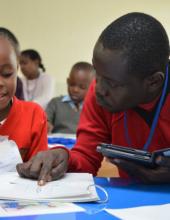
tangerine_use_of_the_tablets_510.jpg
Country
Resource Language
Month and Year

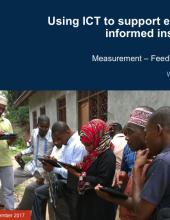
Using ICT to support evidence-informed instruction [Presentation]

Submitted by admin on
Description/Abstract
This presentation was delivered by Wendi Ralaingita at the Open Learning Exchange (OLE) conference in Kathmandu, Nepal (November 2017). It provides an overview of RTI's evidence-based approach to ICT integration, based largely on the Improvement Science literature, particularly Edward Deming. Describes uses of Tangerine open-source software for teacher coaching (Tangerine:Tutor) and classroom continuous assessment (Tangerine:Class) as well as hearing and vision screening tools integrated with EGRA and EGMA assessments.
Assoc. Photo (Port.)
OLE ICT Conference_RTI Presentation 2017.jpg
Resource (File)
Country
Resource Type
Resource Language
Month and Year
Publisher Or Client
RTI International

Technology for Continuous Assessment of Reading Instruction

Submitted by admin on
Description/Abstract
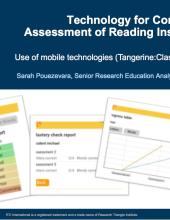
This is a presentation about Tangerine:Class, which was delivered at the 2016 Pacific Circle Consortium in Saipan.
Assoc. Photo (Port.)
TanClass PPC pres.jpg
Resource (File)
Country
Resource Type
Resource Language
Month and Year
Publisher Or Client
RTI International

CIES 2017 Presentation: Measurement of early reading under the SDGs

Submitted by admin on
Description/Abstract
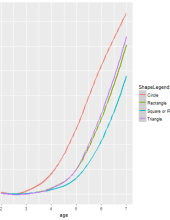
Measurement of learning is central to the Sustainable Development Goals for education, both in early primary (grade 2/3) and in early childhood (under the age of 5) (IAEG 2016). Of particular concern is the ability of global measurement approaches to reflect the social and linguistic differences of a diverse range of societies, including traditionally marginalized groups. This presentation relies on literacy assessment data to answer the following question: can results from non-equated national assessments be used to report against global goals?
Assoc. Photo (Port.)
ShapeName Laos.png
Resource (File)
Gove CIES March 2017.pptx
Country
Resource Type
Resource Language
Month and Year
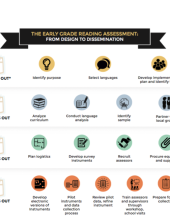
The Early Grade Reading Assessment: From Design to Dissemination

Submitted by admin on
Description/Abstract
An infographic describing the key steps and timeline involved in conducting an Early Grade Reading Assessment (EGRA).
Assoc. Photo (Port.)
Screen Shot 2016-11-30 at 3.08.20 PM.png
Resource (File)
Country
Resource Type
Resource Language
Month and Year
Publisher Or Client
UNESCO Institute for Statistics

Nigeria Education Data Survey (NEDS) 2010 State Report: Anambra

Submitted by admin on
Description/Abstract
The 2010 Nigeria Education Data Survey (NEDS) was a nationally representative sample survey implemented primarily by the National Population Commission (NPC) in collaboration with the Federal Ministry Of Education (FMOE) and the Universal Basic Education Commission (UBEC). The 2010 NEDS has the following specific objectives: Provide data on the schooling status of Nigerian children of basic education age, including factors influencing whether children ever enroll in school and why students drop out of school Quantify household expenditures on children’s schooling by examining different patterns of expenditure by various background characteristics Measure parents’ attitudes to schooling, including the quality of schooling and provide an understanding of attitudes that shape their willingness to send their children to school Measure the frequency of student absenteeism and reasons for missing school in order to suggest possible approaches to maximizing attendance Provide data that allows for trend analysis and State comparisons A very high overall response rate of 98% was achieved with interviews completed in 26,934 households.
Assoc. Photo (Port.)
Resource (File)
Anambra_PDF_rev13.pdf
Country
Resource Type
Month and Year
Publisher Or Client
Federal Ministry of Education Annex