Briefs | 1 March 2021
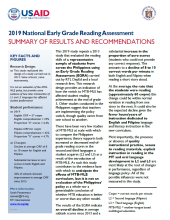
2019 National Early Grade Reading Assessment (EGRA): English and Filipino, Grade 3 [Brief]
An overview of the results of a nationally-representative Early Grade Reading Study conducted in 2019 in the Philippines. The full report is available.
Instruments and Questionnaires | 18 December 2020
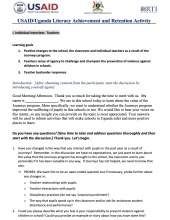
Uganda/LARA: Journeys Impact Qualitative Assessment instruments
LARA developed a set of qualitative tools to learn about the successes and challenges related to the implementation of Journeys and to understand what changes staff and pupils had observed since Journeys started in the program schools.
3. Individual qualitative interview guide for Head teachers and teachers -November 1 2019.docx (DOCX, 52.63 KB)
,
2. FGD Guidelines for Pupils November 1 2019.docx (DOCX, 53.12 KB)
,
4. Focus Group Discussion Guidelines - Teaching and non Teaching staff - November 1 2019.docx (DOCX, 51.65 KB)
,
5. Focus Group Discussion Guidelines - Head teachers and Change Agents - November 1 2019.docx (DOCX, 51.11 KB)
Instruments and Questionnaires | 18 December 2020
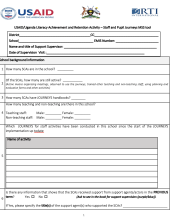
Uganda/LARA: Journeys Monitoring and Support Supervision tool
This tool is used by school support actors (e.g., DEOS, DIS, MEOs, DIS, MIS, IS, CCTs, head teachers, project staff) to monitor and support implementation of Journeys for school staff and Journeys for pupils.
Instruments and Questionnaires | 18 December 2020
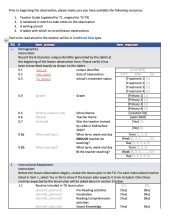
Uganda/LARA: EGR Action Research Tools
LARA developed action research tools to measure the level of fidelity of implementation of the EGR methods and generate lessons learned to inform adaptations in EGR programming. The action research tools gather both historical and real-time data at the school.
Instruments and Questionnaires | 17 December 2020
Uganda/LARA : EGRA and supplementary data collection instruments
The Early Grade Reading Assessment (EGRA) is a diagnostic instrument designed to quickly assess foundational skills for literacy acquisition of pupils in Early Grades of primary school.
1a English protocol Luganda directions.doc (DOC, 195 KB)
,
1b. Luganda protocol.doc (DOC, 221.5 KB)
,
2a.English protocol Runynkore Rukiga directions.doc (DOC, 194.5 KB)
,
2b. Runyankore Rukiga protocol.doc (DOC, 197 KB)
,
3a. English protocol Runyoro Rutooro instructions.doc (DOC, 174 KB)
,
3b. Runyoro Rutooro protocol.doc (DOC, 205.5 KB)
,
4. English Stimuli.doc (DOC, 59 KB)
,
5. Luganda Stimuli.doc (DOC, 61 KB)
,
6. RunRot pupil stimuli.docx (DOCX, 24.13 KB)
,
7. Runyankore Rukiga Stimuli.doc (DOC, 60 KB)
,
Lara Head Teacher Interview.docx (DOCX, 25.45 KB)
,
Lara Teacher Interview.docx (DOCX, 25.33 KB)
,
Pupil Context lnterview.docx (DOCX, 27.51 KB)
,
School Inventory Tool.docx (DOCX, 18.95 KB)
Reports | 17 September 2020
Jordan Early Grade Reading and Mathematics Initiative (RAMP) Endline Survey Report
This report presents the findings of the Jordan Early Grade Reading and Mathematics Initiative (RAMP) endline survey conducted at the end of the 2018–2019 school year (in May 2019).
Reports | 8 June 2020
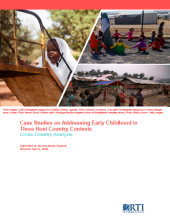
Early Childhood Services for Young Refugee Children: Cross-Country Analysis
This report presents a cross-country analysis of three qualitative case studies
completed in Jordan, Uganda, and Bangladesh in late 2019.
Reports | 8 June 2020
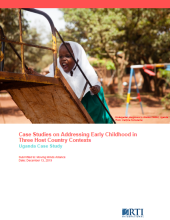
Early Childhood Services for Young Refugee Children: Uganda Case Study
This qualitative case study describes the experiences of young refugee children and their families accessing early childhood development (ECD) services in Uganda in late 2019.
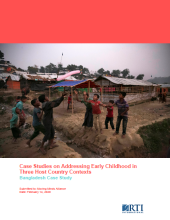
Reports | 8 June 2020
Early Childhood Services for Young Refugee Children: Bangladesh Case Study
This qualitative case study describes the experiences of young refugee children and their families accessing early childhood development (ECD) services in Bangladesh in late 2019.
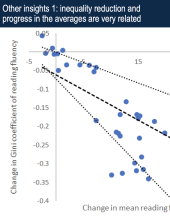
Presentations | 6 May 2020
Measurement of Inequality in Learning Levels [Conference Presentation]
The presentation summarizes a paper by Tim Slade and Luis Crouch on the measurement of learning inequality before and after a successful reading project. The paper concludes that at least for the case studied, the project improved not only the averages but also reduced the inequality.