Arabic

Mathematics Teacher Guide

Submitted by admin on
Description/Abstract
A teacher's guide for mathematics instruction in the context of Jordan, developed by the Jordanian Ministry of Education.
Assoc. Photo (Port.)
Capture.PNG
Resource (File)
غلاف خارجي.pdf
Country
Resource Type
Featured projects
Resource Language
Month and Year

Mobile Learning and Numeracy: Filling gaps and expanding opportunities for early grade learning [Arabic]

Submitted by admin on
Description/Abstract
The present study on Mobile Learning and Numeracy examines how mobile learning (m-learning) could influence and improve numeracy education at early grade levels (ages 4-10) especially in low-income countries. Key questions to guide the research include: 1) What are the benefits and challenges of integrating mobile learning into early grade numeracy education? 2) What is the role of a teacher with regard to mobile learning and numeracy education? 3) How can the community and the parents actively contribute to/participate in the child’s numeracy education with the use of mobile devices? and 4) How can mobile technology be used effectively in measuring/assessing numeracy gains? The conclusions and recommendations of this study have been informed by an international working group that met over two days during the first International Numeracy Conference in Berlin in December 2012. We would like to acknowledge the following participants of this working group for their thoughtful contributions: Michaela Brinkhaus (BMZ); Dorothea Coppard (GIZ); Melanie Stilz (Konnektiv Büro für Bildung und Entwicklung); Jens von Roda-Pulkowski (KfW); Abigail Bucuvalas (Sesame Workshop); Mr. Kann Puthy (Primary Education Department, MoEYS Cambodia); Edward Barnett (DFID).

Assoc. Photo (Port.)
Screen Shot 2020-06-24 at 5.41.40 PM.png
Country
Resource Type
Resource Language
Month and Year
Publisher Or Client
GTZ

Jordan Remedial Study: Mathematics Diagnostic Assessment Tool and Stimulus Sheet

Submitted by admin on
Description/Abstract
In 2013–14, in response to the success of a reading and mathematics intervention, the Ministry of Education in Jordan developed and piloted a remedial program to provide differentiated (focused) support to the lowest performing children. Because the pedagogical approaches of the reading and mathematics activities were very similar, teachers were able to apply remedial activities in both subjects, and thus, children benefited in both reading and mathematics In Jordan, the remedial pilot activity included two teacher administered tools: (a) a “coarse-grain” screening tool used to identify children in need of remedial support and (b) a “fine-grain” diagnostic tool administered to each child identified by the coarse-grain tool as needing remedial support. To ensure efficacy—in particular, of the coarse grain tool’s ability to correctly identify students—the tools were piloted. In the pilot, the coarse-grain screening tool was administered to all students in the pilot classrooms. The students in the class were then ranked based on their performance on the coarse-grain tool. The fine-grain tool was then administered to every fourth or fifth student (depending on class size) on the list arranged in order of performance. Students who performed better on the coarse-grain tool were consistently identified as performing at a higher level by the fine-grain tool, and students who performed more poorly on the coarse-grain tool were determined to be performing at a lower level by the fine-grain tool. The attached resources are the Mathematics Diagnostic Assessment Tool and the Pupil Stimulus Sheets in Arabic used as part of the remedial pilot program.
Assoc. Photo (Port.)
Country
Resource Language
Month and Year

Jordan Remedial Study: Reading Teachers' Guide

Submitted by admin on
Description/Abstract
In 2013–14, in response to the success of a reading and mathematics intervention, the Ministry of Education in Jordan developed and piloted a remedial program to provide differentiated (focused) support to the lowest performing children. Because the pedagogical approaches of the reading and mathematics activities were very similar, teachers were able to apply remedial activities in both subjects, and thus, children benefited in both reading and mathematics In Jordan, the remedial pilot activity included two teacher administered tools: (a) a “coarse-grain” screening tool used to identify children in need of remedial support and (b) a “fine-grain” diagnostic tool administered to each child identified by the coarse-grain tool as needing remedial support. To ensure efficacy—in particular, of the coarse grain tool’s ability to correctly identify students—the tools were piloted. In the pilot, the coarse-grain screening tool was administered to all students in the pilot classrooms. The students in the class were then ranked based on their performance on the coarse-grain tool. The fine-grain tool was then administered to every fourth or fifth student (depending on class size) on the list arranged in order of performance. Students who performed better on the coarse-grain tool were consistently identified as performing at a higher level by the fine-grain tool, and students who performed more poorly on the coarse-grain tool were determined to be performing at a lower level by the fine-grain tool. The attached resources are the Reading Teachers' Guide in Arabic used as part of the remedial pilot program.
Assoc. Photo (Port.)
Resource (File)
Country
Resource Language
Month and Year

Jordan Remedial Study: Mathematics Teachers' Guide (Arabic)

Submitted by admin on
Description/Abstract
In 2013–14, in response to the success of a reading and math intervention, the Ministry of Education in Jordan developed and piloted a remedial program to provide differentiated (focused) support to the lowest performing children. Because the pedagogical approaches of the reading and mathematics activities were very similar, teachers were able to apply remedial activities in both subjects, and thus, children benefited in both reading and mathematics. The attached document is the Mathematics Teachers' Guide in Arabic.
Assoc. Photo (Port.)
jordan math TG.jpeg
Resource (File)
Country
Resource Language
Month and Year

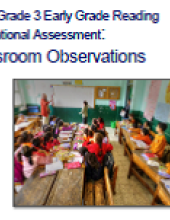
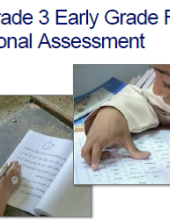
Egypt Grade 3 Early Grade Reading 2nd National Assessment: Classroom Observations (English and Arabic Versions)

Submitted by admin on
Description/Abstract
This report presents key findings of a national, stratified random sample of classroom observations of Grade 3 reading instruction in Ministry of Education (MOE) schools. Classroom observation was a component activity of the 2nd national Early Grade Reading Assessment (EGRA) for Grade 3 implemented in April 2014. The classroom observations were completed in a random sub-set of 39 schools from the larger EGRA sample of 200 schools: 40 primary schools from each of five sub-national regions encompassing 25 of Egypt’s 27 governorates.1 One Grade 3 class, randomly selected, was observed in each school. Each classroom observation applied a formal instrument to the observation of a full class period of Grade 3 Arabic reading plus separate interviews with the observed teacher, school principal and librarian. All observations were conducted by trained MOE staff with significant experience of both the ministry’s Early Grade Reading Program and reading assessment. Schools were not informed in advance of the classroom observation.
Assoc. Photo (Port.)
egypt3.png
Country
Resource Type
Resource Language
Month and Year

Egypt Grade 3 Early Grade Reading 2nd National Assessment (English and Arabic Versions)

Submitted by admin on
Description/Abstract
This report presents key findings of the 2nd national assessment of Grade 3 reading skills in primary schools of the Ministry of Education (MOE) in Egypt. This mid-line assessment reports early progress and student achievements after three years’ implementation of the MOE Early Grade Reading Program nationwide, albeit only one year at Grade 3 level. The MOE program, initiated in Grade 1 during the 2011/12 school year, added enhanced reading instruction to Grade 2 in 2012/13 and then to Grade 3 in 2013/14. This 2nd national assessment measures the improvement in Arabic reading proficiency of this first cohort of MOE students to receive successive years of improved reading instruction in Grades 1-3. The findings of this mid-line assessment provide timely results and empirical measures of the initial progress and reading outcomes of the MOE’s Reading Program since the national Early Grade Reading Assessment (EGRA) baseline for Grade 3 in 2013.
Assoc. Photo (Port.)
egypt1.png
Country
Resource Type
Resource Language
Month and Year

Student Performance in Reading and Mathematics, Pedagogic Practice, and School Management in Jordan [Arabic version]

Submitted by admin on
Description/Abstract
وفيما يتعلق بالأدوات التي تم استخدامها في هذا المشروع – مشروع المسح الوطني لتقييم القراءة والحساب للصفوف الأولى)إيجرا وإيجما( في الأردن – فقد تمت مواءمتها بشكل خاص لكي تتلاءم مع المنهاج الأردني، وذلك من خلال ورشة مواءمة ضمت متخصصين تربويين من وزارة التربية والتعليم ومن معهد تراينجل للأبحاث )أر.تي.آي إنترناشيونال() RTI )International الذين عملوا جنباً إلى جنب مع خبراء التعليم الأساسي ومعلمي القراءة والحساب المحليين ) الأردنيين( وذلك من اجل الخروج بتصاميم )نماذج( مختصرة لتقييم القراءة وتقييم الحساب في الصفوف الأولى، )إيجرا وإيجما( باستخدام مواد مناهج الصف الثاني والثالث. إضافة إلى تقديم تقييمات شفوية فردية للطلبة. وقد قام معهد أر.تي.أي إنترناشيونال ) RTI International( بالتعاون مع شريكه، دجاني للاستشارات، بإرسال فرق بحث لمقابلة مدراء المدارس والمعلمين، وكذلك لإجراء جرد لمصادر التعلم في المدارس والصفوف، ولملاحظة دروس الحساب والقراءة كجزء من المسح القائم لوصف مدى فعالية الإدارة المدرسية. في آذار 2012، بعد أسبوع من التدريب، قامت فرق البحث، والمكونة من فريق عمل شركة الدجاني للاستشارات والمتعاقدين وكذلك أفراد من العاملين في وزارة التربية والتعليم، بزيارة ما مجمله 156 من المدارس الابتدائية حول الأردن. وقد تم اختيار معلم للصف الثاني وآخر للصف الثالث بشكل عشوائي من كل مدرسة، وقد تم أيضا اختيار 10 طلبة بشكل عشوائي من هذه الصفوف لإجراء تقييم مهارات القراءة والحساب للصفوف الأولى )إيجرا وإيجما(، وكذلك إجراء مقابلات معهم للحديث حول تجربتهم في المدرسة. وقد تم اختيار 3120 طالباً للمشاركة في التقييمات والمقابلات. وبالفعل، تم مقابلة المعلمين الذين تم اختيارهم، كما قام أحد كبار المعلمين، في وجود أحد الباحثين، برصد أداء معلم الصف الثاني أثناء تقديمه لدرس القراءة ودرس الحساب. وقد قام الباحثون بعمل جرد لساحات المدرسة والغرف الصفية المختارة. وقد تم الانتهاء من جمع البيانات في نهاية أيار 2012.
Assoc. Photo (Port.)
Jordan EGRA EGMA SSME arabic.png
Resource (File)
Country
Resource Type
Resource Language
Month and Year
Publisher Or Client
USAID

National Early Grade Literacy and Numeracy Survey Jordan: Intervention Impact Analysis Report in Arabic

Submitted by admin on
Description/Abstract
This report, translated in Arabic, discusses the impact and results of the pilot intervention that was implemented during the 2013-2014 school year across 43 schools reaching more than 400 teachers and approximately 12,000 students in Jordan.
Assoc. Photo (Port.)
jordan arabic.png
Country
Resource Type
Resource Language
Month and Year
Publisher Or Client
USAID

Turkey's FATIH project: A plan to conquer the digital divide or a technological leap of faith? [Arabic]

Submitted by admin on
Description/Abstract
Turkey is embarking on one of the world’s largest educational technology projects: putting tablet computers in the hands of every student from grade 5 to 12, and interactive whiteboards in every classroom. Though massive in its planned scope, the goals and approach of Turkey’s FATIH Project (The Movement to Enhance Opportunities and Improve Technology) are little understood. The objective of this brief is to analyze FATIH through the lens of ongoing and previous international, large-scale ICT in education experiences, and to use those experiences to suggest ways in which this important investment in educational technology can lead to the best possible learning outcomes for all students in Turkey.
Assoc. Photo (Port.)
fathi arabic.jpeg
Resource (File)
Country
Resource Language
Month and Year
Publisher Or Client
Education Reform Initiative (ERI)