RTI International

RDC, 2015 : Évaluation des compétences fondamentales en lecture (EGRA) et Aperçu de l'efficacité de la gestion des écoles (SSME) – Rapport des conclusions en 5e année, révisé

Submitted by admin on
Description/Abstract
L’objectif de l’étude est d’avoir une évaluation de référence des compétences en lecture et en mathématiques des élèves de 3e et 5e années d’école primaire en République démocratique du Congo (RDC). Plus concrètement, cette étude offre à l’Agence américaine pour le développement international (USAID) et le Gouvernement de la République démocratique du Congo (GRDC) des données portant sur les capacités des enfants et 3e année d’école primaire à lire dans les trois langues nationales de la RDC (notamment le lingala, le kiswahili ou le tshiluba) et sur les compétences de compréhension et de production orales en français des mêmes élèves. D’autres éléments de l’étude offrent des aperçus des compétences en mathématiques d’enfants en 3e année dans un des districts du Katanga. La présente étude offre aussi un certain contexte et des données portant sur les variables principales en rapport avec les élèves, les enseignants, les directeurs des écoles et les écoles, variables supposées être de bons prédicteurs de la performance des élèves de primaire en lecture et mathématiques. Ces informations diagnostiques aideront les décisionnaires à prendre des décisions éclairées par les données, décisions sur les stratégies correctives qui pourront améliorer la qualité des résultats de l’enseignement et de l’apprentissage des élèves dans les premières années de l’école primaire.
Assoc. Photo (Port.)
grade 5.png
Resource (File)
Resource Type
Resource Language
Month and Year

Using Data for Accountability and Transparency in Schools: Big Data Report

Submitted by admin on
Description/Abstract
The Kenya Big Data Activity is an operations research study to help the Kenya Ministry of Education, Science, and Technology (MoEST) identify the challenges, opportunities, and capacity requirements for implementing a school-based digital Education Management Information System (EMIS) at scale and sustainably. This activity was funded by the U.S. Agency for International Development’s Task Order 19, Data for Educational Research and Planning (DERP) in Africa, under the Education Data for Decision Making (EdData II) program. RTI International, in partnership with IBM Corp. Research Laboratory, Kenya and Digital Divide Data, implemented the study, the MoEST coordinated the effort, and the United Nations Children’s Fund (UNICEF) and other development partners provided collaboration and support.
Assoc. Photo (Port.)
data.png
Resource (File)
Country
Resource Type
Month and Year

Status of Early Grade Reading in Sub-Saharan Africa

Submitted by admin on
Description/Abstract
Student literacy assessments contribute to identifying the U.S. Agency for International Development’s (USAID’s) progress toward Goal 1: improving reading skills for 100 million children by 2015. Tracking progress toward this goal is challenging, and information regarding literacy assessments across sub-Saharan Africa has yet to be fully coordinated. Accordingly, the purpose of this study is to advance knowledge of which select countries in sub-Saharan Africa have and have not conducted early grade reading assessments, while also providing information regarding where literacy issues remain critical and where improvement is underway. Twenty countries were selected because of USAID’s presence and continued interest in working to improve educational opportunities within these countries. The 20 countries are as follows: Benin, Côte d’Ivoire (Ivory Coast), Democratic Republic of the Congo (DRC), Djibouti, Ethiopia, Ghana, Kenya, Liberia, Malawi, Mali, Mozambique, Nigeria, Rwanda, Senegal, Somalia, South Africa, South Sudan, Tanzania, Uganda, and Zambia.
Assoc. Photo (Port.)
literacy.png
Resource (File)
Country
Resource Type
Resource Language
Month and Year

Egypt Grade 3 Early Grade Reading 2nd National Assessment: Classroom Observations (English and Arabic Versions)

Submitted by admin on
Description/Abstract
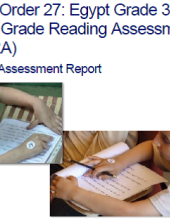
This report presents key findings of a national, stratified random sample of classroom observations of Grade 3 reading instruction in Ministry of Education (MOE) schools. Classroom observation was a component activity of the 2nd national Early Grade Reading Assessment (EGRA) for Grade 3 implemented in April 2014. The classroom observations were completed in a random sub-set of 39 schools from the larger EGRA sample of 200 schools: 40 primary schools from each of five sub-national regions encompassing 25 of Egypt’s 27 governorates.1 One Grade 3 class, randomly selected, was observed in each school. Each classroom observation applied a formal instrument to the observation of a full class period of Grade 3 Arabic reading plus separate interviews with the observed teacher, school principal and librarian. All observations were conducted by trained MOE staff with significant experience of both the ministry’s Early Grade Reading Program and reading assessment. Schools were not informed in advance of the classroom observation.
Assoc. Photo (Port.)
egypt3.png
Country
Resource Type
Resource Language
Month and Year

Task Order 27: Egypt Grade 3 Early Grade Reading Assessment (EGRA) Group Assessment Report (English and Arabic Versions)

Submitted by admin on
Description/Abstract
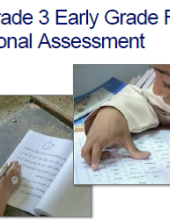
The purpose of this pilot was two-fold: 1) examining the reliability of the group assessment tool to measure the construct of early grade reading; 2) determining whether or not the group assessment could be used as a partial replacement for the individual EGRA.
Assoc. Photo (Port.)
egypt2.png
Country
Resource Type
Month and Year

Egypt Grade 3 Early Grade Reading 2nd National Assessment (English and Arabic Versions)

Submitted by admin on
Description/Abstract
This report presents key findings of the 2nd national assessment of Grade 3 reading skills in primary schools of the Ministry of Education (MOE) in Egypt. This mid-line assessment reports early progress and student achievements after three years’ implementation of the MOE Early Grade Reading Program nationwide, albeit only one year at Grade 3 level. The MOE program, initiated in Grade 1 during the 2011/12 school year, added enhanced reading instruction to Grade 2 in 2012/13 and then to Grade 3 in 2013/14. This 2nd national assessment measures the improvement in Arabic reading proficiency of this first cohort of MOE students to receive successive years of improved reading instruction in Grades 1-3. The findings of this mid-line assessment provide timely results and empirical measures of the initial progress and reading outcomes of the MOE’s Reading Program since the national Early Grade Reading Assessment (EGRA) baseline for Grade 3 in 2013.

Assoc. Photo (Port.)
egypt1.png
Country
Resource Type
Resource Language
Month and Year

Proposing Benchmarks and Targets for Early Grade Reading and Mathematics in Zambia

Submitted by admin on
Description/Abstract
A National Policy Dialogue Workshop was held on July 1, 2015, followed immediately by a Benchmark Setting Workshop July 2–3, to address the question: "What is an acceptable level of reading and mathematics achievement for Zambian pupils in the early grades of primary school?”

Assoc. Photo (Port.)
zambia3.png
Country
Resource Type
Month and Year

National Assessment Survey of Learning for Grade 2: Preliminary Results for Early Grade Mathematics in Zambia

Submitted by admin on
Description/Abstract
The 2014 Standard 2 National Assessment Survey (NAS) was intended to provide a national measure of pupil reading (local languages and English) and mathematics skills. The final report for the entire survey will consist of three main sections reporting pupil reading performance: • Early Grade Reading Assessment (EGRA) by local language • Early Grade Reading Assessment in English • Early Grade Mathematics Assessment (EGMA) This preliminary report focuses on presenting only the results for the EGMA.
Assoc. Photo (Port.)
Resource (File)
Country
Resource Type
Month and Year
Publisher Or Client
DFID

USAID/Zambia Education Project Baseline Report: Nonreading Indicators

Submitted by admin on
Description/Abstract
RTI International was asked to develop 10 nonreading indicators (NRI) related to improved early grade reading (EGR) in Zambia—or more generally, to improved learning outcomes. Accordingly, the desk study that was required as background research for this effort focused on the international literature related to high performing education systems and schools, or “effective schools”; and our own research and experience in the realm of systems reform and reform support for improved learning outcomes. While some of the findings of this desk study may not be immediately applicable to the Zambian context, they nevertheless helped to create an overall understanding of what is needed by a system to improve learning outcomes, and so inform our effort to develop 10 nonreading indicators. The general findings of this desk study are as follows.
Assoc. Photo (Port.)
zambia 2.png
Country
Resource Type
Month and Year