Global

IE Selected Publications (2015 - 2018)

Submitted by admin on
Description/Abstract
This is a list of select peer-reviewed publications by International Education staff between 2015 and 2018. For some of the publications, links to information about the documents and related resources can be found on this websiate. Where possible, the DOI has been included in the attached brief.

Assoc. Photo (Port.)
publications2.jpg
Resource (File)
Country
Resource Type
Resource Language
Month and Year
Publisher Or Client
RTI International

Worldwide Inequality and Poverty in Cognitive Results: Cross-sectional Evidence and Time-based Trends

Submitted by admin on
Description/Abstract
The Sustainable Development Goals (SDGs) for education represent a major departure from the Millennium Development Goals (MDGs) - at least if educational leaders act seriously in their pursuit - in at least two important respects. First, the goals now pertain to learning outcomes. Second, there is a great deal of focus on inequality in the SDGs. Taking note of this new dual emphasis of the SDGs, this paper assembles the largest database of learning outcomes inequality data that we know of, and explores key issues related to the measurement of inequality in learning outcomes, with a view to helping countries and international agencies come to grips with the key dimensions and features of this inequality. Two issues in particular are explored. First, whether, as countries improve their average cognitive performance (as measured by international learning assessments) from the lowest to middling levels, they typically reduce cognitive skill inequality or, more importantly perhaps, whether they reduce absolute lack of skills. Second, whether most of cognitive skills inequality is between or within countries. In dealing with these measurement issues, the paper also explores the degree to which measures of cognitive skills are “proper” cardinal variables lending themselves to generalizations from the field of income and wealth distribution—the field for which many measures of inequality and its decomposition were first applied. To do this, we look into whether using the item response theory (IRT) test scores of programmes such as TIMSS influence these types of findings, relative to the use of the underlying and more intuitive classical test scores. Patterns emerging from the classical scores are far less conclusive than those of the IRT scores, in part due to the greater ability of the IRT scores to discriminate between pupils at the bottom end of the performance spectrum. An important contribution of the paper is to examine the sensitivity of standard measures of inequality to different sets of test scores. The sensitivity is high, and the conclusion is that meaningful comparisons between test score inequality and, for instance, income inequality are not possible, at least not using the currently available toolbox of inequality statistics. Finally, the paper explores the practical use of school-level statistics from the test data to inform strategies for reducing inequalities.
Assoc. Photo (Port.)
12_Poverty_0.jpg
Country
Resource Type
Resource Language
Month and Year
Publisher Or Client
Research on Improving Systems of Education (RISE) Programme

Introducing EF Touch (Presentation)

Submitted by admin on
Author
Description/Abstract
Executive Function (EF) refers to a range of cognitive skills that are key to problem solving and a child's ability to “learn how to learn.” These skills experience an important growth period during early childhood; thus, between 2005 and 2010, researches at the University of North Carolina designed a battery of tools to measure these skills in pre-school aged children known as EF Touch. In 2016, RTI International – a research institute dedicated to evidence-based approaches to education policy and practice - identified EF Touch as a unique opportunity to integrate early childhood EF measurement in its battery of existing international education assessment tools. EF Touch was originally developed by UNC in note card format; then adapted to a paper and pencil format; and later transitioned to laptop and touch-screen monitor “station” requiring two assessors and an expensive third party scoring software. Although the laptop mediated approach was an improvement on paper-based administration, it was still clear that this model was not sustainable, portable, or cost effective for large deployment in the low and middle income (LMIC) contexts where RTI most often works – and where very little research on EFs in young children has been thus far conducted). Therefore, RTI sought to adapt Tangerine® - an open source software designed by RTI for low cost, large-scale, offline assessment – for use in the administration of EF Touch. More than 60 organizations worldwide have used Tangerine on tablets to conduct 1,500,000+ surveys in 70 countries and 100 languages. To accommodate the specific requirements of EF Touch, the Tangerine platform needed extensive modification to accommodate the specific needs of EF touch, including new A/V capabilities, unique millisecond time-stamps indicating reaction time, plus the development of complex skip logic commands tailored to individual performance. The resulting Tangerine-mediated battery of EF Touch tasks were designed to remain scientifically rigorous while significantly reducing costs (one assessor, one tablet); increasing scalability in developing country contexts (offline assessment); and reducing the burden of complicated data entry (data uploaded directly to the server). This presentation provides an overview of EF touch, including the adaptation process to Tangerine and recent results from two field deployments in Kenya. The attached presentation does not contain video files to due the attachment size. The full presentation with videos of task demonstrations can be found via the included google drive link.
Assoc. Photo (Port.)
eft.jpg
Resource (File)
Country
Resource Type
Resource Language
Month and Year

Tangerine: Evaluaciones Móbiles de Manera Sencilla

Submitted by admin on
Description/Abstract
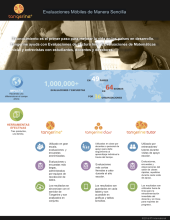
Tangerine overview in Spanish
Assoc. Photo (Port.)
tang spanish.png
Resource (File)
Country
Resource Type
Resource Language
Month and Year
Publisher Or Client
RTI

ACR-Asia: Research Report: Investing in Early Grade Reading in Lower and Middle-income Countries in Asia

Submitted by admin on
Description/Abstract
USAID/Washington, via the All Children Reading (ACR)—Asia task order, commissioned RTI International to conduct research on whether lower and middle-income countries in Asia should invest in early grade reading. To do so, we consider the relationship between increased literacy and employment and social outcomes. We also investigate evolving job opportunities in developing Asian economies, their literacy requirements, and the relationship of Asian growth to the US economy. We then examine data on the current literacy levels among school-going and young-adult populations in Asian countries to see if they meet the needs revealed by job market trends in Asia. The analyses presented in this report show conclusively that it continues to be important for lower and middle income countries in Asia to invest in improving the teaching and learning of literacy skills in early grades. Emphasis should be placed not only on foundational skills, but also on applied skills, such as reading for comprehension across subject areas and applying information gleaned through reading various types of text to understand and solve increasingly complex problems. Education systems therefore must address the full continuum of reading skills development, beginning in the early years and throughout primary school.
Assoc. Photo (Port.)
asia.png
Resource (File)
Country
Resource Type
Featured projects
Resource Language
Month and Year

All Children Reading-Asia: EGRA Benchmarks and Standards Research Report

Submitted by admin on
Description/Abstract
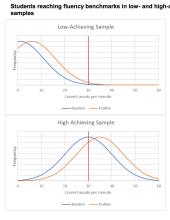
The Early Grade Reading Assessment (EGRA) is widely used to assess reading proficiency in developing countries. Benchmarks were introduced to simplify EGRA results into a single indicator against which countries could measure their children’s reading progress. This report is about the process, rational and considerations for setting benchmarks (a desired level of performance on a reading task) and targets (the percent of students intended to reach the performance level). The report addresses three purposes of benchmarking: 1. Country purpose: Track progress in reading within a national education system and provide data to inform efforts to improve education quality. 2. Agency purpose: Help USAID monitor the progress of projects and countries working to reach specific children-reading goals. 3. The global purpose: Measure progress in reading for all; provide a basis for global advocacy; and provide
Assoc. Photo (Port.)
ACR benchmarks portrait.jpeg
Country
Resource Type
Featured projects
Resource Language
Month and Year

Measures of quality through classroom observation for the Sustainable Development Goals: Lessons from low-and-middle-income countries

Submitted by admin on
Description/Abstract
Background paper prepared for the 2016 Global Education Monitoring Report Education for people and planet: Creating sustainable futures for all With the adoption of the United Nations General Assembly’s Sustainable Development Goals (SDGs), global education agencies are grappling with how quality can and should be measured for global reporting purposes. Several factors at the education system, school, and classroom levels shape education quality, including the limited information available at the global level about what is happening in the classroom. Such information can only come through observation-based measures that record teacher practices, either through routine monitoring conducted by system actors or through surveys. Classroom observation is used extensively in not only teacher education and professional development, but also in evaluation studies. However, there are fewer cases where classroom observations are used for system monitoring purposes—particularly in low- and middle- income countries. This paper reviews what has been learned from observation instruments in low- and middle-income countries and what opportunities (i.e., scope) there are to systematize these countries to that they can monitor quality at both the school and system levels.
Assoc. Photo (Port.)
gmr.png
Resource (File)
Country
Resource Language
Month and Year
Publisher Or Client
UNESCO Global Monitoring Report

Principles for Digital Development - Tangerine: Mobile Assessments Made Easy

Submitted by admin on
Author
Description/Abstract
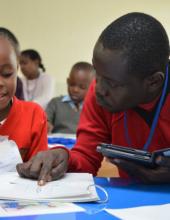
This case study was selected by the Digital Principles for Development as a model illustrating the principles of "design with the user in mind" and "be data driven".
Assoc. Photo (Port.)
prin.png
Country
Resource Language
Month and Year
Publisher Or Client
Principles for Digital Development

RTI International wins 2018 Digital Edge 50 award for education tool

Submitted by admin on
Description/Abstract
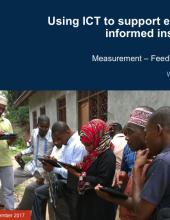
RTI International has been honored with a 2018 Digital Edge 50 Award for being a leader in digital innovation. The prestigious award recognizes a new open-source tool recently developed by RTI to measure executive function (EF) skills in pre-school aged children The tool, EF Touch, is administered using Tangerine®, RTI’s open source software that was designed to transform the way teachers, coaches and researchers assess and observe literacy and numeracy teaching and learning.
Assoc. Photo (Port.)
tangerine_use_of_the_tablets_510.jpg
Country
Resource Language
Month and Year

Using ICT to support evidence-informed instruction [Presentation]

Submitted by admin on
Description/Abstract
This presentation was delivered by Wendi Ralaingita at the Open Learning Exchange (OLE) conference in Kathmandu, Nepal (November 2017). It provides an overview of RTI's evidence-based approach to ICT integration, based largely on the Improvement Science literature, particularly Edward Deming. Describes uses of Tangerine open-source software for teacher coaching (Tangerine:Tutor) and classroom continuous assessment (Tangerine:Class) as well as hearing and vision screening tools integrated with EGRA and EGMA assessments.
Assoc. Photo (Port.)
OLE ICT Conference_RTI Presentation 2017.jpg
Resource (File)
Country
Resource Type
Resource Language
Month and Year
Publisher Or Client
RTI International