Presentations | 3 March 2023
The Teacher Professional Support System in Nepal: A case of implementation research informing policy [CIES 2023 Presentation]
In 2014, the Nepal Ministry of Education, Science, and Technology (MOEST) developed a National Early Grade Reading Program (NEGRP), aimed at improving the reading achievement of early-grade students throughout Nepal.
Presentations | 2 March 2023
Strengthening sector capacity for Student Learning Assessment in the context of bilingualism in Senegal [CIES 2023 Presentation]
This presentation on development of an assessment system under Senegal's new bilingual policy includes an explanation of the bilingual policy in Senegal and plans for development of a national assessment system including use of the ANLAS methodology (Analysis of National Learning Assessment Systems)
Instruments and Questionnaires | 28 February 2023
Early Grade Reading and Mathematics Initiative: KG Data for Decision-Making: Phase II National Survey of Families
The Kingdom of Jordan’s Human Resource Development (HRD) Strategy mandates the universal provision of kindergarten (KG2) by 2025.
Presentations | 24 February 2023
Analyzing Alignment in Early Grade Reading Curricula, Instruction, and Assessment in Nepal: The Surveys of Enacted Curriculum Approach [CIES 2023 Presentation]
This presentation was given at the Comparative and International Education Society (CIES) annual conference in Washington, DC on February 21, 2023.
Presentations | 24 February 2023
Measuring support for children’s engagement in learning: psychometric properties of the PLAY toolkit [CIES 2023 Presentation]
Despite the growing interest in supporting learning through play across many low and middle-income countries, measures of how contexts can support learning through play are lacking.
Presentations | 23 February 2023
Multi-Language Assessment (MLA) for young children: A screener to understand language assets [CIES 2023 Presentation]
The lack of information about children’s oral language skills limits our understanding of why some children do not respond to literacy instruction.

Briefs | 25 May 2022
What Works to Improve Learning at Scale? Key Findings from Learning at Scale and the Kenya Tusome Early Grade Reading Activity
This brief presents findings on what worked to improve learning outcomes at scale under 8 successful early grade literacy programs, with a focus on findings from the Tusome program in Kenya.1 These findings were generated as part of the Learning at Scale study, conducted by RTI International with th
Presentations | 6 May 2022
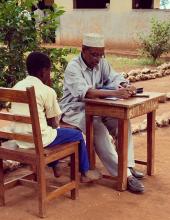
Building an Assessment of Community Defined Social-Emotional Competencies from the Ground Up - A Tanzanian Example
Most of the research that informs our understanding of children’s social-emotional learning (SEL) comes from Western, Educated, Industrialized, Rich, Democratic (WEIRD) societies where behavior is guided by a view of the self as autonomous, acting on individual preferences.

Presentations | 4 May 2022
Agent-based modeling: Understanding influence of teacher-student interactions on learning and equity [CIES Presentation]
“Agent based modeling: A method for understanding individual, social, and environmental influences on learning and equality in the classroom.”
Learning science in the past decade has provided considerable evidence that learning is at once emotional, social, and cognitive (MH Immordino-Yang, et al 20
Presentations | 4 May 2022
Social Network Analysis Methods for Higher Education Development [CIES Presentation]
Social network analysis methods for international development: Applications in higher education development.
Social Network Analysis (SNA) is a promising yet underutilized tool in the international development field.