Monitoring, Evaluation, and Research

Setting and Using Benchmarks for Reading Performance

Submitted by admin on
Description/Abstract
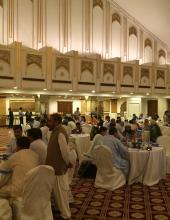
The spread of the Early Grade Reading Assessment (EGRA) has yielded a wealth of country-specific evidence on students’ literacy skills. Those data were then used to help a dozen countries set meaningful benchmarks for student reading performance. This brief summarizes the approach used, shares the results of the benchmarking workshops, and draws some lessons from our experience.
Assoc. Photo (Port.)
Benchmarking Pakistan1_2015-06-11 11.34.24.jpg
Resource (File)
Country
Resource Type
Month and Year

Lot Quality Assurance Sampling (LQAS) Pilot Activities in Amhara and Tigray, Ethiopia: Final Report

Submitted by admin on
Description/Abstract
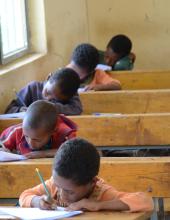
This report summarizes main findings and lessons learned from the piloting of the lot quality assurance sampling (LQAS) methodology in the education sector in Ethiopia. It also suggests next steps for applying the LQAS methodology more broadly for education program monitoring.
Assoc. Photo (Port.)
Ethiopia_LQA_April2016 (378).jpg
Resource (File)
Country
Resource Type
Resource Language
Month and Year
Publisher Or Client
USAID

Development and Pilot Testing of Additional Subtasks for the Early Grade Reading Assessment: EGRA 2.0

Submitted by admin on
Description/Abstract
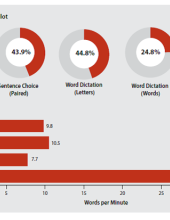
In 2016, RTI International suggested piloting additional subtasks to enhance the Early Grade Reading Assessment instrument. Researchers from RTI collaborated with a team of researchers in Accra, Ghana, to adapt, refine and pilot four subtasks. The work was funded under an EdData II task order, “Measurement and Research Support to Education Strategy Goal 1.” This report describes the skills assessed, the four subtasks, the pilot, and the results.
Assoc. Photo (Port.)
egra 2.0.png
Country
Resource Type
Month and Year

Complements to the Early Grade Reading Assessment: Spelling, Reading Comprehension, and Oral Language Subtasks

Submitted by admin on
Description/Abstract
The EGRA has been a useful tool to understand students’ progress toward fluent reading. However, users are often left wanting additional information about reading comprehension, writing, and language. The subtasks that we piloted in the research activity described in this brief can give researchers and practitioners more detailed information to understand the early literacy abilities of students in low-income contexts.
Assoc. Photo (Port.)
egra 2.0.png
Resource (File)
Country
Resource Type
Month and Year

Results of Social and Behavior Change Communication Pilots in Senegal and Malawi

Submitted by admin on
Description/Abstract
Social and behavior change communication (SBCC) represents the culmination of decades of research and practice in the public health field, where communication has been a critical element of efforts to encourage positive health behaviors. A basic tenet of SBCC is that information is necessary but seldom sufficient to sustainably change behavior (C-Change, 2012). The methodology bridges the gap between awareness and action by influencing the beliefs that can block or enable needed behavior change.
Assoc. Photo (Port.)
senegalSBCC_port2.png
Resource (File)
Country
Resource Type
Month and Year

An Addition to the Toolbox for Measuring Literacy Skills of the Youngest Students: The Group Administered Literacy Assessment (GALA)

Submitted by admin on
Author
Description/Abstract
The GALA was designed to maximize the benefits of a group-administered instrument, while also taking advantage of lessons learned from the individually administered Early Grade Reading Assessment (EGRA). It limits administration time; can be administered with minimal training; has a simplified scoring system; is based on a previously validated tool; assesses a full range of early grade literacy skills; does not rely on passage reading; and can be adapted for new contexts and languages.
Assoc. Photo (Port.)
GALA_2016-08-04 08.56.22.jpg
Resource (File)
Country
Resource Type
Month and Year

Learning Outcomes Assessments and Numeracy With Reference to Early Grade Numeracy in Low Income Countries

Submitted by admin on
Description/Abstract
The focus of this desk study is to provide information on the assessment of early numeracy learning outcomes as an integral part of efforts aimed at increasing education quality in low income countries. In order to provide focus for the study, GIZ identified three assessment-related challenges, which are crosscutting for each of the sections of the study: Using assessment to support children in mastering foundational concepts and competencies, such as number sense and computation. 2. Relating or adapting assessment to the environments of children in low income countries. 3. Applying assessment to understand the strengths and weaknesses of the informal mathematics that children bring to school.

Assoc. Photo (Port.)
giz.png
Country
Resource Type
Resource Language
Month and Year
Publisher Or Client
Deutsche Gesellschaft für Internationale Zusammenarbeit (GIZ) GmbH

Learning Outcomes Assessments and Numeracy With Reference to Early Grade Numeracy in Low Income Countries (Presentation)

Submitted by admin on
Description/Abstract
The focus of this desk study is to provide information on the assessment of early numeracy learning outcomes as an integral part of efforts aimed at increasing education quality in low income countries. In order to provide focus for the study, GIZ identified three assessment-related challenges, which are crosscutting for each of the sections of the study: Using assessment to support children in mastering foundational concepts and competencies, such as number sense and computation. 2. Relating or adapting assessment to the environments of children in low income countries. 3. Applying assessment to understand the strengths and weaknesses of the informal mathematics that children bring to school.

Assoc. Photo (Port.)
math pres.png
Country
Resource Type
Resource Language
Month and Year
Publisher Or Client
Deutsche Gesellschaft für Internationale Zusammenarbeit (GIZ) GmbH

Using an Assessment of Early Mathematical Knowledge and Skills to Inform Policy and Practice: Examples from the Early Grade Mathematics Assessment

Submitted by admin on
Description/Abstract
Article published in the International Journal of Education in Math, Science and Technology, Volume 4, Number 3. (Open Access). Published abstract: "This paper describes the development and intended uses of the Early Grades Mathematics Assessment (EGMA), which measures essential early mathematical knowledge and skills that are foundational to more sophisticated mathematical abilities, predictive of later achievement, and teachable. Administering the EGMA can provide policy makers, practitioners, and researchers with information about whether existing educational policies, curricular reforms or programs, and instructional interventions are supporting students in reaching important goals in mathematics. We highlight the utility of the EGMA results in three abbreviated illustrations of implementation studies in low-income countries. Recommendations for policy makers, practitioners, and researchers are provided."
Assoc. Photo (Port.)
publications icon purchased sm.png
Country
Resource Type
Resource Language
Month and Year
Publisher Or Client
International Journal of Education in Mathematics, Science and Technology

Early Grade Mathematics Assessment (EGMA) Toolkit

Submitted by admin on
Description/Abstract
The EGMA Toolkit provides detailed information about the Early Grade Mathematics Assessment. The first chapter provides an introduction to the instrument and summarizes the purposes of the assessment. Chapter 2 discusses the development of the EGMA, including the theoretical foundations of the instrument. Chapter 3 details the technical adequacy of the EGMA. Chapter 4 provides information on adaptation and training.
Assoc. Photo (Port.)
Screen Shot 2017-02-21 at 10.17.05 AM.png
Resource (File)
EGMA Toolkit_Nov 2022.pdf
Country
Resource Type
Resource Language
Month and Year
Publisher Or Client
RTI