Evaluation

Education Evaluation Services in the Democratic Republic of Congo (DRC) The DRC 2015 Early Grade Reading Assessment, Early Grade Mathematics Assessment, and Snapshot of School Management Effectiveness – Grade 3 Report of Findings

Submitted by admin on
Description/Abstract
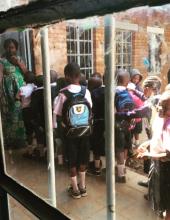
This study primarily provides USAID and the GDRC with information regarding the ability of Grade 3 children to read in three of the DRC’s national languages (Lingala, Kiswahili, and Tshiluba), those same pupils’ receptive and productive oral French skills, and Grade 5 children’s ability to read in French. Other elements of the study provide insight into the numeracy skills of Grade 3 children in one district in Katanga as well as the French reading and numeracy skills of Level 3 pupils in the Accelerated Learning Programs (ALPs). The study also provides background context and data related to key pupil, teacher, head teacher, and school variables that are hypothesized to be good predictors of pupil performance in early grade literacy and numeracy. This diagnostic information will help policymakers make data-informed decisions regarding remediation strategies that can improve the quality of instruction and pupil learning outcomes in early primary grades. English and French versions are available for download.
Assoc. Photo (Port.)
Resource Language
Month and Year

Education Evaluation Services in the Democratic Republic of Congo (DRC): The DRC 2015 Early Grade Reading Assessment and Snapshot of School Management Effectiveness Grade 5 Report of Findings

Submitted by admin on
Description/Abstract
This study primarily provides USAID and the GDRC with information regarding the ability of Grade 3 children to read in three of the DRC’s national languages (Lingala, Kiswahili, and Tshiluba), those same pupils’ receptive and productive oral French skills, and Grade 5 children’s ability to read in French. Other elements of the study provide insight into the numeracy skills of Grade 3 children in one district in Katanga as well as the French reading and numeracy skills of Level 3 pupils in the Accelerated Learning Programs (ALPs). The study also provides background context and data related to key pupil, teacher, head teacher, and school variables that are hypothesized to be good predictors of pupil performance in early grade literacy and numeracy. This diagnostic information will help policymakers make data-informed decisions regarding remediation strategies that can improve the quality of instruction and pupil learning outcomes in early primary grades. English and French versions of the report are available for download.
Assoc. Photo (Port.)
IMG_2107.JPG
Resource (File)
Resource Type
Resource Language
Month and Year

School Quality Assessment for Education and WASH in Three UNICEF-Supported Regions

Submitted by admin on
Description/Abstract
This is the inception report for the School Quality Assessment for Education and WASH in Three UNICEF-Supported Regions of Tanzania. The report outlines the approach to the study including the fundamental research questions and associated design to implementing the study.
Assoc. Photo (Port.)
tz wash.png
Resource (File)
Resource Type
Resource Language
Month and Year
Publisher Or Client
UNICEF Dar es Salaam, Tanzania

Development and Pilot Testing of Additional Subtasks for the Early Grade Reading Assessment: EGRA 2.0

Submitted by admin on
Description/Abstract
In 2016, RTI International suggested piloting additional subtasks to enhance the Early Grade Reading Assessment instrument. Researchers from RTI collaborated with a team of researchers in Accra, Ghana, to adapt, refine and pilot four subtasks. The work was funded under an EdData II task order, “Measurement and Research Support to Education Strategy Goal 1.” This report describes the skills assessed, the four subtasks, the pilot, and the results.
Assoc. Photo (Port.)
egra 2.0.png
Country
Resource Type
Month and Year

Complements to the Early Grade Reading Assessment: Spelling, Reading Comprehension, and Oral Language Subtasks

Submitted by admin on
Description/Abstract
The EGRA has been a useful tool to understand students’ progress toward fluent reading. However, users are often left wanting additional information about reading comprehension, writing, and language. The subtasks that we piloted in the research activity described in this brief can give researchers and practitioners more detailed information to understand the early literacy abilities of students in low-income contexts.
Assoc. Photo (Port.)
egra 2.0.png
Resource (File)
Country
Resource Type
Month and Year

Learning Outcomes Assessments and Numeracy With Reference to Early Grade Numeracy in Low Income Countries

Submitted by admin on
Description/Abstract
The focus of this desk study is to provide information on the assessment of early numeracy learning outcomes as an integral part of efforts aimed at increasing education quality in low income countries. In order to provide focus for the study, GIZ identified three assessment-related challenges, which are crosscutting for each of the sections of the study: Using assessment to support children in mastering foundational concepts and competencies, such as number sense and computation. 2. Relating or adapting assessment to the environments of children in low income countries. 3. Applying assessment to understand the strengths and weaknesses of the informal mathematics that children bring to school.
Assoc. Photo (Port.)
giz.png
Country
Resource Type
Resource Language
Month and Year
Publisher Or Client
Deutsche Gesellschaft für Internationale Zusammenarbeit (GIZ) GmbH

Learning Outcomes Assessments and Numeracy With Reference to Early Grade Numeracy in Low Income Countries (Presentation)

Submitted by admin on
Description/Abstract
The focus of this desk study is to provide information on the assessment of early numeracy learning outcomes as an integral part of efforts aimed at increasing education quality in low income countries. In order to provide focus for the study, GIZ identified three assessment-related challenges, which are crosscutting for each of the sections of the study: Using assessment to support children in mastering foundational concepts and competencies, such as number sense and computation. 2. Relating or adapting assessment to the environments of children in low income countries. 3. Applying assessment to understand the strengths and weaknesses of the informal mathematics that children bring to school.

Assoc. Photo (Port.)
math pres.png
Country
Resource Type
Resource Language
Month and Year
Publisher Or Client
Deutsche Gesellschaft für Internationale Zusammenarbeit (GIZ) GmbH

Using an Assessment of Early Mathematical Knowledge and Skills to Inform Policy and Practice: Examples from the Early Grade Mathematics Assessment

Submitted by admin on
Description/Abstract
Article published in the International Journal of Education in Math, Science and Technology, Volume 4, Number 3. (Open Access). Published abstract: "This paper describes the development and intended uses of the Early Grades Mathematics Assessment (EGMA), which measures essential early mathematical knowledge and skills that are foundational to more sophisticated mathematical abilities, predictive of later achievement, and teachable. Administering the EGMA can provide policy makers, practitioners, and researchers with information about whether existing educational policies, curricular reforms or programs, and instructional interventions are supporting students in reaching important goals in mathematics. We highlight the utility of the EGMA results in three abbreviated illustrations of implementation studies in low-income countries. Recommendations for policy makers, practitioners, and researchers are provided."
Assoc. Photo (Port.)
publications icon purchased sm.png
Country
Resource Type
Resource Language
Month and Year
Publisher Or Client
International Journal of Education in Mathematics, Science and Technology

Early Grade Mathematics Assessment (EGMA) Toolkit

Submitted by admin on
Description/Abstract
The EGMA Toolkit provides detailed information about the Early Grade Mathematics Assessment. The first chapter provides an introduction to the instrument and summarizes the purposes of the assessment. Chapter 2 discusses the development of the EGMA, including the theoretical foundations of the instrument. Chapter 3 details the technical adequacy of the EGMA. Chapter 4 provides information on adaptation and training.
Assoc. Photo (Port.)
Screen Shot 2017-02-21 at 10.17.05 AM.png
Resource (File)
EGMA Toolkit_Nov 2022.pdf
Country
Resource Type
Resource Language
Month and Year
Publisher Or Client
RTI

Nigeria Reading and Access Research Activity (RARA): Results of an Approach to Improve Early Grade Reading in Hausa in Bauchi and Sokoto States

Submitted by admin on
Description/Abstract
From December 2014 to June 2015, the Nigeria Reading and Access Research Activity (RARA) evaluated the effectiveness of an instructional approach to improving Hausa early grade reading outcomes among Primary 2 pupils in the Northern Nigerian states of Bauchi and Sokoto. The approach was designed and implemented by RTI International, in collaboration with Nigerian education authorities, in particular the State Universal Basic Education Boards (SUBEBs) of Bauchi and Sokoto, as well as Colleges of Education (COEs) in these states. It was funded by the United States Agency for International Development (USAID) through the Education Data for Decision Making (EdData II) mechanism (www.eddataglobal.org). This report presents the results of the reading approach evaluation on teacher practices, children's reading outcomes, and instructional leadership.
Assoc. Photo (Port.)
rara.png
Country
Resource Type
Resource Language
Month and Year
Publisher Or Client
USAID