Instruments and Questionnaires

Uganda/LARA EGR Monitoring and Support Supervision Tools

Submitted by admin on
Description/Abstract
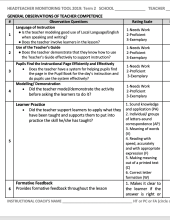
There are two sets of monitoring and support supervision (MSS) tools that the project has been using throughout the implementation period. These are; (i) the Lesson Observation Tools; and (ii) the Head teacher/CCT Coaching Tool. The lesson observation tools are used by the support supervision actors (e.g., school inspectors, CCTs, head teachers and project staff) during support supervision visits to schools. Specifically, the tools gather monitoring data on the uptake of EGR instructional methods by teachers to understand what teachers are doing well and areas where they need support. LARA developed a lesson observation tool for every grade (P1 – P4). Each tool has a section to assess the teacher’s preparedness for the lesson they are going to teach; a check list to assess the teacher’s instructional practices during the lesson; and the post observation section where the support supervision actor summarizes what the teacher did well and areas that the teacher needs to improve. The lesson observation tool for each grade is accompanied by a learner check which is administered to a sample of 4-6 learners per grade. The purpose of a learner check is to quickly show the classroom teacher and or head teacher the reading abilities of the learners present in the observed EGR lesson. The learner checks are designed from the content of the previous weeks and the teacher is able to gauge and determine the areas to prioritize when carrying out revision or remedial sessions. The Head teacher/CCT Coaching Tool is used by the zonal head teachers and CCTs to support head teachers so that they can in turn effectively support teachers in their schools. The zonal head teachers and CCTs observe and support head teachers to provide effective instructional support to teachers. The tool has a pre-observation section which assesses how the head teacher is prepared to support the teacher in class; a lesson observation section used by the zonal head teachers and CCTs to evaluate the actions of the head teacher while in the class observing the lesson; and post observation section to appraise how the head teacher conducts the post observation discussion with the teacher.
Assoc. Photo (Port.)
Screen Shot 2020-12-18 at 7.54.47 AM.png
Country
Month and Year
Publisher Or Client
USAID/Uganda Literacy Achievement & Retention Activity

Uganda/LARA : EGRA and supplementary data collection instruments

Submitted by admin on
Author
Description/Abstract
The Early Grade Reading Assessment (EGRA) is a diagnostic instrument designed to quickly assess foundational skills for literacy acquisition of pupils in Early Grades of primary school. This diagnostic tool, whose content has been adapted for Uganda and Ugandan local languages, can include a number of subtasks depending on the grade being assessed. EGRA is administered to pupils both in their local language and in English via tablets using a software application (for example Tangerine) designed specifically to collect data on mobile devices. EGRA data can also be gathered manually using paper forms. Each instrument is administered by trained assessors in one-on-one sessions with individual pupils, and requires approximately fifteen minutes. The sub tasks in the English EGRA tools used by LARA include letter sound knowledge, oral passage reading, reading comprehension and vocabulary. LARA administers the English sub-tasks mainly to the P3 and P4 pupils. The subtasks in the local language (Luganda, Runyankore/Rukiga and Runyoro/Rutooro) EGRA tools include orientation to print, letter sound knowledge, segmenting, oral passage reading, reading comprehension, and listening comprehension. Apart from orientation to print that is administered to only P1 pupils, the rest of the local language sub-tasks are administered to P1-P4 pupils. The EGRA tools are accompanied by a pupil stimuli packet used to administer the letter sound knowledge and oral passage reading sub tasks. The subtasks used by LARA were adopted from the EGRA tools developed for the School Health and Reading Program (SHRP). SHRP adapted and vetted the tools to the three languages during a series of weeklong workshops that included researchers, primary school teachers, language board members, Coordinating Center Tutors (CCTs) and MoES staff. The adaptation workshop for Luganda was held in December, 2012, Runyankore/Rukiga tools were adapted in January, 2013 and Runyoro/Rutooro tools were adapted in August 2013. The tools were also piloted in each of the three language areas during the workshops. As part of EGRA data collection, LARA administers supplementary data collection tools to assess pupil context and instructional leadership. The tools also provide important contextual information on the teachers and schools participating in EGRA. These tools include; the pupil context interview, a head teacher interview, teacher interview and school inventory. The following provides a summary of each of the tool. Pupil context interview: Used to gather information on pupils’ preschool attendance, language spoken at home, possessions in the household, and support for reading in the home. Head Teacher Questionnaire: Used to gather information from head teachers regarding their instructional leadership, including their training and education background and their support to the teaching of reading at lower grades. Data from this instrument is used to inform training and targeted corrective actions intended to improve the managerial skills of head teachers and their support to the teaching of reading. Teacher Questionnaire: Used to gather information on the teachers’ education and experience and demographics, support and supervision received, and the availability of teaching materials. The information provides the basis of training and the provision of teaching materials to teachers to help them improve their pedagogical skills. School Inventory Form: Used to gather information on school basic infrastructure (for example water source, latrines and electricity) as well as the presence and use of a school library.
Assoc. Photo (Port.)
Screen Shot 2020-12-17 at 8.13.54 PM.png
Country
Resource Language
Month and Year
Publisher Or Client
USAID

DREAMS Registers (for use with Journeys+)

Submitted by admin on
Description/Abstract
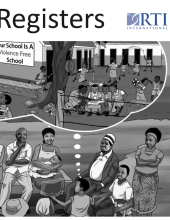
DREAMS registers are used to register and track all children participating in Journeys Plus activities and dialogue meetings to determine the number of activities attended over a given period. The registers are used also to track DREAMS girls attendance before updating their service records in the DREAMS tracker
Assoc. Photo (Port.)
Screen Shot 2020-12-15 at 10.57.44 AM.png
Resource (File)
Country
Sub-topic
Resource Language
Month and Year
Publisher Or Client
USAID

Community Change Agents Register (for use with Journeys+)

Submitted by admin on
Description/Abstract
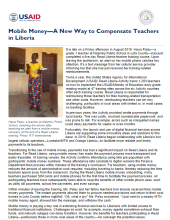
Community Change Agents (CCA) Register is a tool used by community change agents to register community members attending Journeys community dialogue meeting to prevent violence and protect children in their communities. The register has a section where all cases of child abuse are recorded and referred to the sub county for attention
Assoc. Photo (Port.)
Screen Shot 2020-12-15 at 11.03.29 AM.png
Resource (File)
CCA REGISTER (1).pdf
Country
Month and Year
Publisher Or Client
USAID

Core Early Grades Mathematics Assessment (EGMA) Instrument

Submitted by admin on
Description/Abstract
Core EGMA instrument in English
Assoc. Photo (Port.)
Mobile Money.PNG
Resource (File)
Core EGMA_March 2014.pdf
COREEGMA_Stimuli.pdf
Country
Resource Language
Month and Year
Publisher Or Client
RTI

Survey of Student Perceptions of School Climate

Submitted by admin on
Description/Abstract
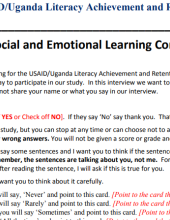
Survey of Student Perceptions of School Climate; developed by RTI under the Uganda LARA project in May 16 2018
Assoc. Photo (Port.)
SEL climate.png
Country
Sub-topic
Month and Year

Survey of Student Social and Emotional Competencies and Agency

Submitted by admin on
Description/Abstract
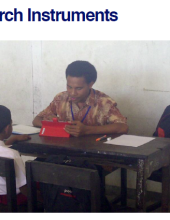
Survey of Student Social and Emotional Competencies and Agency; developed by RTI under the Uganda LARA project in May 2018
Assoc. Photo (Port.)
SEL Tool Uganda.png
Country
Sub-topic
Month and Year

Indonesia 2014 EGRA and SSME Instruments

Submitted by admin on
Description/Abstract
Indonesia 2014: The National Early Grade Reading Assessment (EGRA) and Snapshot of School Management Effectiveness (SSME) Survey Instruments
Assoc. Photo (Port.)
indo.png
Resource (File)
Country
Resource Language
Month and Year

Ghana Teacher Questionnaire

Submitted by admin on
Description/Abstract
Under the USAID Partnership for Education: Testing activity, a teacher questionnaire was introduced to the 2015 national EGRA/EGMA survey in Ghana. This was in response to the 2013 EGRA/EGMA pupil data, which raised questions about how both pupils and their teachers experienced the language of instruction (LOI) policy, which stipulates that pupils should be taught in the Ghanaian language of the local area in the early grades and transition to English by P4. In an effort to learn more about how the LOI policy is implemented in schools, this teacher questionnaire was added in 2015 to collect more information about teacher preparation and instructional practices related to language use. The questionnaire was administered to 671 P2 teachers.
Assoc. Photo (Port.)
ghana.png
Resource (File)
Country
Resource Language
Month and Year

2017 Tanzania National EGRA, EGMA, SSME, and Life Skills Instruments

Submitted by admin on
Description/Abstract
Final, validated instruments used in the 2017 Tanzania National EGRA. The EGRA and SSME were made possible with funding from USAID. The EGMA component was made possible by funding from Global Affairs Canada. The Life Skills component was funded by UNICEF Tanzania.
Assoc. Photo (Port.)
tz egra.png
Resource (File)
Resource Language
Month and Year
Publisher Or Client
USAID, Global Affairs Canada,