Philippines

Country Code
PHL

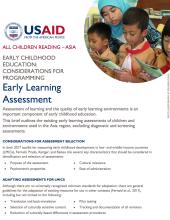
Early Childhood Education: Considerations for Programming in Early Learning Assessment

Submitted by admin on
Description/Abstract
Assessment of learning and the quality of early learning environments is an important component of early childhood education. This brief outlines the existing early learning assessments of children and environments used in the Asia region, excluding diagnostic and screening assessments.
Assoc. Photo (Port.)
ece assessment.jpeg
Resource (File)
Resource Type
Featured projects
Month and Year

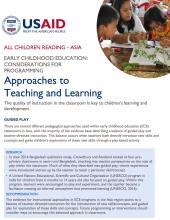
Early Childhood Education: Considerations for Programming in Approaches to Teaching and Learning

Submitted by admin on
Description/Abstract
The quality of instruction in the classroom is key to children's learning and development. This brief looks at the dimensions of guided play, emergent literacy, emergent mathematics, and language of instruction on the quality of instruction.
Assoc. Photo (Port.)
ece tandl.jpeg
Resource (File)
Resource Type
Featured projects
Month and Year

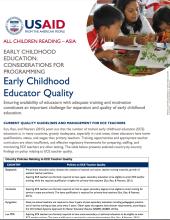
Early Childhood Education: Considerations for Programming in Educator Quality

Submitted by admin on
Description/Abstract
Training opportunities and appropriate teacher curriculum are often insufficient, and effective regulatory frameworks for preparing, staffing, and monitoring ECE teachers are often lacking. This brief presents selected country-by-country findings on policy relating to ECE teacher quality in six countries in Asia.
Assoc. Photo (Port.)
ece educators.jpeg
Resource (File)
Resource Type
Featured projects
Month and Year

Early Childhood Education: Considerations for Programming in Sustainability

Submitted by admin on
Description/Abstract
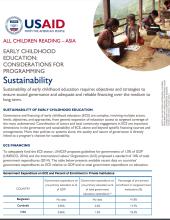
Governance and financing of early childhood education (ECE) are complex, involving multiple actors, levels, objectives, and approaches, from general expansion of education access to targeted coverage of the most underserved. Coordination of actors and local community engagement in ECE are important dimensions in the governance and sustainability of ECE, above and beyond specific financing sources and arrangements. More than policies or systems alone, the quality and nature of governance is directly linked to a program’s chances for sustainability.
Assoc. Photo (Port.)
ece sustain.jpeg
Resource (File)
Resource Type
Featured projects
Month and Year

Early Childhood Education: Considerations for Programming in Asia

Submitted by admin on
Description/Abstract
This report examines available evidence from the Asia region on the current state of ECE interventions, focusing on the 10 countries in the region3 that currently benefit from US Agency for International Development (USAID) education programming. In Asia, many national governments have prioritized the expansion of access and quality improvements of pre-primary education (Sun, Rao, & Pearson, 2015). USAID will support those efforts as part of a coherent approach to improved learning outcomes in primary school.
Assoc. Photo (Port.)
ece report.jpeg
Resource Type
Featured projects
Month and Year

Cultivating Dynamic Educators: Case studies in teacher behavior change in Africa and Asia

Submitted by admin on
Description/Abstract
Cultivating Dynamic Educators: Case Studies in Teacher Behavior Change in Africa and Asia responds to growing recognition by international education professionals, policy makers, and funding partners of the need for qualified teachers and interest in the subject of teacher professional development (also referred to as “teacher behavior change”). The book responds to important questions that are fundamental to improving teaching quality by influencing teaching practice. These questions include: How do we provide high-quality training at scale? How do we ensure that training transfers to change in practice? What methods are most cost-effective? How do we know what works? The book includes case studies from seven countries--Ethiopia, India, Indonesia, Malawi, Nigeria, Philippines and Zambia--describing different approaches to teacher behavior change and illustrates how specific implementation choices were made for each context. Individual chapters document lessons learned as well as methodologies used for discerning lessons. The key conclusion is that no single effort is enough on its own; teacher behavior change requires a system-wide view and concerted, coordinated inputs from a range of stakeholders.
Assoc. Photo (Port.)
TBC book front coer.jpg
Resource Type
Resource Language
Month and Year
Publisher Or Client
RTI Press

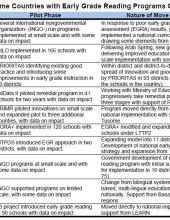
Scale-Up of Early Grade Reading Programs

Submitted by admin on
Description/Abstract
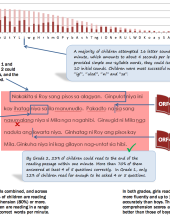
In response to the growing need to improve learning outcomes, USAID's 2011 Education Strategy focused on improving the teaching and learning of reading in early grades. Its goal of 100 million children showing improved reading skills testified to USAID’s commitment to investing in and measuring improvements in learning outcomes. As a result, USAID education programs with a focus on early grade reading have become the norm, with such programs implemented in approximately 20 countries during the five years since the adoption of the education strategy. In the last couple of years, the lessons of successful pilots are being applied on increasing scale in numerous countries. Taking successful pilot projects to scale and helping education systems implement their national reading strategies at scale have therefore become the primary challenges faced by USAID and other supporters of educational improvement in the developing world. The challenges of realizing large-scale impact, and of seeing that impact sustained, are not new to development. However, they are being approached with renewed interest and attention in the education sector. This paper examines seven countries where interventions to improve early grade reading are being taken to scale - some with project support, some through government initiative. Management Systems International's framework for taking projects to scale, and the framework defined in the Brookings Institute's Millions Learning report are used to examine how scale has been and is occurring in these selected countries.
Assoc. Photo (Port.)
Sus doc image.JPG
Resource (File)
Resource Type
Resource Language
Month and Year
Publisher Or Client
USAID

Hiligaynon EGRA: Summary of Results (2014)

Submitted by admin on
Description/Abstract
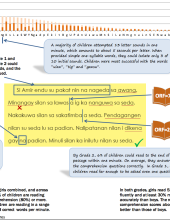
This two page brief provides summary graphics of key data on children's reading ability in schools that teach reading in Hiligaynon and use this language as medium of instruction. The skills were measured using EGRA, conducted in February/March 2014 (end of Grade 1 and Grade 2).
Assoc. Photo (Port.)
hiligaynon summary 2014.png
Resource (File)
Hiligaynon FINAL.pdf
Country
Resource Type
Resource Language
Month and Year
Publisher Or Client
USAID

Maguindanaoan EGRA: Summary of Results (2014)

Submitted by admin on
Description/Abstract
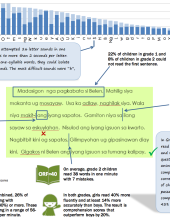
This two page brief provides summary graphics of key data on children's reading ability in schools that teach reading in Sinugbuanong Binisaya and use this language as medium of instruction. The skills were measured using EGRA, conducted in Region VII in February/March 2014 (end of Grade 1 and Grade 2).
Assoc. Photo (Port.)
maguindanaoan 2014 infographic.png
Resource (File)
Maguindanaoan FINAL.pdf
Country
Resource Type
Resource Language
Month and Year
Publisher Or Client
USAID

Sinugbuanong Binisaya EGRA: Summary of Results (2014)

Submitted by admin on
Description/Abstract
This two page brief provides summary graphics of key data on children's reading ability in schools that teach reading in Sinugbuanong Binisaya and use this language as medium of instruction. The skills were measured using EGRA, conducted in Region VII in February/March 2014 (end of Grade 1 and Grade 2).
Assoc. Photo (Port.)
cebuano results 2014.png
Resource (File)
Cebuano FINAL.pdf
Country
Resource Type
Resource Language
Month and Year
Publisher Or Client
USAID