Policy, Systems, and Governance

Benchmarks for Early Grade Reading Skills in West Bank Policy Brief

Submitted by admin on
Description/Abstract
The Ministry of Education and Higher Education (MOEHE) conducted the first EGRA assessment in the West Bank in March 2014 among a nationally representative sample of Grade 2 students, followed by a benchmarking exercise in September 2014. In 2018, the Early Grade Reading (EGR) project conducted a project baseline using an adapted EGRA 1 and MELQO 2 3 . Following this assessment, the MOEHE expressed interest in revising the 2014 provisional Grade 2 benchmarks and developing Grade 1 benchmarks. EGR conducted a technical benchmarking workshop in November 2018.
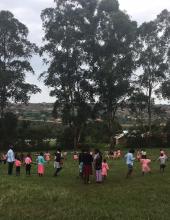
Assoc. Photo (Port.)
Poliicy Brief benchmarks photo.JPG
Resource Type
Resource Language
Month and Year
Publisher Or Client
USAID

Strengthening the Textbook Production Chain in Morocco: Study Conclusions and Recommendations Appendix C: A Cost-Effective Textbook Strategy

Submitted by admin on
Description/Abstract
This is Part 4 of a four-part comprehensive evaluation of the public textbook procurement system in Morocco. This final section of the Strengthening the Textbook Production Chain in Morocco series addresses the issue of how to ensure a long-term, sustainable system of textbook financing for all students in government schools. It also explores options available to the Ministry of Education of Morocco, based on examples from countries that have responded to the same challenges.
Assoc. Photo (Port.)
4_English_Textbooks Morocco_Financing.jpg
Resource (File)
Country
Resource Type
Resource Language
Month and Year
Publisher Or Client
USAID/Morocco

Strengthening the Textbook Production Chain in Morocco: Study Conclusions and Recommendations Appendix B: A Review of the Domain of Electronic Textbooks

Submitted by admin on
Description/Abstract
This is Part 3 of a four-part comprehensive evaluation of the public textbook procurement system in Morocco. It is an overview of the challenges and opportunities of school-based digital teaching and learning, intended to provide a framework for policymakers in Morocco who are considering further investments in information and communication technology (ICT) for learning in government schools. Specifically, it addresses the area of digital textbooks. The overview poses questions that policymakers should ask and provides examples of how other countries have responded to such questions.
Assoc. Photo (Port.)
3_English_Textbooks Morocco_Digital.jpg
Resource (File)
Country
Resource Type
Resource Language
Month and Year
Publisher Or Client
USAID/Morocco

Strengthening the Textbook Production Chain in Morocco: Study Conclusions and Recommendations Appendix A: Analysis of Textbook Procurement Chain and Market for Supplemental Reading Materials (research conducted in 2015)

Submitted by admin on
Description/Abstract
This is Part 2 of a four-part comprehensive evaluation of the public textbook procurement system in Morocco. It documents the Ministry of Education's textbook procurement system processes and presents the results of a survey of supplemental early reading materials in Arabic available in the Moroccan market. It also offers recommendations on how to increase the use of supplemental reading materials in the classroom.
Assoc. Photo (Port.)
2_English_Textbooks Morocco_2015 Results.jpg
Country
Resource Type
Resource Language
Month and Year
Publisher Or Client
USAID/Morocco

Strengthening the Textbook Production Chain in Morocco: Study Conclusions and Recommendations

Submitted by admin on
Description/Abstract
This is Part 1 of a four-part comprehensive evaluation of the public textbook procurement system in Morocco. It offers recommendations on how to improve textbook quality, how to strengthen the procurement system --including budgeting and financing--, and developing a policy for digital textbooks.
Assoc. Photo (Port.)
1_English_Textbooks Morocco_Main.jpg
Resource (File)
Country
Resource Type
Resource Language
Month and Year
Publisher Or Client
USAID/Morocco

Jordan Kindergarten Data for Decision Making

Submitted by admin on
Description/Abstract
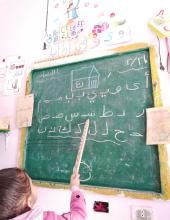
This report presents findings of a national survey of parents regarding enrollment in preprimary education (kindergarten) in Jordan. The findings are surprising because they suggest that the real enrollment rate is significantly higher than what government statistics indicate. The discrepancy seems to be due to a high level of kindergarten provision from private sector and civil society actors who are not licensed by the Ministry of Education.
Assoc. Photo (Port.)
Home-based KG Madaba girl at blackboard.jpg
Country
Resource Type
Featured projects
Resource Language
Month and Year

Grade 1-3 Khmer Language Curriculum Review Report: Summary Report of Available Assessment Data, Teacher Survey and Curriculum Materials Review

Submitted by admin on
Description/Abstract
This report, from the All Children Reading-Cambodia project, documents the results of the teacher survey, desk review and compilation of assessment data and communicates the implications of that research in the form of recommended updates to the syllabus, curriculum and materials for grades 1-2
Assoc. Photo (Port.)
image.png
Resource (File)
Country
Resource Type
Resource Language
Month and Year
Publisher Or Client
USAID

System sustainability for quality early childhood development and education in Kenya- CIES 2018 Presentation

Submitted by admin on
Author
Description/Abstract
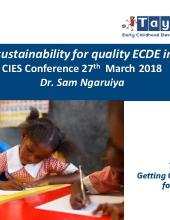
CIES 2018 Presentation, given by Sam Ngaruiya. This study explores the role of the Tayari program in promoting a viable and quality ECDE system that county governments in Kenya can sustainably deliver. Tayari is a three year pilot implemented by the national Ministry of Education and four county governments. The program is designed to help the government develop a cost effective and scalable ECDE model. The pilot program is implemented in public schools and ECDE centers in low resource settings. Utilizing data from a qualitative study conducted in 4 pilot and 3 non-pilot counties’ decision-making, the presentation outlines three key aspects of sustainability: the extent to which collaborative implementation has improved ownership and resource allocation and how the Tayari instructional approach has impacted on process quality and teacher retention in the program. The findings and discussion are critical in helping county governments prioritize investment in a quality and sustainable ECDE model for improved school readiness.
Assoc. Photo (Port.)
Pages from Ngaruiya, Sam_CIES2018_System sustainability for quality ECDE in Kenya.jpg
Country
Resource Type
Month and Year

Implementing ECDE in response to policy change and research evidence in Kenya- CIES 2018 Presentation

Submitted by admin on
Author
Description/Abstract
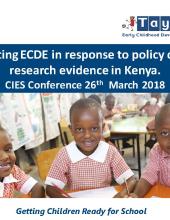
CIES 2018 Presentation, given by Sam Ngaruiya. The Ministry of Education (MoE) with technical support from RTI International are collaborating with four county governments to pilot the Tayari ECDE programme. The objective of Tayari is to develop a cost- effective, scalable, low-cost and quality ECDE model. To maximize the impact of Tayari, the MoE intends to scale-up Tayari. However, the ability to take-up and sustain Tayari rests on the counties’ capacity to ensure a viable ECDE system and meet the critical cost of the model. The ability of the counties to take on a Tayari-type programme requires ample institutional, systemic, organizational and fiscal capacity of the counties to take-up and sustain the model. MoE statistics show that, whereas, access has improved, the quality is affected by non-provision of curriculum-aligned instructional materials in the counties and unclear policy in hiring and continuous professional development of the ECDE officers and teachers. Equally, there are policies at the national level that can be used as guidelines for implementation and management of ECD, but there are still some gaps in policy guidelines for implementation; a study mapping the four Tayari counties and three additional counties found increased investment in ECD infrastructure by the governments This presentation explores how the umbrella policy from the MOE as well as evidence from the Tayari pilot programme’s longitudinal study has informed practice within the four Tayari counties, enabling them to be more responsive to the dynamic policy environment. It also showcases initiatives put in place by the counties to sustain the Tayari implementation in pilot counties.
Assoc. Photo (Port.)
Pages from Ngaruiya, Sam_CIES2018_Impact and Policy Environment of Tayari.jpg
Country
Resource Type
Month and Year

Early Grade Reading Sustainability Framework- CIES 2018 Presentation

Submitted by admin on
Author
Description/Abstract
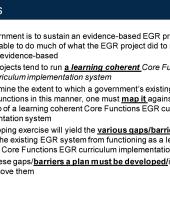
CIES 2018 presentation, given by Luis Crouch on behalf of Hank Healey. The EGR Sustainability Framework emanates from a) a general understanding of evidence-based EGR programs, b) the notion of a “learning coherent” education system (Pritchett, 2015), c) the notion of a “bare bones” or “core functions” system (Crouch and Destefano, 2015); and effective curriculum implementation. To this end, our proposed EGR sustainability framework maintains that one must a) map the existing education system’s institutional, systemic, cultural, and attitudinal capacity to function as an effective learning coherent core functions curriculum implementation system, b) identify the various gaps and barriers that prevent the system from working in this manner, c) develop a plan to address those gaps and barriers, and d) help the MOE to implement that plan.
Assoc. Photo (Port.)
Pages from Healey, Hank_CIES2018_EGR Sustainability Framework.jpg
Country
Resource Type
Resource Language
Month and Year