Language of Instruction

Experience implementing non-mother tongue reading: Tusome in Kenya- CIES 2018 Presentation

Submitted by admin on
Author
Description/Abstract
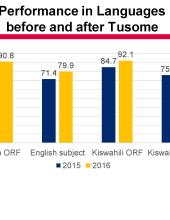
CIES 2018 Presentation, given by Dunston Kwayumba. In many developing countries, subjects are taught and tested in the child’s second or third language. In Kenya, for example, all subjects are taught and examined in English, other than languages such as Kiswahili. Understanding how language skills transfer in language complex environments like Kenya is relatively under-researched using empirical methods. Using an explanatory mixed methods design, the proposed research study will use correlation analysis to examine the effect of literacy interventions on learning outcomes in other subjects. It will answer research questions on the effect of literacy intervention on learning outcomes in English, Kiswahili and other subjects taught at class 2 in Kenya. The study will also investigate the perceptions of head teachers, teachers and curriculum support officers on the specific aspects of intervention programs that could be attributed to the improved or lack of improvement in learning outcomes in the non-language subjects. This is a critical research topic given the number of countries that have been engaging in large scale literacy interventions without careful thought on whether the expected and pre-supposed impact on learning outcomes in other subjects is empirically evident. This is essential to creating and sustaining community buy-in into these literacy programs, as it is local communities that are often the most resistant to local language literacy programs given the unclear relationship with learning outcomes in these critical other subjects.
Assoc. Photo (Port.)
Pages from Kwayumba, Dunston_CIES2018_Non Mother Tongue Reading in Kenya.jpg
Country
Resource Type
Featured projects
Month and Year

Ghana Teacher Questionnaire

Submitted by admin on
Description/Abstract
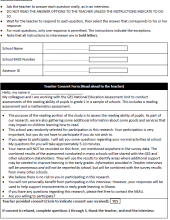
Under the USAID Partnership for Education: Testing activity, a teacher questionnaire was introduced to the 2015 national EGRA/EGMA survey in Ghana. This was in response to the 2013 EGRA/EGMA pupil data, which raised questions about how both pupils and their teachers experienced the language of instruction (LOI) policy, which stipulates that pupils should be taught in the Ghanaian language of the local area in the early grades and transition to English by P4. In an effort to learn more about how the LOI policy is implemented in schools, this teacher questionnaire was added in 2015 to collect more information about teacher preparation and instructional practices related to language use. The questionnaire was administered to 671 P2 teachers.
Assoc. Photo (Port.)
ghana.png
Resource (File)
Country
Resource Language
Month and Year

Examining the secondary effects of mother-tongue literacy instruction in Kenya: Impacts on student learning in English, Kiswahili, and mathematics

Submitted by admin on
Description/Abstract
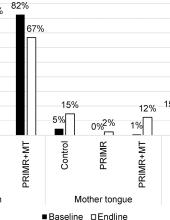
Limited rigorous evidence is available from sub-Saharan Africa regarding whether children who learn to read in their mother tongue will have higher learning outcomes in other subjects. A randomised controlled trial of mother-tongue literacy instruction, the Primary Math and Reading (PRIMR) Initiative, was implemented in Kenya from 2013 to 2014. We compared the impacts of the PRIMR mother-tongue treatment group in two languages with those of another group that did not use mother tongue, but utilised the same instructional components. Results showed that assignment to the mother-tongue group had no additional benefits for English or Kiswahili learning outcomes beyond the non-mother-tongue group, and that the mother-tongue group had somewhat lower mathematics outcomes. Classroom observational analysis showed that assignment to the mother-tongue group had only small impacts on the usage of mother tongue in other subjects. Advocates for mother-tongue programmes must consider such results alongside local implementation resistance in programme design.

Assoc. Photo (Port.)
LOI.jpg
Country
Resource Type
Featured projects
Resource Language
Month and Year
Publisher Or Client
International Journal of Education Development

Independent Evaluation of the Effectiveness of Institut pour l’Education Populaire’s “Read-Learn-Lead” (RLL) Program in Mali

Submitted by admin on
Description/Abstract
The Institute for People’s Education (Institut pour l’Éducation Populaire, or IEP) designed the Read-Learn-Lead (RLL) program to demonstrate that the new official curriculum, if properly implemented and supported, can be a viable and effective approach to primary education, using mother tongue and a very specific pedagogical delivery approach. The RLL program sought also to demonstrate how the new Curriculum can be effectively implemented and supported, and what resources are needed to do so. RLL offers students and teachers carefully structured and systematic lessons, activities, and accompanying materials for instruction and practice on critical early reading skills in mother-tongue medium during the first years of elementary school. It is organized around three programmatic “results sets,” the first of which focuses on Grades 1 and 2 and is the subject of the present evaluation. This independent evaluation study, funded through a grant from the William and Flora Hewlett Foundation and carried out by RTI, explored the effectiveness of the RLL program’s Results Set 1 as applied over three school years (2009-2010 to 2011-2012) in the Bamanankan language and in other Malian national languages (Bomu and Fulfulde in all three years, and Songhai in 2009 and 2010).
Assoc. Photo (Port.)
Resource (File)
Country
Resource Type
Month and Year
Publisher Or Client
William and Flora Hewlett Foundation

Report on Language of Instruction in Senegal

Submitted by admin on
Description/Abstract
This report summarizes applicable research on education in multilingual contexts and on the use of L1-based, bilingual instruction in particular. It also briefly presents the education and sociolinguistic environment in Senegal, as well as a summary of relevant national language education programs in the country. Lastly, the report makes recommendations aimed at supporting a transition toward the use of national languages for instruction in primary schools.
Assoc. Photo (Port.)
Senegal.png
Resource (File)
Senegal LOI paper_FINAL.pdf
Country
Resource Language
Month and Year
Publisher Or Client
USAID

An Approach to Teaching and Reading in Hausa: Narrated RARA approach

Submitted by admin on
Description/Abstract
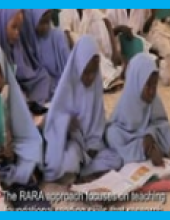
A video overview of the Nigeria Reading and Access Research Activity (RARA) approach to teaching reading in Hausa. Narrated in Hausa with English subtitles.
Assoc. Photo (Port.)
Screen Shot 2017-08-09 at 1.02.15 PM.png
Country
Resource Type
Resource Language
Month and Year

What works in early grade literacy instruction

Submitted by admin on
Description/Abstract
Over the past decade, RTI International has pursued the goal of quality, inclusive, differentiated early grade literacy instruction in nearly 30 early grade reading or early grade literacy programs in low- and middle-income (LMI) countries. Across our diverse portfolio, we have supported Ministries of Education (Ministries) in diverse contexts in their development and implementation of research-based early grade literacy programs and have learned important lessons based on our experience working with Ministries to design, develop, and implement early grade literacy programs. This paper describes the core elements that we have found to improve early grade literacy instruction and learner outcomes: the approach to teaching (Teach), the availability of quality, relevant learner materials (Text), the effective use of instructional time (Time), the use of formative assessment to guide instruction (Test), and provision of instruction in the most effective language (Tongue). This paper focuses on the acquisition of literacy in alphabetic and alphasyllabic languages in the early primary years (most typically, academic levels 1 through 3) and the kinds of exposures, instruction, and support learners need to become fully literate. These are the elements of a literacy program that can be taught, that should be present in teaching and learning materials and in teacher trainings, and that relate specifically to what happens in a classroom.
Assoc. Photo (Port.)
what works literacy portrait.png
Country
Resource Type
Month and Year

USAID/Uganda School Health and Reading Program Early Grade Reading Assessment Results: Cluster 1, End of Primary 4

Submitted by admin on
Description/Abstract
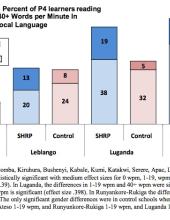
The USAID/Uganda School Health and Reading Program is a large scale, systemic reform effort to increase reading and provide health information in primary schools. This is one of the first Early Grade Reading Studies in Africa to combine rigorous research methods with a large scale reform working through Ministry of Education Systems. This briefer highlights the findings from a Randomized Control Trial/Early Grade Reading Assessment for the first 4 languages (of 12 total program local languages and English) to start the program in Primary 1 in 2013: Ateso, Leblango, Luganda, and Runyunkore-Rukiga. Findings: At the end of Primary 4, learners are between 1.5 and 6 times more likely to be reading 40 or more words per minute in the local language in program schools compared to control schools (all statistically significant differences with effect sizes ranging from 0.39 to 0.75). Program learners were also significantly more likely to be reading 60 or more words per minute in English in 3 of the 4 languages.
Assoc. Photo (Port.)
uganda image.jpg
Resource (File)
Country
Resource Type
Resource Language
Month and Year
Publisher Or Client
United States Agency for International Development

Ghana 2015 EGRA and EGMA: Report of Findings

Submitted by admin on
Description/Abstract
The National Education Assessment Unit (NEAU) of the Ghana Education Service (GES) conducted a national Early Grade Reading Assessment (EGRA) and Early Grade Mathematics Assessment (EGMA) in July 2015. This was the second administration of EGRA and EGMA in Ghana; the first took place in 2013, and both were conducted as part of the USAID Partnership for Education: Testing activity. This report describes the findings.
Assoc. Photo (Port.)
Resource (File)
Country
Resource Type
Resource Language
Month and Year
Publisher Or Client
USAID

Using EGRA data for differentiated instruction: Learning profiles and instructional needs in Uganda

Submitted by admin on
Description/Abstract
Presentation delivered at CIES2017 (Atlanta). A challenge of large-scale education research projects in international development is determining the most appropriate way to effectively report findings for a wide variety of audiences (e.g., researchers, ministry officials, donors, and other relevant stakeholders). It is important to consider technical rigor and accessibility, while ultimately providing results that can be used to inform policy and instruction. Using Early Grade Reading Assessment (EGRA) data from Uganda in two languages, we are replicating an approach for categorizing students into learning profiles, which are directly tied to their particular instructional needs. We have conducted this analysis previously with data from Indonesia. We had conceptualized on the framework to be used across different context This study reports on the efficacy of using the same method with this sample with Luganda speakers. We divided students into five learning profiles based on their reading ability (Next Grade Ready, Fluent, Instructional, Beginner, and Nonreader) and then examined the relationship among these profiles and their reading skills on a variety of EGRA subtasks to determine the instructional need required to promote students from one profile to the next. Our learner profile method has been used with data in two countries and two languages. EGRA has been used in over 70 countries and in more than 100 languages. This study is an initial attempt to explore the value in this method.
Assoc. Photo (Port.)
dubeck and stern.png
Resource (File)
Country
Resource Type
Resource Language
Month and Year