Evaluation

Uganda Acoli Language EGRA Protocol & Pupil Protocol

Submitted by admin on
Description/Abstract
.Acoli Assessor Protocol and Student Stimulus Sheets used in the Uganda SHRP study.
Assoc. Photo (Port.)
Country
Month and Year
Publisher Or Client
USAID

2015 Nigeria National Education Data Survey (NEDS)

Submitted by admin on
Description/Abstract
The 2015 Nigeria Education Data Survey (NEDS) is a follow up to the 2013 Demographic and Health Survey, which is usually conducted to collect additional data on education from a subset of Demographic and Health Survey households. The 2015 NEDS is the third in the series to be conducted in Nigeria. The critical role of accurate and reliable education data in the formulation, implementation, monitoring and evaluation of education policy in Nigeria cannot be overemphasized. The survey provided a substantial amount of household level data that is essential to monitor the level of implementation of the goals of the Federal Ministry of Education, including those of the Universal Basic Education Commission, and Education for All. In addition, the 2015 NEDS provided critical information on the demand for schooling. The survey collected data on the age of children at first school attendance, dropout, and parents’/guardians’ perception of the benefits and demerits of schooling and school quality.
Assoc. Photo (Port.)
neds 1.png
Resource (File)
Country
Sub-topic
Resource Type
Resource Language
Month and Year
Publisher Or Client
Federal Ministry of Education

Ghana 2013 National Education Assessment-Summary of Results

Submitted by admin on
Description/Abstract
The intent of this summary report is to engender broad-based policy discussions and recommendations around one question: Why are pupils struggling with English and mathematics in P3 and P6? It focuses on the 2013 NEA results, which may lead Ghana’s education stakeholders towards changes and recommendations in curriculum, materials, other resources, and instructional approaches that could have long-term impacts on pupil performance. For a narrower audience interested in the technical details of the 2013 methodology, sampling, and analysis, a separate, more comprehensive and technical report has been prepared (Ghana National Education Assessment: 2013 Technical Report); this report summarizes much of the content from the technical document.
Assoc. Photo (Port.)
Screen Shot 2020-10-13 at 11.50.10 AM.png
Resource (File)
Country
Resource Type
Month and Year
Publisher Or Client
USAID

Student Performance on the Early Grade Reading Assessment (EGRA) in Yemen-Executive Summary

Submitted by admin on
Description/Abstract
Assessments of student learning in the primary grades, such as the Early Grade Reading Assessment (EGRA), offer an opportunity to determine whether students are developing the fundamental skills upon which all other literacy skills build, and, if not, where efforts might be best directed. A closer evaluation of students’ mastery of foundational reading skills would help reveal to Yemen’s MOE why learning outcomes have not improved as much as would be desired. To that end, USAID and the Yemen MOE tasked RTI International with administering EGRA to a stratified random sample of 735 students in grades 2 and 3. Students were selected from 40 schools across the three governorates of Amran, Lahj, and Sana’a.
Assoc. Photo (Port.)
Country
Resource Type
Month and Year

Presentation on the State of Literacy in Africa

Submitted by admin on
Description/Abstract
This presentation discusses a desk study which was designed to advance knowledge of which countries have and have not conducted early grade reading assessments, while also providing information on where literacy issues remain critical and where improvement in underway.
Assoc. Photo (Port.)
overview.png
Resource (File)
Country
Resource Type
Resource Language
Month and Year
Publisher Or Client
USAID

National Early Grade Literacy and Numeracy Survey in Jordan: Remedial Pilot Research Activity Report

Submitted by admin on
Description/Abstract
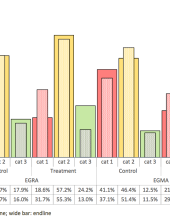
This report discusses Jordan's remedial pilot research program which was designed to assist teachers in improving the performance of those children who had fallen behind the general performance level of the rest of the class. The program focused on Arabic reading and mathematics in grades 1, 2, and 3. The rationale of the program is that children who are not performing at the general level of the class can benefit from additional instructional support that is aimed at their individual level of learning.
Assoc. Photo (Port.)
fine grain.png
Country
Resource Type
Resource Language
Month and Year
Publisher Or Client
USAID

Education Data for Decision Making (EdData II) National Early Grade Literacy and Numeracy Survey -- Jordan: Intervention Impact Analysis Report

Submitted by admin on
Description/Abstract
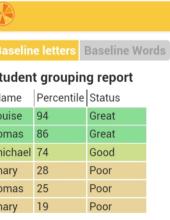
This report discusses the impact and results of the pilot intervention that was implemented during the 2013-2014 school year across 43 schools reaching more than 400 teachers and approximately 12,000 students in Jordan.
Assoc. Photo (Port.)
jordan survey.png
Country
Resource Type
Month and Year

Case Study: Tangerine:Class for data-informed instructional decision making in Kenya

Submitted by admin on
Description/Abstract
This case study will highlight practical lesson learned from the use of mobile devices with Tangerine®:Class open-source software for data-informed instructional decision-making from a year-long, rigorous study conducted by RTI International in Kenya. Throughout 2013, twenty-one teachers and 600 pupils used Tangerine:Class on Android tablets in a randomized controlled trial. While the trial was focused on early reading instruction, the applicable lessons learned are also for mathematics and independent of subject matter. Practical findings concern training and support, the logistics of individual pupil assessments in large classrooms; the nature of instructional decision-making; and the use of data and interactions between teachers, headteachers and parents. This is a chapter of an edited book "Mobile Learning and Mathematics" (Crompton, H. and Traxler, J., eds.) available at Amazon.com.
Assoc. Photo (Port.)
class.jpg
Country
Resource Type
Resource Language
Month and Year
Publisher Or Client
Routledge

MobiLiteracy Uganda (MLIT Uganda): Results of a controlled trial of an SMS-based literacy support program aimed at female caregivers

Submitted by admin on
Description/Abstract
This presentation, based on the Impact evaluation of the MobiLiteracy Uganda program, was delivered at the UNESCO Mobile Learning Week conference in Paris. The presentation highlights the evaluation methodology and raises some important conclusions about evaluating mobile learning programs.
Assoc. Photo (Port.)
mlit pres image.jpg
Resource (File)
MLW presentation 2015.pdf
Country
Resource Type
Resource Language
Month and Year
Publisher Or Client
RTI International

MobiLiteracy-Uganda Program: Phase 1: Endline Report

Submitted by admin on
Description/Abstract
In 2012, Urban Planet Media and Entertainment Corporation/Urban Planet (UP) was awarded a grant through All Children Reading: A Grand Challenge for Development. The grant awarded to UP was used to develop, pilot test, and evaluate an early literacy product in Uganda that targets parents through their mobile phones and encourages them to engage their early primary- school aged children in literacy skills-building activities outside of school hours. The product delivered to caregivers multimedia (text plus audio, or SMS+audio) content in Luganda on a daily basis over period of 91 days. During this period, all of the letters of the Luganda alphabet were introduced as well as 10 key vocabulary words all related to a short story. The product was evaluated by RTI International using RCT methodology. This is the Endline report describing the findings using a product evaluation framework.
Assoc. Photo (Port.)
egra baselin Katakwi Akwooro March 2013 Ateso Moses.jpg
Country
Resource Type
Resource Language
Month and Year
Publisher Or Client
RTI International