Briefs

National Learning Symposium on Creating a Safe and Positive Learning Environment Action Pack

Submitted by admin on
Description/Abstract
Action pack/brief from National Learning Symposium on Creating a Safe and Positive Learning Environment held in Kampala, Uganda on September 19 - 20, 2019.
Assoc. Photo (Port.)
Action.png
Resource (File)
Country
Resource Type
Month and Year

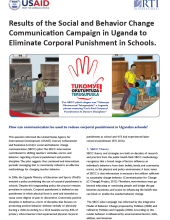
Results of the Social and Behavior Change Communication Campaign in Uganda to Eliminate Corporal Punishment in Schools Briefer 002

Submitted by admin on
Description/Abstract
Briefer describing the Results of the Social and Behavior Change Communication Campaign in Uganda to Eliminate Corporal Punishment in Schools.
Assoc. Photo (Port.)
Capture 10 28.PNG
Resource (File)
Country
Resource Type
Resource Language
Month and Year

Journey to Self-Reliance: Case Study of Early Grade Reading Assessments in the Philippines

Submitted by admin on
Author
Description/Abstract
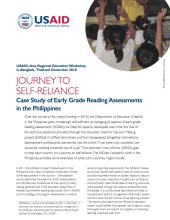
Over the course of four years (ending in 2016), the Department of Education (DepEd) in the Philippines grew increasingly self-sufficient at managing all aspects of early grade reading assessments (EGRAs). As DepEd’s capacity developed over time, the role of the technical assistance provided through the Education Data for Decision Making project (EdData II) shifted, diminished, and then disappeared altogether. International development professionals sometimes cite the cliché, “If we were truly successful, we would be working ourselves out of a job.” That sentiment now informs USAID’s goal to help each country on a journey to self-reliance. The EdData II project’s work in the Philippines provides some examples of what such a journey might include.
Assoc. Photo (Port.)
PHil JSR.jpeg
Resource (File)
Country
Resource Type
Featured projects
Month and Year

Journey to Self-Reliance: Case Study of Capacity Development in Cambodia

Submitted by admin on
Author
Description/Abstract
What conditions make it possible to accomplish significant capacity development without running any workshops, without requiring any explicit project deliverables, and with only three short-term technical assistance trips over the course of 19 months? The All Children Reading–Cambodia Activity has been supporting the Education Quality Assurance Department (EQAD) of the education ministry in Cambodia since February 2017. An EQAD staffer, asked about the assistance, said, “The value of the support …is more than I can express… Through collaboration with [the project], EQAD has developed remarkably.” This case study examines how a different approach to providing technical assistance helped EQAD make those “remarkable” strides toward self-reliance.
Assoc. Photo (Port.)
Cambodia JSR.jpeg
Country
Resource Type
Featured projects
Month and Year

Early Childhood Education: Considerations for Programming Overview

Submitted by admin on
Description/Abstract
The purpose of this brief is to answer the question: What are the considerations for effective ECE programming in the Asia region? To answer, we focus on the quality and sustainability, including governance and financing, of ECE. The four subject briefs provide evidence and present considerations for the following topics: ECE assessments, including measures of child learning and assessments of the quality of learning environments; Approaches to quality teaching and learning, focusing on emergent literacy and early mathematics, with consideration given to the language of instruction; Ensuring early childhood educator quality; and Sustainability of ECE.
Assoc. Photo (Port.)
ECE programming.jpeg
Resource (File)
Country
Resource Type
Featured projects
Month and Year

Early Childhood Education: Considerations for Programming in Early Learning Assessment

Submitted by admin on
Description/Abstract
Assessment of learning and the quality of early learning environments is an important component of early childhood education. This brief outlines the existing early learning assessments of children and environments used in the Asia region, excluding diagnostic and screening assessments.
Assoc. Photo (Port.)
ece assessment.jpeg
Resource (File)
Resource Type
Featured projects
Month and Year

Early Childhood Education: Considerations for Programming in Approaches to Teaching and Learning

Submitted by admin on
Description/Abstract
The quality of instruction in the classroom is key to children's learning and development. This brief looks at the dimensions of guided play, emergent literacy, emergent mathematics, and language of instruction on the quality of instruction.
Assoc. Photo (Port.)
ece tandl.jpeg
Resource (File)
Resource Type
Featured projects
Month and Year

Early Childhood Education: Considerations for Programming in Educator Quality

Submitted by admin on
Description/Abstract
Training opportunities and appropriate teacher curriculum are often insufficient, and effective regulatory frameworks for preparing, staffing, and monitoring ECE teachers are often lacking. This brief presents selected country-by-country findings on policy relating to ECE teacher quality in six countries in Asia.
Assoc. Photo (Port.)
ece educators.jpeg
Resource (File)
Resource Type
Featured projects
Month and Year

Early Childhood Education: Considerations for Programming in Sustainability

Submitted by admin on
Description/Abstract
Governance and financing of early childhood education (ECE) are complex, involving multiple actors, levels, objectives, and approaches, from general expansion of education access to targeted coverage of the most underserved. Coordination of actors and local community engagement in ECE are important dimensions in the governance and sustainability of ECE, above and beyond specific financing sources and arrangements. More than policies or systems alone, the quality and nature of governance is directly linked to a program’s chances for sustainability.
Assoc. Photo (Port.)
ece sustain.jpeg
Resource (File)
Resource Type
Featured projects
Month and Year

Benchmarks for Early Grade Reading Skills in West Bank Policy Brief

Submitted by admin on
Description/Abstract
The Ministry of Education and Higher Education (MOEHE) conducted the first EGRA assessment in the West Bank in March 2014 among a nationally representative sample of Grade 2 students, followed by a benchmarking exercise in September 2014. In 2018, the Early Grade Reading (EGR) project conducted a project baseline using an adapted EGRA 1 and MELQO 2 3 . Following this assessment, the MOEHE expressed interest in revising the 2014 provisional Grade 2 benchmarks and developing Grade 1 benchmarks. EGR conducted a technical benchmarking workshop in November 2018.
Assoc. Photo (Port.)
Poliicy Brief benchmarks photo.JPG
Resource Type
Resource Language
Month and Year
Publisher Or Client
USAID