Materials Production
Coming soon – SharEd 2.0! Keep an eye out for updates and redirection to a new landing page in the coming months. Thanks for visiting.
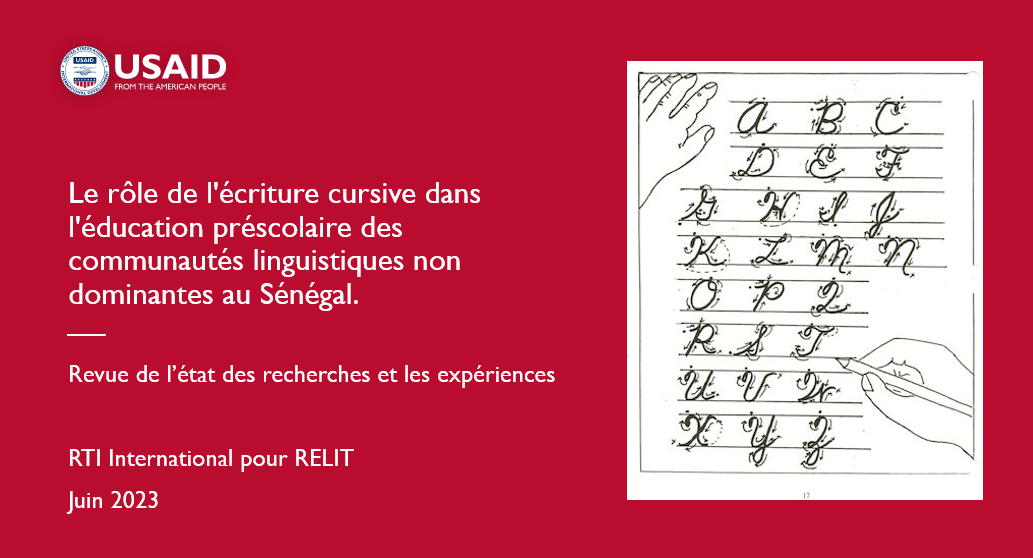
Le rôle de l'écriture cursive dans l'éducation préscolaire des communautés linguistiques non dominantes au Sénégal
Cette brève revue de la littérature examine l'expérience mondiale en matière d'enseignement de l'écriture cursive au début de l'école primaire, ainsi que les avantages et les inconvénients que cela peut présenter pour l'acquisition de la littératie. Elle a été préparée dans le cadre du programme RELIT du Sénégal afin de conseiller le ministère de l'Éducation sur la manière de procéder à l'élaboration du programme d'enseignement de la langue nationale et à la rédaction des manuels scolaires. //
This brief literature review looks at global experience with teaching cursive writing in early primary school, and the advantages and disadvantages that this may have on literacy acquisition. It was prepared as part of the Senegal RELIT program to advise the Ministry of Education on how to proceed with national language curriculum and textbook development.
The use of WordCalc tool: Developing grade-appropriate books that children love to read! [CIES 2024 Presentation]

The ability of citizens to think critically and take a well-considered position in life is influenced by their ability to read with comprehension and by the content of what they read. WordCalc is an instrument that contributes to a body of children’s literature that is an important step to building this skill. This abstract introduces WordCalc, an advanced computer program designed to analyze linguistic features of texts. It was developed and improved in the context of two USAID-funded reading projects in the Kyrgyz Republic – Time to Read and Okuu Keremet! The very first version was produced as an Excel program under another USAID reading project in Georgia. The program addresses the lack of children’s books written in local languages, specifically Kyrgyz, Russian, and Uzbek, in the Kyrgyz Republic. By analyzing large amounts of text, WordCalc provides local authors and publishers with language patterns that are attractive and engaging to young readers, leveled according to reading ability. The project conducted a market analysis of children’s books in 2020, revealing the scarcity of modern, locally inspired storybooks for children in schools, libraries, the market, and elsewhere. The available books predominantly consisted of outdated fairy tales and folklore, lacking consideration for the local context and culture as well as contemporary realities and topics. The majority of existing books were imported from Russia and other countries. The limited spectrum of topics highlighted the urgent need for accessible and age-appropriate literature that resonates with children’s interests, language preference and social background. Using WordCalc entails collecting as much text as possible, in different languages and for different age groups, in order to analyze text size, word and sentence counts, word length, high-frequency words and phrases for each language. Through these analyses, the program provides insight into the linguistic characteristics of text read by readers at different levels. The patterns per language and reading level enable authors to tailor their writing to the various reading levels of young readers so that children have a variety of text at the right level for them to develop their reading skill. The refinement of WordCalc resulted in the creation of a comprehensive dictionary comprised of the most frequently used words for grades 1-4 in Kyrgyz, Russian, and Uzbek, totaling 10,000 unique words. This dictionary serves as a foundational resource for creating age-appropriate content that appeals to young readers. In collaboration with linguists, the project team identified and incorporated difficult and rare words specific to grades 1-4, ensuring comprehensive coverage of a rich vocabulary. The Kyrgyz and Uzbek languages in particular face a shortage of text-based resources, including scientific papers, articles, and standardized textbooks for grades 1-4. Therefore, the project team employed a meticulous approach to creating the dictionary, leveraging the expertise of linguists to compensate for the limited resources available for compiling the dictionary. The aim was to ensure that the final product was accurate and useful. To validate the effectiveness of WordCalc as an instrument, the team conducted several reviews of more than 1,000 texts in the three languages. In Okuu Keremet!, around 40 authors and illustrators were trained to use WordCalc, and so far, it has facilitated the production of more than 1,200 new titles, specifically tailored to children’s reading levels and their linguistic context. Moving forward, WordCalc will be introduced to a wider audience, including educators, authors, publishers, and the general public. Its usefulness for creating leveled literature for children will be encouraged among other players such as publishers, textbook writers and others. For example, two big local publishing companies want to use WordCalc as a tool for quality assurance and are already using it in the book production process. WordCalc also serves as a valuable resource for analyzing existing literature for children. By applying the program to previously published books, authors and publishers can gauge whether the books are appropriately aligned with specific ages or grades; they can refine their storytelling techniques and enhance the cultural authenticity of their work. This ensures that the existing literature is adapted to meet the needs and expectations of young readers in the Kyrgyz Republic. In conclusion, WordCalc has proven to be a valuable tool to create new texts for grade 1-4 children that builds not just reading skill but comprehension and critical thinking skills which have been consistently weak in the reading assessment of children. The expansion of genres among children’s books, including information books which are very popular, expands the range of topics that children are thinking about and exposes them to new knowledge, ideas, and feelings. By redressing the lack of literature in local languages such as Kyrgyz and Uzbek, WordCalc is also contributing to the strength of these languages as it codifies a rich vocabulary among young readers across an expanding range of topics. Engaging stories in mother tongue foster a love for reading among young readers. WordCalc’s ability to sift through and analyze text in different languages is a gift to local authors and publishers who can now create “just right” books for children in the Kyrgyz Republic.
Aligning Learning Inputs to Global Norms (ALIGN) for Minimum Proficiency: Case Studies from Djibouti, Uzbekistan, Nigeria

he Sustainable Development Goals (SDGs) include a commitment to ensure that by 2030, all girls and boys complete free, equitable, and quality primary and secondary education leading to relevant and effective learning outcomes (SDG 4.1). Performance on this goal is reported as the proportion of learners: “(a) in grades 2/3; (b) at the end of primary; and (c) at the end of lower secondary achieving at least a minimum proficiency level in (i) reading and (ii) mathematics, by sex” (M. Gustafsson, 2019, p. 6).
These SDG indicators are based on global research that highlights the critical contribution of foundational skills in reading and mathematics to learners’ overall academic performance (Juel, 1988; Wharton-McDonald et al., 1988; Duncan et al., 2007; Duncan & Magnuson, 2011; Watts et al., 2014; Claessens & Engel, 2013). They also apply research from health and development sectors indicating that foundational skills are essential to reducing social inequality and improving individuals’ social and economic security and well-being (OECD, 2010; UNESCO, 2016).
The recent COVID-19 pandemic further underscored the importance of focusing on foundational skills. Studies show the pandemic has resulted in a 17 percent global increase in the number of ten-year-olds lacking basic skills to 70 million learners in 2021 alone (ONE Campaign, 2021). There is an urgent need to reverse this trend so every learner develops the foundational skills required to participate fully in their community’s social and economic life. That means using evidence-based approaches to identify where resources are most needed, both across countries and within a country, to address learning inequities and ensure that learners are able to demonstrate minimum proficiency levels.
This panel presentation will show how the Align Learning Inputs to Global Norms (ALIGN) for Minimum Proficiency process can help address these needs. The ALIGN process is an evidence-based gap analysis that uses the Global Proficiency Framework (GPF) as a reference to determine if a country’s education system will enable learners to meet global norms in reading and mathematics. An ALIGN process focuses on four components: curriculum and standards, teaching and learning materials, teacher training, and assessment. The ALIGN process identifies potential gaps or misalignments in each of these four components and actions to address them.
The ALIGN process was successfully piloted in four countries, Djibouti, Nigeria, and Uzbekistan.
UEEP Success Story #9: New Student Books Inspire Former English Language Teacher Lola to Go Back Into Teaching Again

The U.S. Agency for International Development (USAID), together with the Ministry of Public Education of the Republic of Uzbekistan, launched the
Uzbekistan Education for Excellence Program. One of the objectives of the Program was to create student textbooks, workbooks, and teacher guides on
teaching English as a foreign language (TEFL) to be used as the main teaching material in local schools of Uzbekistan.The Program involved international experts in the process of creating the books to ensure Uzbek boys and girls have access to the best learning and teaching materials, which will lead to stronger student performance and the long-term success of the Uzbek children. Cambridge University Press laid the foundation for the development of the books, Florida State University experts
supported the creation of the student standards, and the local Product Review Group of seven experts from Uzbekistan helped with the cultural
customization of these teaching and learning materials to make them appropriate for Uzbek society. In the 2021–2022 academic year the Program piloted the new books in two regions. Local teachers were provided with professional development trainings from foreign and local trainers on how to
effectively use these teaching materials, and over 600,000 school students have already enjoyed learning from the new textbooks. Starting in the 2022–2023
academic year, the Ministry of Public Education printed and distributed books for all schools in the Republic of Uzbekistan

Breaking Norms, Accelerating Learning Recovery, Building a Case of Learning for All in the Philippines [CIES 2024 Presentation]

Education being recognized as a fundamental right plays a vital role in fostering better societies and ensuring fair access to quality education. In this panel, we will explore the significance of education protests concerning pedagogy, curriculum, and theories. The Philippines Department of Education (DepEd), with support from USAIDs project Advancing Basic education in the Philippines (ABC+), has taken innovative steps to improve learning outcomes and reach marginalized communicates beyond traditional methods. The 2018 Program for International Student Assessment (PISA) revealed that Filipino 15-year-old students scored low in reading comprehension and ranked near the bottom in math and science among 79 countries. This raised concern about curriculum, teaching practice, the learning environments of Philippines schools, and in general the quality of education in the Philippines. It is important to note that over 90% of the students in the Philippines reported speaking a language at home different from the language used in instruction and the PISA test (English). Such language disparity significantly impacts PISA scores, and the Philippines’ linguistic diversity adds to the complexity. The Philippines is one of 44 nations where no single language group exceeds 50% of the total population. Estimates of the number of native Philippine languages range from 110 to 185. The adoption of Mother Tongue Based-Multilingual Education (MTB-MLE) in 2009 recognized this and explicitly emphasized the socio-cultural value of children learning in their maternal languages and put a focus on the importance of language to expanding access to education and improving learning outcomes. This panel highlights the importance of utilizing data to advocate for Early Grade Learning (EGL) and exploring alternative investment pathways beyond traditional sources.

UEEP Success Story #4: Uzbekistan's New ICT Materials Meet World Educational Standards (UEEP)

The Ministry of Public Education (MPE) with the support of the U.S. Agency for International Development (USAID) and the Uzbekistan Ministry of Public Education, initiated a reform to enhance ICT education to produce graduates with computer and programming skills that will contribute to youth employability. Under the USAID-funded Uzbekistan Education for Excellence Program, the Republican Education Center and Abdulla Avloni Institute collaborated with RTI International and Mississippi State University to update Uzbekistan’s ICT educational standards and goals, scopes and sequences, teacher guides, student textbooks, student evaluations, and teacher professional development. The Program and MPE piloted an ICT program for grades 5–11.
UEEP Success Story #6: Early Grade Teacher Co-Authors New Uzbek Language Arts Textbooks (UEEP)

This success story highlight the experience of one Uzbek Language Arts teacher in supporting the development of new reading materials for grades 1-4 learners. When she started working on the student textbooks and teacher guides, she found transforming Uzbekistan's approach to reading in local language challenging and rewarding, especially with the tremendous support of the international and local experts, who helped the writers to ensure international best practices guided the content and teaching methods. The result of their hard work, lead to the creation of books that inspire children to learn and develop a love of the Uzbek language.
UEEP Success Story #5: Uzbek Teacher of Mathematics Contributes to New Curriculum and Books (UEEP)

This success story highlights the experience of a early grade math teacher and textbook writer. She outlines the development of age-appropriate requirements and standards for students first and then, once those are set, write teacher guides and student textbooks. Before starting work on the teacher guide, the Program developed the topic scopes and sequences. The teacher guides were then designed to give teachers clear instructions on the lessons. With help of the teacher guides, the teachers will know how to begin the lesson, how to connect the topics, how to continue, what problems or unexpected questions may occur, and how to guide and assist students. Additionally, they incorporated more practical examples and problem-solving tools.
UEEP Success Story #3: Guess What: Learning English Becomes Easy in Uzbekistan (UEEP)

The United States Agency for International Development’s (USAID’s) Uzbekistan Education for Excellence Program is supporting the Ministry of Public Education to update its English as a Foreign Language (EFL) curriculum through the procurement, adaptation, and piloting of Cambridge University Press teacher guides, student textbooks, and student workbooks in two regions—Sirdaryo and Namangan. Thanks to teachers’ active engagement and participation in this piloting of EFL materials, the Program will be able to finalize the teacher guides for national rollout during the 2022/2023 school year.
UEEP Success Story #2: U.S. Assistance with Student Standards Renews Teachers’ Optimism

The Government of Uzbekistan’s Ministry of Public Education embarked on an ambitious set of education reforms within the general
secondary education system that covers grades 1 to 11. Among these reforms are the development of high-quality Student Standards that will give a solid foundation for all other curriculum products and instruction.
In partnership with the Ministry of Public Education, the U.S. Agency for International Development-funded Uzbekistan Education for Excellence Program conducted the Product Review Orientation Workshop for Student Standards to prepare approximately 50 educators from across Uzbekistan to undertake a formal review of the new Student Standards for Uzbek Language Arts and Mathematics grades 1–4 and Information and Communications Technology grades 1–11 produced by the Program
