Asia Region/ILOA and ACR-Asia

Locally Driven Prototypes of Future Learning Spaces in the Philippines [CIES 2024 Presentation]

Submitted by admin on
Description/Abstract
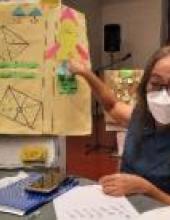
We are indeed dealing with a volatile, uncertain, complex, and ambiguous (VUCA) environment. The Philippines suffers natural and man-made vulnerabilities such as typhoons that occur throughout the year, earthquakes, and more recently, the coronavirus disease 2019 (COVID-19) pandemic. These challenges necessitated the establishment of the Education Futures Program. While the Philippines Basic Education Continuity Plan in response to the pandemic, DepEd recognized at that time the urgent need to “future proof” education. Nationwide education in futures thinking and foresight planning was needed to address the future learning needs of all children and building education resilience in times of crisis. This presentation provides an overview of the "Co-creating Learning Spaces for Improved Early Language Literacy and Numeracy in the Philippines" activity, under the USAID funded All Children Reading (ACR) - Philippines. Following a brief introduction to futures thinking and foresight planning, this presentation describes how school-level teams in the Philippines developed prototypes of learning spaces for the future that addressed anticipated needs of learners. We present the prototyping process centered on human centered design thinking, the way that school teams collected feedback on their innovations from teachers in the region, parents, and learners themselves, and a snapshot of the prototypes developed, and the benefit of the prototyping process to school teams and the relative success they had in realizing their future learning spaces innovations after two years.
Assoc. Photo (Port.)
Feedback on Prototypes.jpg
Country
Resource Type
Featured projects
Resource Language
Month and Year
Publisher Or Client
USAID

Instructional design of a blended teacher professional development (TPD) course in the Philippines [CIES 2024 Presentation]

Submitted by admin on
Author
Description/Abstract
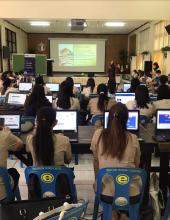
This presentation features the instructional design of a blended learning online course on formative assessment developed at the request of the Philippine Department of Education (DepEd), under the USAID/Philippines All Children Reading task order. In 2020, DepEd, through the National Educators Academy of the Philippines (NEAP), issued a policy aimed at strengthening the quality of TPD. The policy calls for several transformations, including the use of a wider range of learning modalities, such as job-based learning and teacher communities of practice; the adoption of a wider range of delivery platforms, such as online and blended learning; and the immediate application of TPD lessons in classrooms. The adoption of the policy has been slow and there are few exemplars of approved courses that meet these requirements. The challenge was to design a learning experience for teachers that not only exemplified these requirements but was also flexible enough to adapt to the myriad school contexts in the Philippines and was ready to be taken to scale by regional DepEd offices―without donor support―before the closeout of USAID funding for this activity.
Assoc. Photo (Port.)
Video lessons.jpg
Country
Resource Type
Featured projects
Month and Year
Publisher Or Client
USAID/Philippines

Teacher’s Guide for Remote Learning During School Closures and Beyond (Filipino)

Submitted by admin on
Description/Abstract
Over 91% of the total student population worldwide has been affected due to school closures caused by COVID-19, according to UNESCO. How can the system ensure education of the country that every student has equal access to quality education during the crisis? Important role of teachers. Help students cope with and understand the uncertainty caused by the pandemic. Encourage students to continue learning despite the closure of schools. This guide is for teachers. Support to students needs to continue while physical attendance at schools is completely or partially prohibited. Able to engage their students in various distance learning methods.

Assoc. Photo (Port.)
Teacher’s Guide for Remote Learning During School Closures and Beyond.png
Country
Resource Type
Featured projects
Resource Language
Month and Year

Characteristics of Select Philippine Mother Tongue Languages Used in Basic Education Teaching and Learning (USAID ACR Asia)

Submitted by admin on
Description/Abstract
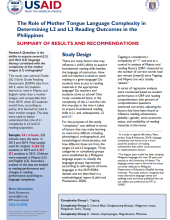
This reference document is a companion to the Language Complexity Study conducted by RTI International under the All Children Reading–Philippines project in 2020. The study was a secondary analysis of Early Grade Reading Assessment (EGRA) data at multiple time points, looking specifically at the effect of language complexity on reading acquisition of second and third languages (L2 and L3, respectively). The study used the 2013 and 2019 National EGRA data sets to analyze performance according to categories of language complexity based on syllabic complexity, orthographic depth, and other related items. The study was guided by the methodology described by Brunette et al. (2019), who studied the effects of language complexity on reading outcomes in Uganda. The languages selected for analysis were those among the officially supported mother tongue (MT) languages of instruction in the Philippines. Analysts assessed whether the level of complexity was in any way predictive of the average increase or decrease in L2 and L3 scores across schools as measured in 2019 (provided there were schools that reported using MT in 2019, which was not the case for three of the languages: Chavacano, Ivatan, and Sambal.
Assoc. Photo (Port.)
Country
Resource Type
Featured projects
Month and Year

The Role of Mother Tongue Language Complexity in Determining L2 and L3 Reading Outcomes in the Philippines (USAID ACR Asia)

Submitted by admin on
Description/Abstract
This study uses national Grade (G) 3 Early Grade Reading Assessment (EGRA) data from 2013, when G3 students learned to read in Filipino and English rather than a mother tongue, and comparable data from 2019, when G3 students would have, according to policy, first learned to read in their mother tongue. The data were used to better understand the role of L1 complexity in L2 and L3 reading acquisition. Sample: 241 schools; 232 schools were the same in 2013 and 2019. Final sample used for analysis: 2,264 G3 students in 2019 and 2,267 G3 students in 2013. Children were assessed in Filipino (L2) and English (L3). Secondary analysis of the data set looked at reading performance and changes in reading performance according to language complexity.
Assoc. Photo (Port.)
The Role of Mother Tongue Language Complexity in Determining L2 and L3 Reading Outcomes in the Philippines.png
Country
Resource Type
Featured projects
Resource Language
Month and Year

Classroom-Based Early Grade Reading Assessment— Cambodia

Submitted by admin on
Author
Description/Abstract
The purpose of this activity was to develop and pilot a CB-EGRA in the Khmer language for validation and use in Cambodia. The CB-EGRA is a paper-based assessment that can be administered with little training to a group of students at one time. It is therefore an arguably more efficient and cost-effective method of obtaining early grade reading data, compared to a traditional EGRA.
Assoc. Photo (Port.)
Classroom-Based Early Grade Reading Assessment— Cambodia.png
Country
Resource Type
Featured projects
Month and Year
Publisher Or Client
USAID

Improving Learning Outcomes for the Philippines - Strengthening performance management: Case studies and key insights

Submitted by admin on
Description/Abstract
Taken together, the case studies in this Report highlight the core components of an effective performance and accountability framework – a comprehensive system to optimize individual and system-wide performance through establishing outcome goals, tracking, and incentivizing progress against them The case studies show that effectiveness is not determined by implementing a set of individual policies, tools, and structures, but rather how they are collectively used to drive a culture that empowers its people to achieve a system’s ambitious agenda. The components of a performance and accountability framework that are featured in these case studies include: • System leadership that prioritizes a culture of high-performance around targets. • Outcome focused targets and supporting indicators that are well understood and communicated throughout the system, to define and quantify a system’s aspiration. • Quantitative data which is available and regularly shared across a system to gauge system performance, and to identify areas for additional focus or support. • Targeted and tailored support for system actors to help them improve performance, including a focus on specialized support for underperformers, driven by an understanding of data and evidence. • Performance routines and reporting with key system actors focused on reviewing progress, problem solving, and decision making to unlock barriers to improvement. • System engagement and site-visits/fieldwork that surfaces key challenges and opportunities to drive improvement. • Public engagement that keeps the public up to date on progress. Some of these components may require adaptation to different parts of the system. For example, targets may feature in performance agreements for senior leadership roles, but not for frontline staff who may be engaged in a more indirect way around targets (for example, communication of the reform with a focus on enhancing practice and improved outcomes). Similarly, formal performance routines that focus on a broader strategic reform are effective at driving a performance culture at senior levels, but not so for frontline staff who are rightly focused on teaching practice in their classroom. To be effective, embedding a performance and accountability culture across a system requires a nuanced and tailored application of these components to frontline staff, middle management, and senior levels.
Assoc. Photo (Port.)
FY24PerformanceManagement_CoverSheet_Portrait.png
Country
Resource Type
Featured projects
Resource Language
Month and Year

2022 Higher Education in Asia: Strategic Review: Improving Learning Outcomes for Asia (ILOA) Mechanism

Submitted by admin on
Description/Abstract
The United States Agency for International Development's (USAID's) Bureau for Asia conducted a strategic review to examine the depth and breadth of USAID higher education (HE) programming in Asia over the five-year period from 2016 through 2021. The review highlights ways in which USAID's HE programming has been a vehicle for all sectors, not only education, to achieve USAID development objectives. The review's findings and recommendations should inform continued USAID HE investment in Asia. USAID investments in HE support the 2022 lndo-Pacific Strategy (IPS). Within USAID and the interagency, there is a growing interest in HE programming opportunities. This recognition of the role of HE in driving economic development is reflected in its inclusion in the lndo-Pacific Strategy of the United States (White House, 2022), which highlights education as key to regional economic prosperity and security, as well as regional resilience to transnational threats. Unlike in previous strategies, HE is now explicitly noted in the 2022 version of the strategy as a vehicle to advance the United States Government's (USG's) vision for a "free and open lndo-Pacific" (p. 6). This review details examples of how USAID HE investments could support the IPS by countering malign influence, strengthening democratic systems, conducting cutting-edge research to fight the COVID-19 pandemic, and building diverse and equitable partnerships between U.S. and Asian partners. USAID is forging lasting transpacific partnerships through HE investments. In 2021, this engagement included partnerships among 270 higher education institutions (HEls) from across the region and with more than 20 HEls from across the U.S. Programs are aligned with USAID's Education Policy and achieving outcomes in all USAID sectors by "advancing knowledge and research; providing quality and relevant education and workforce training; and engaging and strengthening networks and communities" (Dockser et al., 2020, p. 5) in food security and agriculture; democracy, governance, and human rights; peace and security; economic growth and workforce development; and global health. These investments are advancing locally led development, producing the next generation of leaders, laying the groundwork for more resilient economies and future trade partners, and sustainably advancing American values in a region wary of malign influence.
Assoc. Photo (Port.)
HEactivities_GIS.png
Resource Type
Featured projects
Month and Year

ILOA Fact Sheet

Submitted by admin on
Author
Description/Abstract
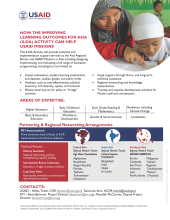
One-page fact sheet describing the Improving Learning Outcomes for Asia (ILOA) Activity.
Assoc. Photo (Port.)
ILOA One Pager_updated 2023.10.05.png
Resource (File)
Resource Type
Featured projects
Month and Year

Education system strengthening across Asia: a systematic review of USAID activities and critical discussion [CIES 2023 Panel Presentation]

Submitted by admin on
Description/Abstract
The purpose of this formal group panel presentation is to hold an in-depth discussion on USAID’s investments into system strengthening across Asia over the past decade and how these efforts are situated within the broader global move to focus more intentionally and coherently on education system strengthening. The panel will discuss a 2022 empirical research study (the USAID System Strengthening Review, hereafter “the Review”) conducted by two international research organizations for the USAID Asia Bureau which reviews USAID system strengthening work in 11 Asian countries. This Review offers a qualitative evidence-based analysis relevant to the field of comparative and international education (CIE) and analyzes new data collected from a desk review of relevant project documents, reports, and evaluations, key informant interviews, multi-stakeholder survey, and three deep-dive case studies in Nepal, Cambodia, and the Philippines. The group panel will include three presentations on different aspects of the Review and include discussant commentary and critique to elicit group and audience discussion. The first panel presentation discusses a theoretical framework drawn from the RISE Programme (Pritchett 2015 and Spivak 2021) and recent analysis from the Brookings Institution’s Center for Universal Education. The Review’s central research questions are guided by these broader global trends, as well as its own analysis framework developed specifically for this study, discussed in Presentation 3. Conclusions are drawn based on this framework, and the overall discussion in Presentations 2 and 3 considers the context of USAID programming in Asia and how new knowledge provides new insights.
Assoc. Photo (Port.)
Resource (File)
Resource Type
Featured projects
Month and Year
Publisher Or Client
USAID