Reports | 28 May 2020
2019 Language Usage Study in Bahasa Sug, Chavacano, Magindanawn, and Mëranaw Mother Tongue Schools
The objective of this study was to provide insight into the relationships between the teachers’ and students’ language usage, the MTB-MLE policy implementation, and student reading outcomes, especially in areas with linguistically heterogeneous populations.

Multimedia | 2 April 2020
Learning to Read: The Power of the 5T's
Learning to read is a critical foundational skill in the early grades. The Government of Uganda in partnership with the Literacy Achievement and Retention Activity funded by the United States Agency for International Development (USAID) is working to improve early grade reading.
Reports | 26 February 2020
Evaluación de Lectura Inicial en El Salvador: Informe Final
La Agencia de los Estados Unidos para el Desarrollo Internacional (USAID) decidió financiar este estudio para proporcionar información actual al Ministerio de Educación (MINED) y al Gobierno El Salvador sobre el desempeño en lectura de los estudiantes de segundo y tercer grado a nivel nacional y,
Briefs | 24 February 2020
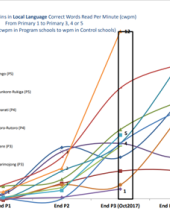
USAID Uganda School Health and Reading Program EGRA results Cluster 1 End of Primary 5, Cluster 2 End of Primary 4, Cluster 3 End of Primary 3
To measure the impact of SHRP on reading achievement, EGRA data were collected at the beginning of Primary 1 (P1) and then at the end of every school year through Primary 3, 4 or 5 depending on when the local language entered the program.
Briefs | 24 February 2020
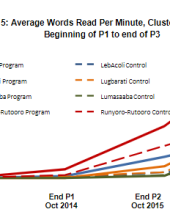
USAID/Uganda School Health and Reading Program Follow up 3 End of Primary 3: Lebacoli, Lugbarati, Lumasaba, and Runyoro-Rutoro and English
Has reading achievement increased as a result of the USAID/Uganda School Health and Reading Program? Early Grade Reading Assessment (EGRA) data collected for Cluster 2 at the end of P3 suggests improved progress towards reading proficiency in all 4 program languages.
Briefs | 24 February 2020
USAID/Uganda School Health and Reading Program Cluster 2 Follow up 2, End of Priamry 2: Lebacoli, Lugbarati, Lumasaba, and Runyoro-Rutoro and English
Has reading achievement increased as a result of the USAID/Uganda School Health and Reading Program? Is classroom teacher behavior improving based on program interventions?
Briefs | 24 February 2020
USAID/Uganda School Health and Reading Program Cluster 2 Follow up 1, End or Primary 1: Lebacoli, Lugbarati, Lumasaba, and Runyoro-Rutoro and English
Have fundamental reading skills increased as a result of the USAID/Uganda School Health and Reading Program interventions?
Briefs | 24 February 2020
USAID/Uganda School Health and Reading Program Cluster 2 Baseline: Lebacoli, Lugbarati, Lumasaba, and Runyoro-Rutoro and English
This report summarizes the findings from a baseline assessment that was conducted in February and March, 2014 to determine the current status of reading achievement in the “Cluster 2” schools in which the Program will be working, as well as achievement in control1 schools that will be used as a basi
Briefs | 24 February 2020
USAID/Uganda School Health and Reading Program Cluster 3 Baseline: Lugwere, Lusoga, Lhukonzo, Ŋakarimojoŋ and English
This report summarizes the findings from a baseline assessment that was conducted in February and March, 2015 to determine the current status of reading achievement in the “Cluster 3” schools in which the Program is currently working, as well as achievement in control 1 schools that will be used as
Briefs | 24 February 2020
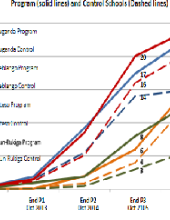
USAID/Uganda School Health and Reading Program Cluster 1 Follow up 4, End or Primary 4: Ateso, Leblango, Luganda, Runyankore/Rukiga and English
Has reading achievement increased as a result of the USAID/Uganda School Health and Reading Program interventions?