Briefs | 15 April 2019
Early Childhood Education: Considerations for Programming in Approaches to Teaching and Learning
The quality of instruction in the classroom is key to children's learning and development. This brief looks at the dimensions of guided play, emergent literacy, emergent mathematics, and language of instruction on the quality of instruction.
Briefs | 15 April 2019
Early Childhood Education: Considerations for Programming in Educator Quality
Training opportunities and appropriate teacher curriculum are often insufficient, and effective regulatory frameworks for preparing, staffing, and monitoring ECE teachers are often lacking.
Briefs | 15 April 2019
Early Childhood Education: Considerations for Programming in Sustainability
Governance and financing of early childhood education (ECE) are complex, involving multiple actors,
levels, objectives, and approaches, from general expansion of education access to targeted coverage of
the most underserved.
Reports | 15 April 2019
Early Childhood Education: Considerations for Programming in Asia
This report examines available evidence from the Asia region on the current state of ECE interventions, focusing on the 10 countries in the region3 that currently benefit from US Agency for International Development (USAID) education programming.
Publications | 4 January 2019
Mathematics from the Beginning: Evaluating the Tayari Preprimary Program’s Impact on Early Mathematics Skills
Given the dearth of research on early numeracy interventions in low- and middle-income countries, this
paper presents the instructional methodology and impact results of the Tayari program.
Publications | 4 January 2019
Capturing Children’s Mathematical Knowledge: An Assessment Framework.
This paper explores an innovative assessment framework for measuring children’s formal and informal
mathematical knowledge.

Briefs | 13 August 2018
Early Mathematics Counts: Promising Instructional Strategies for Low- and Middle- Income Countries
There is a large body of evidence substantiating the importance of mathematical
literacy and the key role of foundational mathematics in early years of education
on later academic outcomes (Duncan et al., 2007; Duncan & Magnuson, 2011;
Hanushek & Woessmann, 2008; Siegler et al., 2012).

Publications | 30 July 2018
Early Mathematics Counts: Promising Instructional Strategies for Low- and Middle- Income Countries
This paper examines common instructional strategies in early grade mathematics interventions through a review of studies in classrooms in low- and middle-income countries.
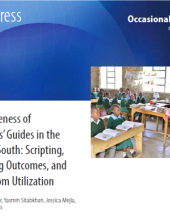
Occasional Papers | 22 June 2018
Effectiveness of Teachers’ Guides in the Global South: Scripting, Learning Outcomes, and Classroom Utilization
This report presents the results of RTI International Education’s study on teachers' guides across 13 countries and 19 projects.
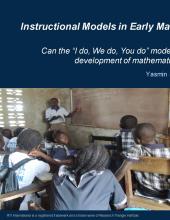
Presentations | 9 April 2018
Instructional models in early mathematics: Can the "I do, we do, you do" model support the development of mathematical thinking? CIES 2018 Presentation
CIES 2018 Presentation, given by Yasmin Sitabkhan.