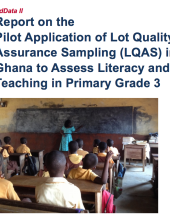
Reports | 15 December 2016
Report on the Pilot Application of Lot Quality Assurance Sampling (LQAS) in Ghana to Assess Literacy and Teaching in Primary Grade 3
This report summarizes main findings and lessons learned from the piloting of lot quality assurance sampling (LQAS) in the education sector in Ghana. It also suggests next steps for applying LQAS more broadly for education program monitoring.
Reports | 18 November 2016
Student Performance in Reading and Mathematics, Pedagogic Practice, and School Management in Jordan [Arabic version]
وفيما يتعلق بالأدوات التي تم استخدامها في هذا المشروع – مشروع المسح الوطني لتقييم القراءة والحساب للصفوف الأولى)إيجرا وإيجما( في الأردن – فقد تمت مواءمتها بشكل خاص لكي تتلاءم مع المنهاج الأردني، وذلك من خلال ورشة مواءمة ضمت متخصصين تربويين من وزارة التربية والتعليم ومن معهد تراينجل للأبحاث )أر.تي.آي
Reports | 18 November 2016
Student Performance in Reading and Mathematics, Pedagogic Practice, and School Management in Jordan [English version]
To gain insight into both student facility with foundational skills and to better understand characteristics among Jordanian schools associated with this performance, USAID/Jordan, in partnership with the Jordan Ministry of Education (MOE), contracted with RTI International under the Education Data

Reports | 7 October 2016
Iraq Education Surveys–MAHARAT Task 1: Analysis of Student Performance in Reading and Mathematics, Pedagogic Practice, and School Management (English version)
This analysis report was written to gain insight into both student facility with foundational skills and to better understand characteristics among Iraqi schools associated with this performance.
Reports | 23 September 2016
National Early Grade Literacy and Numeracy Survey Jordan: Intervention Impact Analysis Report in Arabic
This report, translated in Arabic, discusses the impact and results of the pilot intervention that was implemented during the 2013-2014 school year across 43 schools reaching more than 400 teachers and approximately 12,000 students in Jordan.
Reports | 23 September 2016
National Early Grade Literacy and Numeracy Survey - Jordan: Intervention Impact Analysis Report
This report discusses the impact and results of the pilot intervention that was implemented during the 2013-2014 school year across 43 schools reaching more than 400 teachers and approximately 12,000 students in Jordan.
Reports | 20 September 2016
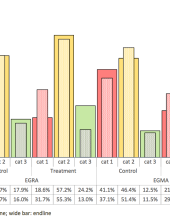
Education Data for Decision Making (EdData II) National Early Grade Literacy and Numeracy Survey -- Jordan: Intervention Impact Analysis Report
This report discusses the impact and results of the pilot intervention that was implemented during the 2013-2014 school year across 43 schools reaching more than 400 teachers and approximately 12,000 students in Jordan.
Reports | 15 September 2016
Data for Education Programming in Asia and Middle East: Philippines EGRA Four Language Study – 2015 Follow-On
A year after the first baseline EGRA was completed in four language regions, a follow-up survey was administered to samples of 30 to 40 teachers and 375 to 400 students per grade in the same regions (randomly sampled).
Reports | 15 September 2016
PhilEd Data II: Early Grade Reading Assessment Results: A cross-language look at MTB-MLE implementation in the Philippines
Following the study completed in 2013, measuring English, Filipino and Ilokano reading skills, this 2014 EGRA study is serves as a baseline for monitoring the government's Mother Tongue-Based Multilingual Education (MTB-MLE) program by conducting EGRA assessments in four mother-tongue languages—Cebu
Reports | 15 September 2016
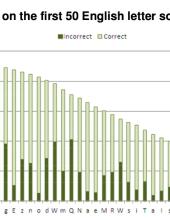
PhilEd Data: Strengthening Information for Education, Policy, Planning and Management in the Philippines. Early Grade Reading Assessment Results (Grades 3 English and Filipino, Grade 1 Ilokano)
The present report describes the results of two reading assessments that were carried out to measure performance of a representative national sample of children reading English and Filipino at the end of grade 3 (Objective 1, above) and a regional sample of children reading Ilokano in grade 1 (Objec