Liberia

Country Code
LBR

READ Liberia Grade 2 Supplemental Reader

Submitted by admin on
Description/Abstract
15 Grade Two Supplemental Reading Books (B)

Assoc. Photo (Port.)
Grade 2_0.png
Resource (File)
Country
Featured projects
Month and Year

Early Grade Reading Barometer

Submitted by admin on
Description/Abstract
The Early Grade Reading Barometer is an interactive dashboard that lets you: - SEE an overview of how well students are reading, the percentage of struggling readers, and how comprehension is associated with reading fluency. - VIEW information about student performance on EGRA subtasks. See how outcomes vary by key student and school characteristics. - EXPLORE how different EGRA subtasks are related to one another. View graphic displays of these relationships. - CHOOSE a target oral reading fluency benchmark, and see information on how many students are meeting the targeted benchmark now and how the percentage of students meeting the benchmark value could change over time. - SEE how countries compare with each other with respect to student outcomes on EGRA assessments and progress towards meeting UN SDG Goal 4. - REVIEW the impact of interventions aimed at improving the fundamental reading skills of students. - COMPARE how the distributions for selected EGRA subtasks have changed or remained the same over time.
Assoc. Photo (Port.)
Generic_icon_shared.rti_.org_.png
Resource Type
Resource Language
Month and Year
Publisher Or Client
USAID

CIES 2019 Presentation: An examination of executive function skills in primary 1 students from Liberia

Submitted by admin on
Description/Abstract
Executive functions are a cognitive skill set that underlie our goal-directed, planning, and problem solving behavior, and include the components of working memory, inhibitory control, and cognitive flexibility. EF skills undergo the majority of development during the pre-primary years of a child’s life and have been shown to contribute to academic success. However, most of our knowledge about children’s EF skills have been based on research with children living in high-income countries. This presentation reports on findings from the administration of an EF assessment with children from a West African country. Students entering Primary 1 grade for the first time from Kindergarten class were sampled. All students were administered four pre-literacy tasks and a set of questions measuring socio-economic status. Half of the sample also received EF touch games, including two training modules, two tasks measuring inhibitory control and 1 task measuring working memory. The presentation will focus on the findings of the use of EF Touch with this sample of children from a West African country. First, a brief description of the process of adapting and revising the tools for use in Liberia is reported. Second, a descriptive analysis is presented in order to describe the feasibility of using EF Touch with young children in this context. Third, children’s performance on the three tasks is summarized and correlations among the scores on the three tasks is reported and discussed. Fourth, a model exploring the unique contributions of simple reaction time and demographic characteristics is presented. Finally, the overall contribution to the field of early childhood assessment and executive function measurement in LMICs is discussed.
Assoc. Photo (Port.)
liberia portrait ef.jpeg
Resource (File)
Country
Resource Type
Resource Language
Month and Year
Publisher Or Client
USAID Read Liberia

One Page Brief on Executive Functioning (EF) Touch

Submitted by admin on
Description/Abstract
EF Touch is a tablet-administered assessment designed to measure children’s three key executive function skills: working memory, inhibitory control, and cognitive flexibility. These functions are important for organizing information, planning, solving problems, sustaining attention, and coordinating action and thoughts in support of goal-directed behaviors. Consequently, these functions are integral to children’s ability to learn how to learn. Most of what we know about executive functions has been gathered from studies in high-income countries. However, EF Touch is now being adapted and tested with young children living in LMICs, including Kenya and Liberia.
Assoc. Photo (Port.)
EF Touch.jpg
Country
Sub-topic
Resource Type
Month and Year

Instructional models in early mathematics: Can the "I do, we do, you do" model support the development of mathematical thinking? CIES 2018 Presentation

Submitted by admin on
Author
Description/Abstract
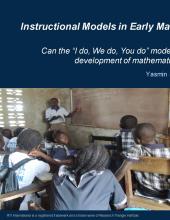
CIES 2018 Presentation, given by Yasmin Sitabkhan. The purpose of this presentation is to explore the applicability of the direct instruction (DI) model (also known as the “I do, We do, You do” model) for early grades mathematics instruction in low-income contexts through data gathered on two projects, the Tayari Early Childhood Project in Kenya and the Liberia Teacher Training Project (LTTP2). The results from the two studies point to the effectiveness of the gradual release of responsibility model for early mathematics instruction. The model as it is, with an explicit I do, we do, and you do” section for each concept, does not align with best practices in early mathematics instruction. However, the workshop model, which essentially is a “we do, you do” model, may foster more productive instruction that encourages critical thinking and problem-solving behavior.
Assoc. Photo (Port.)
Pages from Sitabkhan, Yasmin_CIES2018_MathInstructionModel.jpg
Country
Resource Type
Month and Year

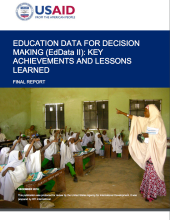
Education Data for Decision Making(EdDataII): Key Achievements and Lessons Learned

Submitted by admin on
Description/Abstract
USAID's Education Data for Decision Making (EdData II) was implemented over a 12 year period beginning in 2004. EdData II had at its core the goal of improving access to data for USAID Missions and host country ministries, to use for making informed policy decisions. The tools and research developed under EdData II whelped to inform the development of learning metrics under the Sustainable Development Goals (2015); provide evidence to support the design and monitor the implementation of USAID's 2011-2017 Education strategy, and provide actionable, high-quality data to inform policy and practice in around 35 countries. The report reflects on EdData II and the project's impact, providing a summary of the most salient and impactful project activities, and drawing key lessons from their development and implementation.

Assoc. Photo (Port.)
core report.png
Resource (File)
Country
Resource Type
Month and Year
Publisher Or Client
USAID

Proposing Benchmarks for Early Grade Reading Skills in Liberia

Submitted by admin on
Description/Abstract
Ministry of Education officials, district education officers, and a cross section of stakeholders attended this workshop over two days to begin Liberia’s first ever effort to define standards for student performance in key areas of reading skill development in grades 1, 2 and 3.
Assoc. Photo (Port.)
liberia.png
Country
Resource Type
Resource Language
Month and Year

Liberia Teacher Training Program Endline Assessment of the Impact of Early Grade Reading and Mathematics Interventions

Submitted by admin on
Description/Abstract
This report addresses the main research question: In Cohort 1 and Cohort 2 schools, were the pupils who participated in the United States Agency for International Development’s Liberia Teacher Training Program (LTTP) Phase II (LTTP II) reading and mathematics interventions now achieving better results?
Assoc. Photo (Port.)
Resource (File)
Country
Resource Type
Month and Year
Publisher Or Client
USAID