
Ethiopia

Country Code
ETH

Lot Quality Assurance Sampling (LQAS) Pilot Activities in Amhara and Tigray, Ethiopia: Final Report

Submitted by admin on
Description/Abstract
This report summarizes main findings and lessons learned from the piloting of the lot quality assurance sampling (LQAS) methodology in the education sector in Ethiopia. It also suggests next steps for applying the LQAS methodology more broadly for education program monitoring.
Assoc. Photo (Port.)
Ethiopia_LQA_April2016 (378).jpg
Resource (File)
Country
Resource Type
Resource Language
Month and Year
Publisher Or Client
USAID

Pre-Service Teacher Education Programs at Colleges of Teacher Education in Ethiopia (A READ-TA Baseline Assessment)

Submitted by admin on
Description/Abstract
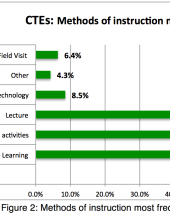
Beginning in Spring 2013, MOE, in collaboration with READ TA, began the process of developing new reading curriculum and materials for MT reading in grades 1-8 by first reviewing and validating findings for what was currently in existence. A similar process for the remaining three activity areas began in May 2013 with rapid baseline assessments for pre- and in-service teacher training and ICT in Colleges of Teacher Education and primary schools. This report is one in the series that outlines not only the findings and validation process for the baseline assessment for the respective activity area, but also presents conclusions and recommendations to MOE for review and approval so that READ TA work under the associated activity area can begin.
Assoc. Photo (Port.)
ctes .png
Resource (File)
pa00mhtb.pdf
Country
Resource Type
Resource Language
Month and Year
Publisher Or Client
USAID

Teacher Professional Development and Support Systems: An Analys is of Seven Language Areas in Ethiopia (A READ TA Baseline Assessment Report)

Submitted by admin on
Description/Abstract
Beginning in Spring 2013, MOE, in collaboration with READ TA, began the process of developing new reading curriculum and materials for MT reading in grades 1-8 by first reviewing and validating findings for what was currently in existence. A similar process for the remaining three activity areas began in May 2013 with rapid baseline assessments for pre- and in-service teacher training and ICT in Colleges of Teacher Education and primary schools. This report is one in the series that outlines not only the findings and validation process for the baseline assessment for the respective activity area, but also presents conclusions and early recommendations to MOE for review and approval so that READ TA work under the associated activity area can begin.
Assoc. Photo (Port.)
tpd baseline.png
Resource (File)
pa00mhtc.pdf
Country
Resource Type
Resource Language
Month and Year
Publisher Or Client
USAID

READ TA Information and Communication Technology (ICT) Baseline Assessment Report

Submitted by admin on
Author
Description/Abstract
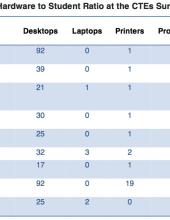
Beginning in Spring 2013, MOE, in collaboration with READ TA, began the process of developing new reading curriculum and materials for MT reading in grades 1-8 by first reviewing and validating findings for what was currently in existence. A similar process for the remaining three activity areas began in May 2013 with rapid baseline assessments for pre- and in-service teacher training and ICT in Colleges of Teacher Education and primary schools. This report is one in the series that outlines not only the findings and validation process for the baseline assessment for the respective activity area, but also presents conclusions and early recommendations to MOE for review and approval so that READ TA work under the associated activity area can begin.

Assoc. Photo (Port.)
ethiopia cte.jpg
Country
Resource Type
Resource Language
Month and Year
Publisher Or Client
USAID

Reading the script: How the scripts and writing systems of Ethiopian languages relate to letter and word identification

Submitted by admin on
Description/Abstract
Article published in Writing Systems Research. Published Abstract: Reading research suggests that script type and writing systems have a relationship with children’s ability to recognise letters, syllables and words. In Ethiopia, the scripts used for writing language differ by visual complexity and the psycholinguistic grain size of the script. The Ge’ez-script languages have alphasyllabic-based writing systems, while the Latin-script languages have phoneme-based writing systems. These differences in script and the differences in aspects of the writing system influence early reading acquisition. We exploited a large, regionally representative data set assessing a variety of early reading tasks in six Ethiopian languages to estimate the impact of script and aspects of writing system differences on early reading outcomes in the areas of letter identification, word reading, non-word decoding and story reading. We made comparisons between language outcomes using Ge’ez and Latin scripts, controlling for student background and school socio-economic status (SES). Additional analyses compared across-script and writing system differences within regions and gender. We found that Ethiopian script and writing system differences have implications for instructional methods for letter identification and word decoding.

Assoc. Photo (Port.)
publications icon purchased sm.png
Country
Resource Type
Resource Language
Month and Year
Publisher Or Client
Writing Systems Research

Survey of Children's Reading Materials in 11 African Countries: Suvey Instruments

Submitted by admin on
Description/Abstract
The attached survey instruments were used to analyze various learning materials as part of the Survey of Children's Reading Materials in African Languages in Eleven Countries (part of the DERP program).
Assoc. Photo (Port.)
Month and Year
Publisher Or Client
USAID

Summary of the Early Grade Reading Materials Survey in Ethiopia

Submitted by admin on
Description/Abstract
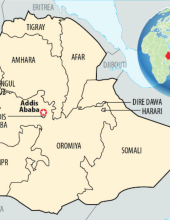
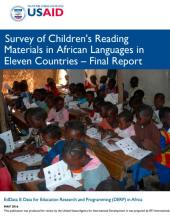
The purpose of the Reading Materials Survey was to develop an approach to collecting information on the available supply of early grade reading (EGR) materials. The approach included the development of a questionnaire and a protocol for data collection. The survey results will serve primarily to inform the Global Reading Repository by providing a detailed description of the current supply of EGR materials in African languages. This document specifically summarizes the findings from Early Grade Reading Materials Survey conducted in Ethiopia.
Assoc. Photo (Port.)
ethiopia materials.png
Country
Resource Type
Resource Language
Month and Year
Publisher Or Client
USAID

Survey of Children's Reading Materials in African Languages in Eleven Countries - General Report

Submitted by admin on
Description/Abstract
The purpose of the Reading Materials Survey was to develop an approach to collecting information on the available supply of early grade reading (EGR) materials. The approach included the development of a questionnaire and a protocol for data collection. The survey results will serve primarily to inform the Global Reading Repository by providing a detailed description of the current supply of EGR materials in African languages in the following 11 countries in sub-Saharan Africa: the Democratic Republic of the Congo (DRC), Ethiopia, Kenya, Malawi, Mali, Mozambique, Nigeria, Senegal, Tanzania, Uganda, and Zambia.
Assoc. Photo (Port.)
survey port.JPG
Resource Type
Month and Year
Publisher Or Client
USAID

Early Grade Reading and Math Assessments in 10 Countries: Dissemination and Utilization of Results – A Review

Submitted by admin on
Author
Description/Abstract
EdData II, which began in late 2004, provides survey expertise to help national and local governments as well as the donor community to assess their education status. Project advisors collaborate with USAID Missions and Bureaus, other donors, and host-country stakeholders to find innovative and cost-effective ways to gather and analyze education data. One task order under EdData II, called "Learning Outcomes Research and Assessment Related Projects (2009-2013) supported the conduct of early grade basic skills in reading and math. Experiences with the various assessments were documented in an EdData II publication: "Learning Outcomes Research and Assessment-Related Project: Final Report (October 2013). The final "Learning Outcomes" report covered initial country reactions to the assessments and their findings. The purpose of this review was to collect data on how results had been disseminated and used long after the initial release of the report.
Assoc. Photo (Port.)
goal 1 report.png
Resource Type
Resource Language
Month and Year
Publisher Or Client
USAID