Open Educational Resources
Coming soon – SharEd 2.0! Keep an eye out for updates and redirection to a new landing page in the coming months. Thanks for visiting.
MEL Framework for Technology Supported Remote Teacher Training

This MEL Framework for Technology-Supported Remote Training seeks to help education program implementers, governments, and program evaluators more effectively design, implement, and learn lessons from remote training activities. It places special consideration on the unique characteristics of technology-supported interventions in the global South.
The framework presents minimum standards for the evaluation
of technology-supported remote training, which, in turn, facilitates the development of an actionable evidence base for replication and scale-up. Rather than “just another theoretical framework” developed from a purely academic angle, or a framework stemming from a one-off training effort, this framework is based on guiding questions and proposed indicators that have been carefully investigated, tested, and used in five RTI monitoring and research efforts across the global South: Kyrgyz Republic, Liberia, Malawi, the Philippines, and Uganda (Pouezevara et al. 2021). Furthermore, the framework has been reviewed for clarity, practicality, and relevance by several RTI project teams across Africa and Asia.
All Children Reading - Philippines: Project Background Brief

ACR–Philippines falls under All Children Reading–Asia, a broader program implemented by RTI International across multiple countries in the Asia Region. The activities directly contribute to USAID’s education goal to improve early grade reading (EGR) skills for 100 million children worldwide. There are two main areas of activity in support of the overall goals and objectives: EGR instruction and assessment in support of mother-tongue based multilingual education (MTB-MLE), and the use of educational technologies to support improved instruction in early grade reading, especially during school closures. Key achievements and activities through July 2021 are summarized in these briefs--one broad and one specific to the COVID-19 response.

Accessing eResources on the DepEd Commons
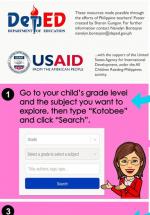
This infographic describes how to find early literacy resources in multiple languages, which were developed by Philippine teachers with support from the USAID/All Children Reading activity in 2020-2021

DepEd Commons and dissemination of eResources: a SWOT analysis [Presentation]
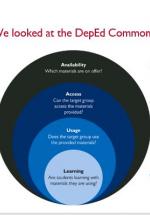
This presentation was delivered at the 2021 mEducation Alliance Symposium in a panel on the subject of education technologies for basic education in the Philippines.

Developing eResources for Early Literacy and Numeracy [Presentation]
This presentation was delivered at the 2021 mEducation Alliance Symposium in a panel on the subject of education technologies for basic education in the Philippines.

Governments' Organizational Responses to COVID-19 - Igniting Interest and Institutional Capacity in EdTech - Study Report

Led by the Basic Education Coalition (BEC), the Governments' Organizational Responses to COVID-19 - Igniting Interest and Institutional Capacity in EdTech study sought to understand what governments, specifically Ministries of Education (MoE), had to do organizationally to implement these programs, such as forging new partnerships, organizing and capacity building of personnel, developing or revising distance learning policies, and so on.
The information shared in this report stems from a global survey implemented across 12 countries in Asia, Africa, the Caribbean and South America with 23 responses from key MoE staff, including several department directors. In doing so, the study fills a knowledge gap for the international basic education sector and provides valuable insights to inform future education systems' capacity building programming. Insights and learnings surfaced from this study provide critical data on MoE capacity, technology investment, and other emerging structural shifts and strategies to support large-scale Education Technology (EdTech) programming and digital transformation of key activities.

Remedial Instruction Program for School Pupils

The purpose of the facilitator’s Guide for Remedial Instruction Program for School Pupils is to provide guidance to facilitators during the teacher training to make it more practical and active, and ensure that the training meets participants’ needs. As trainers you must familiarize yourself with the facilitator’s Guide, and ensure that you review the session’s plans before every session.
This guide provides you with a time table and session plans for all days of training. There are a variety of activities, including demonstrations and pair practice. The guide was developed to provide opportunities for participants to practice skills, and the emphasis throughout the training should always be participants practice.
P4 Teacher's Guide Rutooro

Primary 4 Teacher's Guide Rutooro
P4 Pupil Book Rutooro

Primary 4 Pupil Book - Rutooro
P3 Teacher's Guide Rutooro

Primary 3 Teacher's Guide Rutooro