Presentations | 28 April 2022
Return to Learning- Pakistan Case Study [CIES Presentation]
In the past two years, the COVID 19 pandemic and the ensuing and repeated school closures has caused an unprecedented upheaval to the education of children world-wide.
Presentations | 28 April 2022
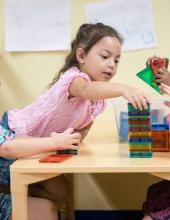
Measuring the impact of play on social and emotional learning across countries [CIES Presentation]
This presentation was part of a CIES 2022 panel on measuring learning through play and child SEL outcomes across humanitarian and LMIC contexts.
Presentations | 28 April 2022
Linking EGRA and GALA for Sustainable Benchmarking [CIES Presentation]
Prior Early Grade Reading Assessments (EGRA) have been used to set reading fluency benchmarks in Tanzania for USAID report and for the Government of Tanzania (GoT).
Presentations | 28 April 2022
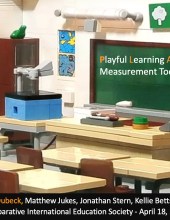
PLAY overview CIES (Dubeck et al., 2022)
Play has the potential to transform the global learning crisis. In infancy and early childhood, play builds a strong foundation for later learning by improving brain development and growth (Goldstein, 2012).
Presentations | 26 April 2022
Teacher well-being as a critical element to success of remote learning during the pandemic [Presentation]
This presentation describes findings from a study of the remote learning experience of school actors; school heads, teachers, parents and other HLPs, and learners during the first year of COVID-19 school closures in the Philippines.
Reports | 12 April 2022
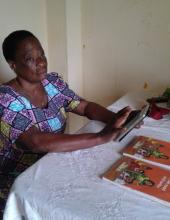
MEL-Tech Case Studies: Lessons Learned from Technology-Supported Remote Trainings in Five Countries During the Pandemic
This report presents case studies of five remote training activities conducted by USAID-funded and RTI-implemented programs: the Advancing Basic Education Project (ABC+) in the Philippines, the Malawi Early Grade Reading Improvement Activity (MERIT), Read Liberia, Okuu Keremet!
Toolkits and Manuals | 12 April 2022
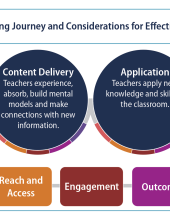
MEL Framework for Technology Supported Remote Teacher Training
This MEL Framework for Technology-Supported Remote Training seeks to help education program implementers, governments, and program evaluators more effectively design, implement, and learn lessons from remote training activities.
Sample Teacher and Pupil Materials | 12 April 2022
Read Liberia Activity: Teacher Instruction Guide-Grade 2, Volume 2
An Instructional guide for 2 teachers in Liberia.
Sample Teacher and Pupil Materials | 12 April 2022
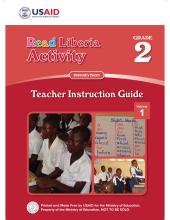
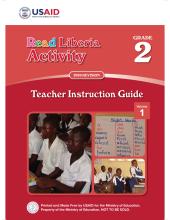
Read Liberia Activity: Teacher Instruction Guide-Grade 2 Volume1
An instructional guide for grade 2 teachers in Liberia.
Sample Teacher and Pupil Materials | 12 April 2022
Read Liberia Activity: Let's Read, Grade 2
Let's Read is a grade 2 learning resource for teachers in Liberia.