Expiring soon

This site is scheduled to close soon. Please download any necessary files as soon as possible.


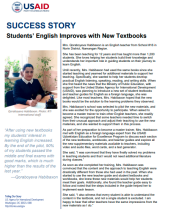
UEEP Success Story #8: Student's English Improves with New Textbooks

This success story highlights a English as a foreign language teacher's experience piloting the new ELF textbooks launched by the Ministry of Public Education, with support from the United States Agency for International Development (USAID. As a master training, she recognized that some teachers needed time to switch from their unusual approach and adjust their teaching to use the new materials, and she wanted to support them in this process. As part of her preparation to become a master trainer, she met with English as a foreign language experts from the Uzbekistan Education for Excellence Program to discuss each section of the new textbooks, workbooks, and teacher guides and explore all the new supplementary materials available to teachers, including video and audio files, word cards, and a test generator. She found that the new content and the approach to teaching English were drastically different from those she had used in the past. She found the teacher guide easy to follow and noted that the steps included in the guide helped her to implement each lesson.
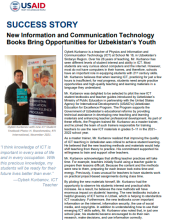
UEEP Success Story #7: New Information and Communication Technology Books Bring Opportunities for Uzbekistan's Youth

This success story highlights the experience of a ICT master teacher trainer who participated in the piloting of new ICT teaching and learning materials in Uzbekistan. Improving the quality of ICT teaching in Uzbekistan was critical to achieve student learning and the new teaching methods and materials are helping shift teaching from theory to practice. Shifting teacher practices will take time as teachers initially found using a teacher guide to prepare their lessons difficult. Because the content and the methods were new to them, preparing for each lesson took extra time and energy. Previously, it was unusual for teachers to have students work on practical project-based assignments during class time. By piloting the new materials, teachers are observing increasing students interest and practical skills. As a result, the new methods will have enormous impact on students’ learning.
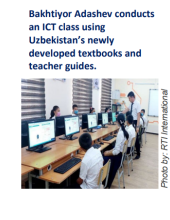
UEEP Success Story #4: Uzbekistan's New ICT Materials Meet World Educational Standards (UEEP)

The Ministry of Public Education (MPE) with the support of the U.S. Agency for International Development (USAID) and the Uzbekistan Ministry of Public Education, initiated a reform to enhance ICT education to produce graduates with computer and programming skills that will contribute to youth employability. Under the USAID-funded Uzbekistan Education for Excellence Program, the Republican Education Center and Abdulla Avloni Institute collaborated with RTI International and Mississippi State University to update Uzbekistan’s ICT educational standards and goals, scopes and sequences, teacher guides, student textbooks, student evaluations, and teacher professional development. The Program and MPE piloted an ICT program for grades 5–11.
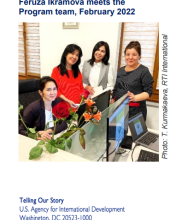
UEEP Success Story #6: Early Grade Teacher Co-Authors New Uzbek Language Arts Textbooks (UEEP)

This success story highlight the experience of one Uzbek Language Arts teacher in supporting the development of new reading materials for grades 1-4 learners. When she started working on the student textbooks and teacher guides, she found transforming Uzbekistan's approach to reading in local language challenging and rewarding, especially with the tremendous support of the international and local experts, who helped the writers to ensure international best practices guided the content and teaching methods. The result of their hard work, lead to the creation of books that inspire children to learn and develop a love of the Uzbek language.
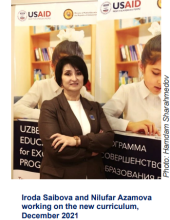
UEEP Success Story #5: Uzbek Teacher of Mathematics Contributes to New Curriculum and Books (UEEP)

This success story highlights the experience of a early grade math teacher and textbook writer. She outlines the development of age-appropriate requirements and standards for students first and then, once those are set, write teacher guides and student textbooks. Before starting work on the teacher guide, the Program developed the topic scopes and sequences. The teacher guides were then designed to give teachers clear instructions on the lessons. With help of the teacher guides, the teachers will know how to begin the lesson, how to connect the topics, how to continue, what problems or unexpected questions may occur, and how to guide and assist students. Additionally, they incorporated more practical examples and problem-solving tools.
UEEP Success Story #3: Guess What: Learning English Becomes Easy in Uzbekistan (UEEP)

The United States Agency for International Development’s (USAID’s) Uzbekistan Education for Excellence Program is supporting the Ministry of Public Education to update its English as a Foreign Language (EFL) curriculum through the procurement, adaptation, and piloting of Cambridge University Press teacher guides, student textbooks, and student workbooks in two regions—Sirdaryo and Namangan. Thanks to teachers’ active engagement and participation in this piloting of EFL materials, the Program will be able to finalize the teacher guides for national rollout during the 2022/2023 school year.

UEEP Success Story #1: Co-Creation Workshop Enhances Program Start Up in Uzbekistan [UEEP]

This success story outlines the co-creation process for the Uzbekistan Education for Excellence Program in From February 2020. RTI held a collaborative, interactive Co-Development Workshop to 1) affirm the shared vision for the Program, 2) clarify the Program’s overall mandate and scope, and 3) produce outlines of planned activities with associated implementation strategies, resource needs, and roles and responsibilities.
Uzbekistan Teacher Support System Study

In Year 2 (October 2020–September 2021), the Program designed and implemented a Status of Instruction Study (SIS) to shed light on teachers’ knowledge, attitudes and beliefs, skills, and behaviors; the resources available at the school level and for the targeted subjects; and how these resources are used. The Program also designed a Teacher Support System Study (TSSS) to examine the existing teacher support system and identify teacher support challenges and opportunities. The TSSS results will be used to create a Program TPD approach. The TSSS data collection process was integrated into the second phase of the SIS data collection process, which occurred in mid-2021. This was done because both studies targeted the same respondents: teachers, school directors, and methodologists. The TSSS, like the SIS, was originally intended to include in-person interviews. However, because of the prolonged difficulties caused by the coronavirus disease 2019 (COVID-19) pandemic, data collection was done remotely. This report presents the TSSS methodology and findings from online surveys administered to more than 4,100 teachers, 183 school directors, and 131 methodologists from all regions of Uzbekistan, including the Republic of Karakalpakstan and Tashkent City.
Uzbekistan Status of Instruction Study Round 1

The Status of Instruction Study (SIS) aims to shed light on teachers’ knowledge, attitudes and beliefs, and skills and behaviors; the resources available at the school level and for the targeted subjects; and how these resources are used. The SIS was designed to inform the customization and development of student textbooks, teacher guides, and TPD approaches. Originally, the SIS was to have a school-based data collection component that would include classroom observations and parent and teacher interviews. Given the protracted challenges resulting from the coronavirus disease 2019 (COVID-19) pandemic, data collection was conducted remotely and focused on garnering feedback directly from teachers. As such one limitation of this study is that all data are self-reported without additional means of triangulation or confirmation at this point in time. This report presents the SIS methodology and findings from online surveys administered to more than 9,400 teachers from all regions of Uzbekistan, including the Republic of Karakalpakstan and Tashkent City.

Uzbekistan ICT and EFL Teacher Guide Uptake Study Phase II Report

This study is Phase II of a two-part Teacher’s Guide Uptake Study (TGUS) for ICT and EFL. Phase I was conducted in December 2021 and field tested the above-referenced ICT TGs and the addendum to the EFL TGs to determine, within a short period of time, what changes and adaptations in terms of content, instructional strategies, and design needed to be made before revising the books and submitting them to MoPE for nationwide printing and rollout at the end of Year 3 of the Program (beginning of 2022/2023 school year). TGUS Part I also served to test TGUS data collection tools, built team capacity to use Tangerine, RTI’s opensource data collection platform, and determine the current level of use of student-centered instructional strategies by ICT and EFL teachers. The purpose of Phase II of this study, conducted in May 2022, was to continue to track teachers’ use of the new TGs and their application of selected student-centered teaching strategies in the classroom. Findings from Phase II also informed the overall design of the ULA and Mathematics TPD approach employed to support teachers during the pilot of the ULA and Mathematics TGS and STBs in the 2022/2023 school year. For comparative purposes and to show levels of uptake over time, this report combines select Phase I findings with Phase II findings.

Pages