Presentations | 22 April 2019
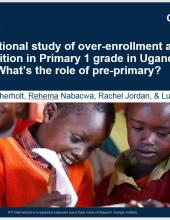
A national study of over-enrollment and repetition in Primary 1 grade in Uganda: What's the role of pre-primary [CIES 2019 Presentation]
In an optimally efficient education system, all children enroll and complete the primary cycle in a one year to one grade ratio, acquiring basic reading, math and critical thinking skills along the way.
Presentations | 22 April 2019
CIES 2019 Presentation: An examination of executive function skills in primary 1 students from Liberia
Executive functions are a cognitive skill set that underlie our goal-directed, planning, and problem solving behavior, and include the components of working memory, inhibitory control, and cognitive flexibility.
Instruments and Questionnaires | 22 April 2019
Core Early Grades Mathematics Assessment (EGMA) Instrument
Core EGMA instrument in English
Reports | 18 April 2019
2018 Early Grade Reading and Mathematics Initiative (RAMP) Lot Quality Assurance Sampling Assessment
This report summarizes the findings of the 2018 Early Grade Reading and Mathematics Initiative (RAMP) Lot Quality Assurance Sampling Assessment, measuring impact between 2017 and 2018.
The United States Agency for International Development (USAID) and UK Aid have funded RAMP as a national effort de
Briefs | 15 April 2019
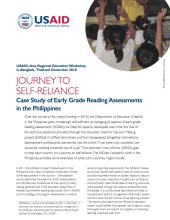
Journey to Self-Reliance: Case Study of Early Grade Reading Assessments in the Philippines
Over the course of four years (ending in 2016), the Department of Education (DepEd) in the Philippines grew increasingly self-sufficient at managing all aspects of early grade reading assessments (EGRAs).
Briefs | 15 April 2019
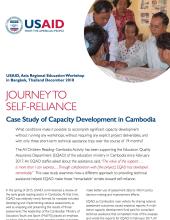
Journey to Self-Reliance: Case Study of Capacity Development in Cambodia
What conditions make it possible to accomplish significant capacity development without running any workshops, without requiring any explicit project deliverables, and with only three short-term technical assistance trips over the course of 19 months?
The All Children Reading–Cambodia Activity has b
Briefs | 15 April 2019
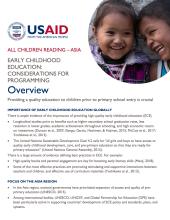
Early Childhood Education: Considerations for Programming Overview
The purpose of this brief is to answer the question: What are the considerations for effective ECE programming in the Asia region? To answer, we focus on the quality and sustainability, including governance and financing, of ECE.
Briefs | 15 April 2019
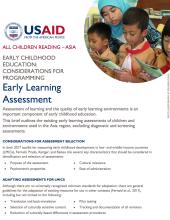
Early Childhood Education: Considerations for Programming in Early Learning Assessment
Assessment of learning and the quality of early learning environments is an important component of early childhood education. This brief outlines the existing early learning assessments of children and environments used in the Asia region, excluding diagnostic and screening assessments.
Briefs | 15 April 2019
Early Childhood Education: Considerations for Programming in Approaches to Teaching and Learning
The quality of instruction in the classroom is key to children's learning and development. This brief looks at the dimensions of guided play, emergent literacy, emergent mathematics, and language of instruction on the quality of instruction.
Briefs | 15 April 2019
Early Childhood Education: Considerations for Programming in Educator Quality
Training opportunities and appropriate teacher curriculum are often insufficient, and effective regulatory frameworks for preparing, staffing, and monitoring ECE teachers are often lacking.