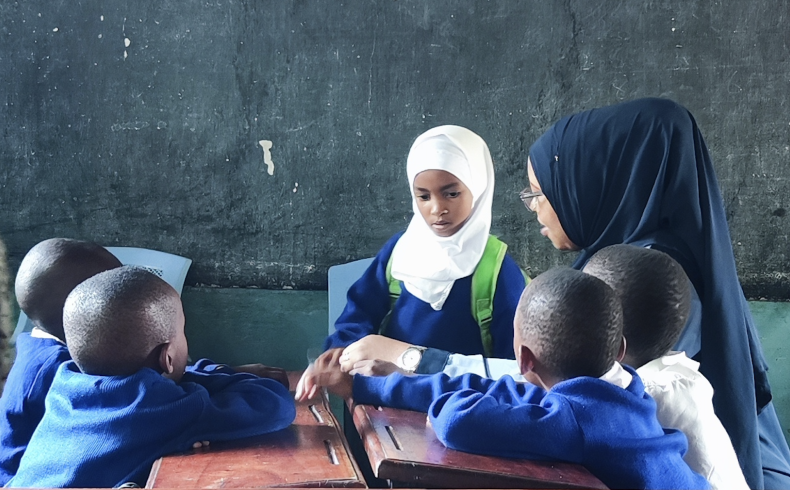
Effective Accelerated Instruction
“Before, when the teacher asked me to read, I would cry. Now I raise my hand first!” (Standard 2 girl, Mtwara)
In four regions in Tanzania, about 20% of children were consistently falling behind in foundational literacy skills by the end of Standard 2. With funding from the Hempel Foundation, RTI International collaborated with Government of Tanzania Regional Education offices to implement the Reading Recovery Activity, providing play-based catch-up classes to about 75,000 Standard 2 learners in 2,400 schools.
According to an independent external evaluation, the results were outstanding. Participating learners more than doubled key foundational literacy skills within eight months, with Letter Sound scores rising from 13.1 to 27.3 (a 14.2-point gain, 108%), Invented Word Decoding increasing from 10.2 to 26.0 (a 15.8-point gain, 155%), and Comprehension improving from 7.2 to 11.3 (a 4.1-point gain, 57%), while comparable non-participating peers in the same schools showed negligible gains. The accelerated learning proved equally effective for girls and boys, and for learners in rural or urban schools.
What features made the Reading Recovery Activity successful?
- Learners were targeted using a census-based, group-administered reading assessment that was already in use by the regional government.
- Learners were organized into skill groups based on the building blocks of phonemic awareness.
- These skills were then practiced through playful, game-based learning with an emphasis on peer support.
- Movement between skill groups was based on mastery as measured through a technology-assisted application.
The recipe for success was a play-based approach that reduced anxiety, inspired learner engagement and enabled teachers to differentiate support within groups.
The Reading Recovery Activity was a crowd-pleaser. A survey of 1,334 participants in November 2025 presented a picture of overwhelming satisfaction and enjoyment in the program, with over 98% responding that they wanted to come to catch-up classes. The program was popular even among learners who did not progress quickly. For example, a girl in Iringa said, “I like coming because we play letter games and sing songs – even if I still can’t read many words, it’s fun.” The model intentionally cultivated social dynamics which transformed potential stigma (e.g., “I’m the only one who can’t read”) into shared identity and mutual support (e.g., “We are the Catch-up Class group”).
Teachers embraced the program, too. Teacher training reinforced teaching strategies that had been introduced previously and provided a safe environment in which teachers could practice. External evaluators observed teachers in the classroom using specific praise, patience during learners’ hesitation, and celebratory routines (e.g., songs, stickers, or a “star of the day”), with an emphasis on creating socially supportive environments that normalized mistakes and encouraged persistence – leading to increased learner participation. A boy from Morogoro noted, “When I get stuck, my teacher smiles and says ‘Jaribu tena, unaweza’ (‘Try again, you can do it’) – I feel happy to try again.” Teachers were observed circulating the classroom, kneeling beside individual children, providing immediate corrective feedback, and using the Tangerine:Teach digital tool to target their support precisely to each learner’s needs.
Parental engagement was important for strong participation. Teachers and head teachers used several low-cost outreach strategies to engage parents, such as invitations to observe sessions, sending home progress notes, and using ‘Open Day’ meetings that were already planned. Head teachers demonstrated the Tangerine:Teach tool for parents and showed them the data documenting concrete learning gains. As one teacher from Ruvuma noted, “Parents who came to the Open Day saw their children playing Bingo and reading cards. After that, attendance became almost 100%.” Reflecting on the program, a father from Mtwara said, “My child used to hide books. Now he brings the game cards home and teaches his little sister.”
A replicable, low-cost model. The Reading Recovery Activity model creates an extraordinarily positive, socially rich, and pedagogically sound learning environment that stands in stark contrast to typical joyless remedial education programs in low-resource settings. It costs only $300 per school per year, including assessments, games, school supplies, initial teacher training, and supervision and support: making it a promising model for replication and scale.